Read Your Bible: But How? (Lectio Divina)

Open Bible by Petr Kratochvil

“Read your Bible.” But how?

I’ve benefitted from reading large portions of Scripture–whole narratives, books, and multiple chapters–in one sitting. I’ve also benefitted immensely from slowing down and meditatively just reading a few verses at a time. Lectio Divina is a way of reading Scripture that encourages that. It’s reading, as many have said, for transformation and not just information.

Lectio Divina means “holy reading” or “divine reading.” The idea is to deliberately reflect in God’s presence on God’s words, inviting God to echo his words in us today. The most classic formulation of this ancient Benedictine practice is the four-part: lectio (read), meditatio (meditate), oratio (pray), and contemplatio (contemplate).

I’ve also seen a slightly adjusted form, which I’ve used in groups and individually.  It goes like this:

    1. Read: What does the passage say?
    2. Pray: What is God saying to me through this passage?  (short phrase or single word)
    3. Listen: How is God calling me to respond to what he’s saying?
    4. Respond: What will I commit to God to do in response?

Lectio works best with smaller passages–a few verses from the Psalms or Proverbs… perhaps some words of Jesus or a Pauline prayer. Colossians 3:15-17 is a good place to start, if you’re new to the practice:

Let the peace of Christ rule in your hearts, since as members of one body you were called to peace. And be thankful. Let the word of Christ dwell in you richly as you teach and admonish one another with all wisdom, and as you sing psalms, hymns and spiritual songs with gratitude in your hearts to God. And whatever you do, whether in word or deed, do it all in the name of the Lord Jesus, giving thanks to God the Father through him.

In a group setting, readers (four different ones) can read the passage out loud (slowly) before each of the four movements. Individually, one could just read and re-read the passage before each of the four movements.

I’ve also found benefit in doing the fourth “respond” movement creatively: maybe I respond not just seated through prayer, but perhaps there is a response through song or drawing or movement that I can offer.

There are other approaches to Lectio; it’s certainly not meant to be formulaic. But whether I do it in 5 minutes or 30 minutes, with a group or by myself, I find that I am always impressed with how much God’s Word/words still can speak today–if I quiet myself enough to listen.

Greek Isaiah in a Year, Week 20=Isaiah 26

This week in Greek Isaiah in a Year covers Isaiah 26.

Here is the schedule and text for Monday through Friday, using again the text from R.R. Ottley’s Book of Isaiah According to the Septuagint. Ottley is also here in Logos (reviewed here) and here as a free, downloadable pdf in the public domain. The full reading plan for our group is here (pdf).

Monday, April 15Isa 26:1-4

Ὠιδή

26 Τῇ ἡμέρᾳ ἐκείνῃ ᾄσονται τὸ ᾆσμα τοῦτο ἐπὶ γῆς Ἰούδα, λέγοντες Ἰδοὺ πόλις ὀχυρά, καὶ σωτήριον ἡμῖν θήσει τεῖχος καὶ περίτειχος. ἀνοίξατε πύλας, εἰσελθάτω λαὸς φυλάσσων δικαιοσύνην καὶ φυλάσσων ἀλήθειαν, ἀντιλαμβανόμενος ἀληθείας καὶ φυλάσσων εἰρήνην. ὅτι ἐπι σοὶ ἤλπισαν, Κύριε, ἕως τοῦ αἰῶνος, ὁ θεὸς ὁ μέγας ὁ αἰώνιος,

Tuesday, April 16Isa 26:5-8

ὃς ταπεινώσας κατήγαγες τοὺς ἐνοικοῦντας ἐν ὑψηλοῖς· πόλεις ὀχυρὰς καταβαλεῖς, καὶ κατάξεις αὐτὰς ἕως τοῦ ἐδάφους, καὶ πατήσουσιν αὐτοὺς πρᾳέων καὶ ταπεινῶν. ὁδὸς εὐσεβῶν εὐθεῖα ἐγένετο, καὶ παρεσκευασμένη ἡ ὁδὸς τῶν εὐσεβῶν. ἡ γὰρ ὁδὸς Κυρίου κρίσις· ἠλπίσαμεν ἐπὶ τῷ ὀνόματί σου καὶ ἐπὶ τῇ μνείᾳ

Wednesday, April 17Isa 26:9-12

ᾗ ἐπιθυμεῖ ἡ ψυχὴ ἡμῶν. (Ὠιδή.) ἐκ νυκτὸς ὀρθρίζει τὸ πνεῦμά μου πρὸς σέ, ὁ θεός, διότι φῶς τὰ προστάγματά σου ἐπὶ τῆς γῆς. δικαιοσύνην μάθετε, οἱ ἐνοικοῦντες ἐπὶ τῆς γῆς. 10 πέπαυται γὰρ ὁ ἀσεβής· οὐ μὴ μάθῃ δικαιοσύνην ἐπὶ τῆς γῆς, ἀλήθειαν οὐ μὴ ποιήσῃ· ἀρθήτω ὁ ἀσεβής, ἵνα μὴ ἴδῃ τὴν δόξαν Κυρίου. 11 Κύριε, ὑψηλός σου ὁ βραχίων καὶ οὐκ ᾔδεισαν, γνόντες δὲ αἰσχυνθήσονται· ζῆλος λήμψεται λαὸν ἀπαίδευτον, καὶ νῦν πῦρ τοὺς ὑπεναντίους ἔδεται. 12 Κύριε ὁ θεὸς ἡμῶν, εἰρήνην δὸς ἡμῖν, πάντα γὰρ ἀπέδωκας ἡμῖν.

Thursday, April 18Isa 26:13-17

13 Κύριε ὁ θεὸς ἡμῶν, κτῆσαι ἡμᾶς· Κύριε, ἐκτὸς σοῦ ἄλλον οὐκ οἴδαμεν, τὸ ὄνομά σου ὀνομάζομεν. 14 οἱ δὲ νεκροὶ ζωὴν οὐ μὴ ἴδωσιν, οὐδὲ ἰατροὶ οὐ μὴ ἀναστήσουσιν· διὰ τοῦτο ἐπήγαγες καὶ ἀπώλεσας καὶ ἦρας πᾶν ἄρσεν αὐτῶν. 15 πρόσθες αὐτοῖς κακά, Κύριε, πρόσθες κακὰ πᾶσιν τοῖς ἐνδόξοις τῆς γῆς. 16 Κύριε, ἐν θλίψει ἐμνήσθην σου, ἐν θλίψει μικρᾷ ἡ παιδία σου ἡμῖν. 17 καὶ ὡς ἡ ὠδίνουσα ἐγγίζει τοῦ τεκεῖν, καὶ ἐπὶ τῇ ὠδῖνι αὐτῆς ἐκέκραξεν, οὕτως ἐγενήθημεν τῷ ἀγαπητῷ σου.

Friday, April 19: Isa 26:18-21

18 διὰ τὸν φόβον σου, Κύριε, ἐν γαστρὶ ἐλάβομεν καὶ ὠδινήσαμεν καὶ ἐτέκομεν· πνεῦμα σωτηρίας σου ἐποιήσαμεν ἐπὶ τῆς γῆς, ἀλλὰ πεσοῦνται οἱ ἑνοικοῦντες ἐπὶ τῆς γῆς. 19 ἀναστήσονται γὰρ οἱ νεκροί, καὶ ἐγερθήσονται οἱ ἐν τοῖς μνημείοις, καὶ εὐφρανθήσονται οἱ ἐν τῇ γῇ· ἡ γὰρ δρόσος ἡ παρὰ σοῦ ἴαμα αὐτοῖς ἐστιν, ἡ δὲ γῆ τῶν ἀσεβῶν πεσεῖται. 20 Βάδιζε, ὁ λαός μου, εἴσελθε εἰς τὰ ταμιεῖά σου, ἀπόκλεισον τὴν θύραν σου, ἀποκρύβηθι μικρὸν ὅσον ὅσον, ἕως ἄν παρέλθῃ ἡ ὀργὴ Κυρίου. 21 ἰδοὺ γὰρ Κύριος ἀπὸ τοῦ ἁγίου ἐπάγει τὴν ὀργὴν ἐπὶ τοὺς ἐνοικοῦντας ἐπὶ τῆς γῆς· καὶ ἀνακαλύψει ἡ γῆ τὸ <αἷμα> αὐτῆς, καὶ οὐ κατακαλύψει ἡ γῆ τοὺς ἀνῃρημένους.

See here for more resources and links to texts for Greek Isaiah.

And here are the Week 20 readings above, in pdf form.

Gary Burge’s Jesus and the Jewish Festivals, reviewed

Jesus and the Jewish Festivals

In college I thought my friend Chad was really cool (he was) for climbing on top of college buildings late at night and shouting the Shema at the top of his lungs… until he was corralled by Public Safety.

Sh’ma Yisrael: Adonai Eloheinu, Adonai echad!

I learned my first Hebrew in Gary Burge’s Christian Thought class my senior year in college. He had us reciting the Shema (Deut. 6:4-5) in no time. We’d stand and say it out loud at the beginning of class: Sh’ma Yisrael: Adonai Eloheinu, Adonai echad! (Hear, Israel: the Lord our God, the Lord is one!)

I was never quite as bold as Chad with my recitation of the Shema, but it’s stayed with me these past 11 years since taking Dr. Burge’s class.

Burge’s writing in Jesus and the Jewish Festivals is just as good as his teaching in the classroom. Burge, a Professor of New Testament at Wheaton College and Graduate School, focuses especially on the Gospel of John as he looks at Jesus and the Sabbath (ch. 2), the Passover (ch. 3), Tabernacles (ch. 4), Hannukah (ch. 5) and Jesus’ last Passover (ch. 6). Chapter 1 explores “the festivals of Judaism” more generally, while the final chapter (7) looks at what early Christians did with these Jewish festivals.

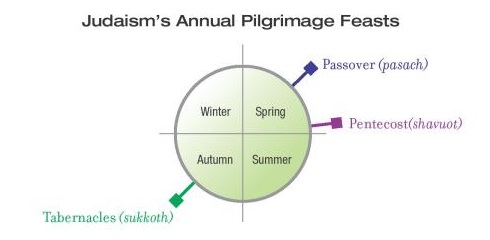
As Burge puts it, Judaism had three “great pilgrimage festivals”:

Burge_Pilgrimage Feasts

These three festivals

were based not only on the agricultural rhythms of the year, but also they served to tell the story of Israel’s salvation. Israel was rescued from Egypt (Passover, Pesach), Israel met God at Mount Sinai (Pentecost, Shavuot), and then Israel wandered in the wilderness (Tabernacles, Sukkoth). (122)

The chapters cover the original Jewish context of the festivals, Jesus’ relation to each, and then what faith looks like through the lens of that festival–both for Jews then and (especially) for Christians now.

As with other books in the Ancient Context, Ancient Faith series, Jesus and the Jewish Festivals is printed on glossy paper and full of high-quality, color illustrations. It’s like a guide book in that regard. I don’t know whether it was Burge or an editor or both, but the photographs and charts throughout the book are expertly placed and reinforce the text at just about every turn. For example, this image appears in conjunction with Burge’s description of the Passover:

Burge_Passover

As Burge recounts John 6 and the feeding of the 5,000, he notes that “Passover themes were swirling around almost every aspect of the story” (60). Further, Jesus “is the manna from God’s treasury for which Israel has been waiting. He had been sent by God as manna descended in the wilderness” (63). Then, there is always application to people of faith today: “Therefore celebrating Passover is not only knowing about what happened yesterday–though this is important–it is also about knowing the God who desires to feed us now” (65). I have always appreciated this way of approaching biblical studies with a doxological posture.

Another thing I appreciated about Jesus and the Jewish Festivals is the ease with which Burge uncovers layers of meaning in the Gospels, showing how Jesus related to the major themes of Jewish festivals. I found my own gratitude for Jesus’ sacrifice, for example, greatly enhanced by the author’s description of Jesus’ last Passover. As Burge puts it: “If we understand these festivals and their symbolism, then suddenly we understand the more profound things about Jesus and his work” (31, italics original). The color illustrations make Burge’s explanations even more vivid.

My critiques of the book are few and minor. At times there is what seems to be just a wee bit of speculation on the part of the author as he explores symbolism in John. For example, he says, “But I am convinced that Jesus wanted to die during the Festival of Passover because of the profound meaning it would convey with regard to his sacrifice” (102). Burge doesn’t further elaborate, and this seems a difficult (though not impossible) claim to support.

Jesus and the Jewish Festivals would be aided by a Scripture and subject index at the back of the book. I also found myself wanting more explanation of the Jewish calendar. Page 26 has a nice figure that shows all the months of the calendar of Judaism (together with various festivals noted), but a little more about its construction would have even further undergirded Burge’s tour of the festivals.

I really enjoyed reading Jesus and the Jewish Festivals. Not only did I find my knowledge and understanding of the Jewish festivals refreshed and expanded; I also grew in my appreciation of Jesus and his work due to the connections Burge made. This seems to have been an intention of this book, and in this regard, it is quite successful. Anyone who wants to better grasp Jesus’ words and work in the Gospels, whether pastor or parishioner, scholar or student, would do well to work her or his way through Burge’s short volume.

Thanks to Zondervan for the review copy. Jesus and the Jewish Festivals is on Amazon here. Its product page is at Zondervan’s site here.

Praying Morning Prayer (beta site)

MP Beta

My friend Ben Rey has made a really attractive site for praying Morning Prayer from the Book of Common Prayer. The site is in beta right now, but you can use it to pray each day–it’s got the liturgy and Scriptures. Ben says:

Thanks again for participating in the Morning Prayer (MP) beta testing. The initial goal of this site is to provide individuals and communities access to Morning Prayer in its simplest form. Simple both in terms of the selected liturgy/scripture readings, and in terms of the layout for your tablet or mobile device. 

Your feedback will either reinforce or change that vision. Think of this as your Morning Prayer site. What do you want for yourself, for your church, for your friends and family? So please complete the brief feedback form on the website at some point in the first week.

The readings start for this coming Sunday, March 7 and will be updated automatically. We will launch the website onto it’s own domain in a few weeks with changes made based on your feedback. Please feel free to share this link/email with others, as the more the merrier in beta testing.

Here’s the site. You can offer Ben feedback here.

An All-Greek Bible, coming this fall?

German Bible Society

I hope this is real:

Just found this on @christianbook.com – christianbook.com/Christian/Book… Someone likes you, @drjewest LXX/NA28! #lxx #na28

— Chuck Grantham (@ChuckGrantham) April 8, 2013

(via Jim West)

Yes, this does appear to be a Greek Old Testament (LXX) and Greek New Testament (NA28under one cover. Here’s the product page. The thing is more than 3,000 pages and expensive. And those dimensions of 18.4 x 13.3 (inches) can’t possibly be right.

But we’ll see. I know a guy who knows a guy, and he’s asking to see if it’s real. I’ll post again here if what we’re really seeing is just a remnant of an April Fool’s Joke on CBD….

UPDATE: Note the comment below from Rick Brannan of Logos, reproduced here: “FWIW, I asked a guy I know at Hendrickson about this and he said it was real, said it would be at SBL in Baltimore, and reported the issue with dimensions (the dimensions are likely in centimeters and not inches).”

Nice!

SECOND UPDATE: A few more product details here.

Review of IVP’s Dictionary of the Old Testament: Pentateuch (final part 3)

IVP OT Dictionary Pentateuch

I’ve been spending some time the last few weeks with InterVarsity Press’s Dictionary of the Old Testament: Pentateuch in Logos Bible Software. You can read part 1 of my review here and part 2 here; those help provide context for this third and final part to the review.

In this post I summarize and briefly interact with three more articles: “Warfare,” “Book of Genesis,” and “Haran.” Then I offer my concluding thoughts.

Warfare

A.C. Emery’s article explores “the conduct of warfare found in the Pentateuch, as well as instructions provided for the waging of warfare in Israel” (877). He notes, “Conflict is a common event recorded within the OT” (877), even if the student of ancient warfare tactics may not find much in the Pentateuch. To wit: “With rare exception the battle is described more for the divine intervention than for its technical conduct, which is the particular interest of this article” (878-9). God himself is described “as a warrior” (877) in the Pentateuch.

Emery looks at common Hebrew words that the Pentateuch uses to describe warfare and battles, with qārab (“draw near”) being the most common. He explores Pentateuchal “battle accounts” (879), from Abraham in Genesis 14 to Amalek in Exodus 17 and the “Canaanite king of Arad” and Og, king of Bashan, in Numbers 21-25 (879-80). There are “various instructions with regard to activities related to warfare” (880), including “the need to be… emotionally and religiously prepared for the dangers of combat” and the mechanics of negotiations and siege warfare (880). Emery’s final section examines the ethical difficulty that warfare poses.

Surprisingly, Emery does not in his ethics section mention the difficult Deuteronomy 7:2 with its “show them no mercy” command. He also has an article in the dictionary (“ḤĒREM”) that covers that passage, but his treatment of warfare ethics in “Warfare” was briefer than I would have liked. But, as with the rest of the dictionary, the few-page article still offers a decent jumping-off point for further research, even if it’s not a one-stop shop.

Book of Genesis

The entry on the book of Genesis examines the book with special reference to structure, plot, and theology (350). L.A. Turner’s key assumption is: “Genesis is a narrative book, and its theology is conveyed through features such as its structure, plot and characterization, rather than through set pieces of divine promulgation, as in legal or prophetic texts” (356).

Regarding structure, though there are varying theories, most agree that “Genesis is composed of two distinct blocks of unequal size” (350). The first runs roughly through Genesis 11 or the first few verses of Genesis 12 and is about humanity generally. Genesis 12 onward picks up the story of Abraham. The “main sections” in Genesis, according to Turner, are “the Abraham story (Gen 11:27–25:18), the Jacob story (Gen 25:19–37:1) and the story of Jacob’s family (Gen 37:2–50:26)” (350). The Hebrew word tôlĕdôt (genealogy) is a structural marker throughout Genesis.

The plot of Genesis has “progressive complexity” (352), moving from early human history to complex characters and families by the end of the book. “Divine promises and blessings” constitute “the book’s central core” (353) for Turner, and set the stage for the rest of the Bible (358). Regarding theology, he notes the tension “between divine sovereignty (as exemplified in the genealogies) and human free will (as demonstrated in the narratives)” (357).

I wanted to be sure to review a longer article in the dictionary. I was unexpectedly riveted as Turner walked through Genesis (10 pages in print). I found his contention that the book’s structure has theological import to be particularly compelling.

Haran

“Haran” in English could refer either to a place or to a person, though the spelling is different between each word in Hebrew (379). Both the place and the person are in Genesis 11:27-32, so M.W. Chavalas treats them together (379).

Haran the place is where Abraham lived after leaving Ur and before departing for Canaan (379). He also sought a wife for Isaac there, and Jacob found Rachel and Leah there, too. Similar to Ur, Haran centered on lunar worship. Haran is located in what today is southeastern Turkey. There is “only a small amount of archaeological evidence…for the city, and even less for patriarchal times” (379). It seems to have been inhabited already well before Abraham’s time, perhaps by some 20,000 people (379). Chavalas notes its likely founding “as a merchant outpost by the Sumerian city of Ur in the late third millennium B.C.” (379).

Haran the person has “very little biblical or extrabiblical information” recorded about him. He was Terah’s son, Lot’s father, and Abram’s brother. It was Haran’s death at Ur that led Lot to go to Haran with Abram. Haran also had two daughters, Iscah and Milcah.

The more I research Abraham and the Pentateuch, the more I realize how important Lot was to him. His desire to bear a family perhaps through Lot seems to be what led to his rescue of Lot in Genesis 14.  Several dictionary articles point this out nicely. Chavalas covers Haran fairly thoroughly in a short amount of space (just two or three print pages).

**********

I hope Logos will update the dictionary so that the sidebar Table of Contents can expand to include all the article sub-points. Another thing that would make the product better is an easier way to find out about contributors from within an article. Having their names hyperlinked with their biographical information would be nice. As it is, one has to move between the article and the separate “Contributors” section to find out more about each author. [EDIT: Author names have hyperlinks in the Accordance production of this module.]

The Logos edition of the IVP Dictionary of the Old Testament: Pentateuch is overall a good module. Being able to have it open to both Hebrew and English biblical texts saves considerable time compared to using the print edition. The Dictionary is a solid first place to go on issues, themes, and people in the Pentateuch.

The Dictionary is on Amazon here (in print) and at Logos here. My thanks to Logos for the review copy.  Read part 1 of my review here and part 2 here.

Greek Isaiah in a Year, Week 19=Isaiah 24:6-25:12

IsaiahThis week in Greek Isaiah in a Year covers Isaiah 24:6-25:12.

Here is the schedule and text for Monday through Friday, using again the text from R.R. Ottley’s Book of Isaiah According to the Septuagint. Ottley is also here in Logos (reviewed here) and here as a free, downloadable pdf in the public domain. The full reading plan for our group is here (pdf).

Monday, April 8Isa 24:6-11

διὰ τοῦτο ἀρὰ ἔδεται τὴν γῆν, ὅτι ἡμάρτοσαν οἱ κατοικοῦντες αὐτήν· διὰ τοῦτο πτωχοὶ ἔσονται οἱ ἐνοικοῦντες ἐν τῇ γῇ, καὶ καταλειφθήσονται ἄνθρωποι ὀλίγοι. πενθήσει οἶνος, πενθήσει ἄμπελος, στενάξουσιν πάντες οἱ εὐφραινόμενοι τὴν ψυχήν. πέπαυται εὐφροσύνη τυμπάνων, πέπαυται αὐθαδία καὶ πλοῦτος ἀσεβῶν, πέπαυται φωνὴ κιθάρας. ᾐσχύνθησαν, οὐκ ἔπιον οἶνον, ποκρὸν ἐγένετο τὸ σίκερα τοῖς πίνουσιν. 10 ἠρημώθη πᾶσα πόλις, κλείσει οἰκίαν τοῦ μὴ εἰσελθεῖν. 11 ὀλολύζετε περὶ τοῦ οἴνου πανταχῇ· πέπαυται πᾶσα εὐφροσύνη τῆς γῆς

Tuesday, April 9Isa 24:12-17

12 καὶ καταλειφθήσονται πόλεις ἔρημοι, καὶ οἶκοι ἐγκαταλελιμμένοι ἀπολοῦνται. 13 ταῦτα πάντα ἔσται ἐν τῇ γῇ ἐν μέσῳ τῶν ἐθνῶν· ὅν τρόπον ἐάν τις καλαμήσηται ἐλαίαν, οὕτως καλαμήσονται αὐτούς· καὶ ἐὰν παύσηται ὁ τρυγητός. 14 οὗτοι φωνῇ βοήσονται, οἱ δὲ καταλειφθέντες ἐπὶ τῆς γῆς εὐφρανθήσονται ἅμα τῇ δόξῃ Κυρίου, ταραχθήσεται τὸ ὕδωρ τῆς θαλάσσης. 15 διὰ τοῦτο ἡ δόξα Κυρίου ἐν ταῖς νήσοις ἔσται τῆς θαλάσσης, τὸ ὄνομα Κυρίου ἔνδοξον ἔσται. 16 Κύριε ὁ θεὸς Ἰσραήλ, ἀπὸ τῶν πτερύγων τῆς γῆς τέρατα ἠκούσαμεν, Ἐλπὶς τῷ εὐσεβεῖ. καὶ ἐροῦσιν Οὐαὶ τοῖς ἀθετοῦσιν· οἱ ἀθετοῦντες τὸν νόμον, 17 φόβος καὶ βόθυνος καὶ παγὶς ἐφʼ ὑμᾶς τοὺς ἐνοικοῦντας ἐπὶ τῆς γῆς.

Wednesday, April 10Isa 24:18-23

18 καὶ ἔσται ὁ φεύγων τὸν φόβον ἐμπεσεῖται εἰς τὸν βόθυνον· ὁ δὲ ἐκβαίνων ἐκ τοῦ βοθύνου ἁλώσεται ὑπὸ τῆς παγίδος· ὅτι θυρίδες ἐκ τοῦ οὐρανοῦ ἠνεῴχθησαν, καὶ σεισθήσεται τὰ θεμέλια τῆς γῆς. 19 ταραχῇ ταραχθήσεται ἡ γῆ, καὶ ἀπορίᾳ ἀπορηθήσεται ἡ γῆ. 20 ἔκλινεν καὶ σεισθήσεται ὡς ὀπωροφυλάκιον ἡ γῆ, ὡς ὁ μεθύων καὶ ὁ κραιπαλῶν, καὶ πεσεῖται, καὶ οὐ μὴ δύνηται ἀναστῆναι· κατίσχυσεν γὰρ ἐπʼ αὐτῆς ἡ ἀνομία. 21 Καὶ ἐπάξει ὁ θεὸς ἐπὶ τὸν κόσμον τοῦ οὐρανοῦ τὴν χεῖρα καὶ ἐπὶ τοὺς βασιλεῖς τῆς γῆς. 22 καὶ συνάξουσιν καὶ ἀποκλείσουσιν εἰς ὀχύρωμα καὶ εἰς δεσμωτήριον· διὰ πολλῶν γενεῶν ἐπισκοπὴ ἔσταο αὐτῶν. 23 καὶ τακήσεται ἡ πλίνθος, καὶ πεσεῖται τὸ τεῖχοι· ὅτι βασιλεύσει Κύριος ἐν Σιὼν καὶ ἐν Ἰερουσαλήμ, καὶ ἐναντίον τῶν πρεσβυτέρων δοξασθήσεται.

Thursday, April 11Isa 25:1-6

Ὠιδή

25 Κύριε ὁ θεός μου, δοξάσω σε, ὑμνήσω τὸ ὄνομά σου, ὅτι ἐποίησας θαυμαστὰ πράγματα, βουλὴν ἀρχαίαν ἀληθινήν· γένοιτο, Κύριε. ὅτι ἔθηκας πόλεις εἰς χῶμα, πολεῖς ὀχυρὰς τοῦ πεσεῖν αὐτῶν τὰ θεμέλια· τῶν ἀσεβῶν πόλις τὸν αἰῶνα οὐ μὴ οἰκοδομηθῇ. διὰ τοῦτο εὐλογήσει σε ὁ λαὸς ὁ πτωχός, καὶ πόλεις ἀνθρώπων ἀδικουμένων εὐλογήσουσίν σε. ἐγένου γὰρ πάσῃ πόλει ταπεινῇ βοηθός, καὶ τοῖς ἀθυμήσασιν διʼ ἔνδειαν σκέπη, ἀπὸ ἀνθρώπων πονηρῶν ῥύσῃ αὐτούς· σκέπη διψώντων, καὶ πνεῦμα ἀνθρώπων ἀδικουμένων, [εὐλογήσουσίν σε,] ὡς ἄνθρωποι ὀλιγόψυχοι διψῶντες ἐν Σιὼν ἀπὸ ἀνθρώπων ἀσεβῶν, οἷς ἡμᾶς παρέδωκας. καὶ ποιήσει Κύριος σαβαὼθ πᾶσι τοῖς ἔθνεσιν· ἐπὶ τὸ ὄρος τοῦτο πίονται εὐφροσύνην, πίονται οἶνον·

Friday, April 12: Isa 25:7-12

χρίσονται μύρον ἐν τῷ ὄρει τούτῳ παράδος ταῦτα πάντα τοῖς ἔθνεσιν· ἡ γὰρ βουλὴ αὕτη ἐπὶ πάντα τὰ ἔθνη. κατέπιεν ὁ θάνατος ἰσχύσας, καὶ πάλιν ἀφεῖλεν ὁ θεὸς πᾶν δάκρυον ἀπὸ παντὸς προσώπου· τὸ ὄνειδος τοῦ λαοῦ ἀφεῖλεν ἁπὸ πάσης τῆς γῆς, τὸ γὰρ στόμα Κυρίου ἐλάλησεν. καὶ ἐροῦσιν ἐν τῇ ἡμέρᾳ ἐκείνῃ Ἰδοὺ ὁ θεὸς ἡμῶν ἐφʼ ᾧ ἠλπίζομεν, καὶ ἠγαλλιώμεθα καὶ εὐφράνθημεν ἐπὶ τῇ σωτηρίᾳ ἡμῶν. 10 ὅτι ἀνάπαυσιν δώσει ὁ θεὸς ἐπὶ τὸ ὄρος τοῦτο, καὶ καταπατηθήσεται ἡ Μωαβῖτις ὅν τρόπον πατοῦσιν ἅλωνα ἐν ἁμάξαις· 11 καὶ ἀνήσει τὰς χεῖρας αὐτοῦ, ὅν τρόπον καὶ αὐτὸς ἐταπείνωσεν τοῦ ἀπολέσαι, καὶ ταπεινώσει τὴν ὕβριν αὐτοῦ ἐφʼ ἃ τὰς χεῖρας ἐπέβαλεν· 12 καὶ τὸ ὕψος τῆς καταφυγῆς τοῦ τοίχου σου ταπεινώσει, καὶ καταβήσεται ἕως τοῦ ἐδάφους.

See here for more resources and links to texts for Greek Isaiah.

And here are the Week 19 readings above, in pdf form.

The Handy Guide to New Testament Greek, reviewed

Handy Guide to GNT

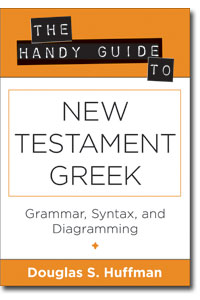
Recently my Greek reading has improved due to spending regular time refreshing my memory on verb paradigms, rules of syntax, and so on. The tool I’ve been using is Douglas S. Huffman’s Handy Guide to New Testament Greek (Kregel, 2012). Huffman’s Handy Guide consists of three parts:

  1. Grammar (“Greek Grammar Reminder: With Enough English to Be Manageable”)
  2. Syntax (“Greek Syntax Summaries: With a Few Helps to Be Memorable”)
  3. Diagramming (“Phrase Diagramming: With Enough Results to Be Motivating”)

“A Select Bibliography” concludes the guide and points beginning, intermediate, and advanced Greek readers to grammar texts, reading resources, diagramming helps, and more.

Handy Guide to New Testament Greek joins a number of similar little books already on the market for reviewing and retaining Koine Greek. There is Biblical Greek: A Compact Guide, a helpful and portable distillation of Mounce’s popular grammar. One might also consider Dale Russell Bowne’s Paradigms and Principal Parts for the Greek New Testament, Paul Fullmer and Robert H. Smith’s Greek at a Glance, and even the back of Kubo’s Reader’s Lexicon for its solid summary of Greek grammar with paradigm charts.

How does Huffman’s offering differ? Unlike Paradigms and Principal Parts or Greek at a Glance, the Handy Guide consists of more than simply verb paradigms or noun declension charts. It includes those, but with accompanying explanation along the way. In this regard it is similar to Mounce’s Compact Guide.

Different from Mounce, however, is the lack of any vocabulary-related helps in Huffman. It’s hard to imagine someone wanting a “handy guide” to “New Testament Greek” who doesn’t also want some treatment of vocabulary, which Mounce’s guide accomplishes nicely with its included brief lexicon. Huffman does include information about how words are formed, in his chart on comparative and superlative adjectives, for example:

Huffman Guide sample

But vocabulary is otherwise absent from the guide.

Part 1, “Greek Grammar Reminder,” covers everything from accents and breathing marks to nouns, adjectives, adverbs, and verb declensions. (Verb paradigm charts take up the majority of part 1.)

Huffman’s “Verb Usage Guide” (from part 2) contains a refreshing amount of detail on Greek verbs for such a short guide. For example, he lists 20 categories of participles followed by a “Participle Usage Identification Guide” to help readers of Greek texts determine what kind of participle is at hand. Part 2 also explains noun case usage. His explanations of nominative, genitive, dative, accusative, and vocative cases are short, clear, and include plenty of examples with Scripture references.

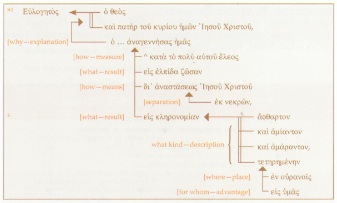
Where Huffman is really unique (and what makes this guide desirable especially for a second-year Greek student or pastor) is in his part 3 on diagramming. He briefly treats “technical diagramming” (the kind some of us had to do for English in 5th grade–showing syntactical relationships at the word level) and arcing, then moves into a rich, 22-page description of “phrase diagramming,” which looks like this:

Huffman, p. 103 (1 Peter 1:3-4)

The goal of this kind of diagramming is “to grasp the writer’s general flow of thought and argument, which he has expressed in particular words and sentences” (85). Huffman’s eight steps to phrase diagramming explain the process so that even a beginner can understand it well. His “Special & Problem Issues” section is the icing on the cake of part 3.

The guide is truly “handy”; it fits nicely together with a Greek New Testament, so one can keep it close at hand. The color-coding in the paradigms is done well, so that verb endings stand out for an easy refresher course.

An unfortunate and fairly noticeable drawback to this guide, in my view, is in the layout and color scheme. The orange theme, as attractive as it looks on the cover (pictured above), gets to be an eyesore after looking at more than a page or two. It’s too bright to read comfortably, and there are charts with at least four different shades of orange.

When there is Greek in black font (in grammatical category explanations), it looks great. But the Greek in the charts in orange has a fuzzy or slightly blurry, pixelated appearance. There are also quite a few charts that are in landscape orientation (rather than the default portrait orientation), so that the reader has to flip the book sideways. That alone would not be a huge deal, but the orange was distracting to me.

Hopefully there will be demand for future printings, and hopefully future printings will make the layout and fonts more useable. And despite the omission of vocabulary, this guide has great content. Resources on sentence and phrase diagramming for Greek are few and far between, but Huffman’s guide covers that territory well, and having that coupled with quick-reference charts will help just about anyone seeking to retain and improve their biblical Greek.

Kregel sent me a copy of the book for review. Its product page is here, and it’s on Amazon here. The Table of Contents are here (pdf); read an excerpt here (pdf).

Dry Cleaner Music

From This is Colossal:

Sound designer and composer Diego Stocco (warning: lots of sound) continues his ongoing project of making music from uncommon objects and places with this new video using loops recorded from a local dry cleaner. Stocco has also made music from a tree, from sand, and even a a bonsai, among others. Of all of them I really think this is his finest. Make sure you make it past the 2:10 mark. (via neatorama)

Here’s the video: