Week of Honest Toddler (win a free copy of HT)

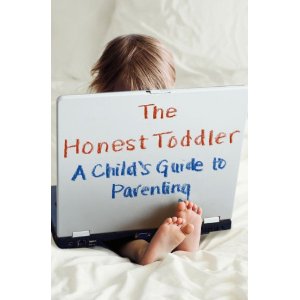
HT book cover

There is still time to enter our drawing for a free copy of Honest Toddler: A Child’s Guide to Parenting.

Just today HT posted some great reviews of children’s books.

In the meantime, I’ve reviewed HT’s new book here.

And the link for the HT book giveaway is here. Happy entering!

The Honest Toddler: A Book Review

Being a parent is very simple. There is no reason for you to constantly go to other adults who do not know your toddler for advice or conspiring. What happens at home stays at home. …When it comes to being a good parent, the most important resources are the words that come out of your child’s amazing mouth. If your child is too young to speak, guess accurately on the first try.

–Honest Toddler

Honest Toddler, under the supervision of mom Bunmi Laditan, has now added a full-length book to a popular and cathartic Twitter feed, Facebook page, and blog/Website. I’ve posted quite a bit about HT at Words on the Word already.

Real-life Honest Toddler is a girl, but HT is “asexual,” which makes the whole thing more universal.

And now, s/he has written a parenting guide. The chapter titles alone produce enough laughs to make the book worth the price:

  • Chapter 1: “Why Did You Do That?”: The Ins and Outs of Toddler Behavior and How to Leave It Alone
  • Chapter 5: Sleep: Weaning Yourself Off It
  • Chapter 18: Potty Training Simplified/Eliminated

Bunmi has tapped into the psyches of Every Parent because HT, in all the quirky specifics of his/her behavior, is Every Toddler. (“Give a toddler a rag and a spray bottle, and your house will be sparkling before you know it. First it will be soaking, and your mobile phone may have water damage, but after a thorough wipe-down, the results will please you.”)

This Child’s Guide to Parenting is thorough–HT includes everything from media recommendations (music, books, TV) to hygiene (“leave well enough alone”), from restaurant behavior to grandmas and grandpas (“you should learn as much as possible from your child’s grandparents”). Interspersed between chapters are letters from parents to HT and homework assignments (sample: “Visit the toy store and get all the things. Next, go to a field. Run until nightfall”).

The Honest Toddler is hilarious, brilliantly written, and often pointed in its humor (see: HT’s disdain for Pinterest). I was impressed by how much this little toddler had to say. Although, now that I think about it, my toddlers have always had a lot to say.

The open parent who reads this book will be perhaps re-conditioned: temper tantrums are just “loud responses,” toddler ignoring is simply “selective acknowledgement,” and whining is “a legitimate form of speech.”

Honest Toddler, for all his/her impossible demands (duh), has some great advice. Facebook, for example: “Toddlers are tired of hearing Facebook notifications during story time. We’re sick of having to sit in parked cars, fully strapped in, while you make sure you get the last word on a virtual dispute with an acquaintance. This website is a distraction. Log off. Permanently.” 

Communication: “Did you know that there are more than four hundred different meanings for ‘no’ in Toddler English?” (with a sample chart). Packing for vacation: “There’s no such thing as minimalism when it comes to packing for a trip with small children.”

Readers of HT’s blog, FB, and Twitter feed will recognize some material here (the “toddler-approved recipes” and physics breakdown of car napping), but not much. This is 256 pages of sheer, highly original, creative genius.

There are occasional moments of dark-ish humor (“There’s nothing special about a child [i.e., infant] who can’t go anywhere without a blanket over her legs”), but, then again, this was written by a toddler.

And, HT, if you’re reading: make sure your mom lets you watch Daniel Tiger’s Neighborhood. You’ll like it way better than Caillou.

If you’re a parent of a toddler or know one, The Honest Toddler is essential reading, if only to relax and laugh enough to keep one’s head in the game of toddler parenting. (If you’re interested in the possibility of a free copy, I’m giving one away here.)

I have to stop now; my own two-year-old just woke up to join us in watching the late-night basketball game and blogging, and now is requesting–you guessed it–Daniel Tiger and some water.

Many thanks to Scribner (imprint of Simon & Schuster) for the review copy, given to me for the purposes of an honest review. Find the book’s product page here. It’s on Amazon here.

And thanks especially to Bunmi/HT for making me a better parent. Or at least a parent who is able to laugh a little bit more and cry a little bit less as I raise my little ones.

Honest Toddler: Free Book Giveaway

HT book cover

Honest Toddler, under the supervision of mom Bunmi Laditan, has now added a full-length book to a popular and cathartic Twitter feed, Facebook page, and blog/Website. HT’s mom blogs here.

Thanks to Scribner (imprint of Simon & Schuster), Words on the Word has a copy of Honest Toddler: A Child’s Guide to Parenting to give away.

To enter, simply comment on this blog post with the best (brief) parenting tip you can come up with. Or just say hi. For a second entry, share the link to this post on FB, Twitter, via mind meld, etc., and let me know in the comments section that you did.

I’ll announce the winner right here some time next Monday.

And tomorrow I’ll post my review of the book on the book’s official release date. UPDATE: Review is here.

Daniel Tiger’s Neighborhood

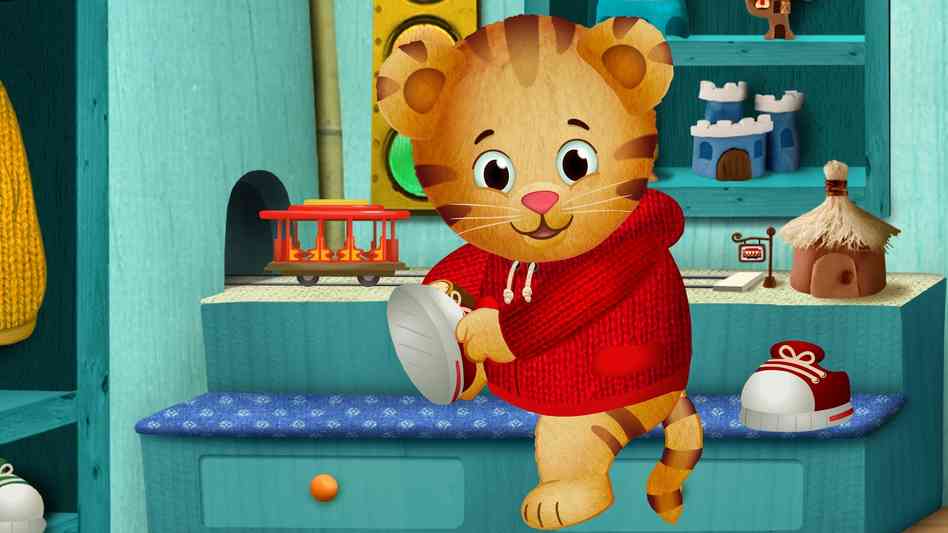
daniel tiger


How do you follow Mr. Rogers? Well, you don’t, really. Which helps to explain PBS’s decision to move to an animated tiger as the leading host and tour guide of the Neighborhood of Make-Believe.

I’ll admit: I was skeptical of Daniel Tiger at first. So is my five-year-old, every time we turn it on for our two-year-old to watch. (The former sits down with the latter for every episode, though, every time.)

Mr. Rogers’s pastoral sense and uncanny ability to love, honor, and celebrate children is not quite replicated by Daniel Tiger, but Daniel does pretty well–better than I thought an animated character could do. Here’s a short clip (30 seconds) that represents how Daniel models dealing with disappointment:


It’s not uncommon for my two-year-old to answer Daniel Tiger’s questions and comments, which Daniel puts to the viewer in much the same way that Mr. Rogers did.

Daniel Tiger mp3Best of all–there’s a soundtrack for the show. This has a noticeably positive effect on our two-year-old and his assessment of life in the early morning, without having him in front of a screen. Nearly every morning at our house now begins with a collective listen through this album. The music is catchy! I have to try really hard not to sing these songs to people around me.

The big hit lately around our house has been these printable pages of the characters in Daniel Tiger’s Neighborhood.

Unfortunately, my quoting, “When something seems bad, turn it around–find something good!” doesn’t always work for my two-year-old when he’s really grumpy. But it’s hard being two! And Daniel Tiger seems to get that, keeping a positive outlook throughout all the vicissitudes of toddlerdom.

My five-year-old son reviews: Can You Count to a Googol?

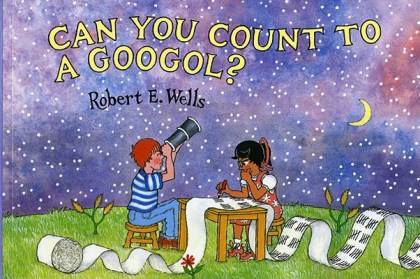
can you count to a googol

“Can you count to a googol?”

“I can’t. I think it might take a hundred days to count to a googol. You think so, daddy?”

Thus inquired my 5-year-old son as we sat down to read Can You Count to a Googol? by Robert E. Wells.

As the book worked its way through various numbers leading up to googol, it asked, “What would YOU do with ONE BILLION dollars?” My son said, “Spend it for something that is one billion dollars… but one billion dollars is a lot!”

Here’s his review of the book, in his words:

This book tells you everything about a googol. A googol is a number: a really, really, really, really big number. It is 1 with a hundred zeros after it. And how about we write it to show you what it looks like?

10000000000000000000000000000000000000000000000000000000000000000000000000000000000000000000000000000

In one picture, 10 monkeys are balancing 100 bananas, and some bananas are balancing each other! And there’s a girl clapping, and a boy raising his hands, and a wagon with a basket in it. The picture is trying to show us how many 100 is.

In another picture, there’s a big thing: there’s 100 eagles carrying two people and two monkeys. And 100 penguins–each have 10 ice creams.

There’s nothing that’s googol, not even all of the people in the whole universe. Stars aren’t googol. Asteroids aren’t googol, too.

This book might be good for 5-year-olds and up. So a little bit the best for 4-year-olds. And a LOT best for 5-year-olds.

[Dad’s editorial note: When the page appeared on which a monkey and some children were writing out a googol on a board, my 5-year-old stopped and counted every 0–there really were 100.]

Thanks to Albert Whitman & Company for the copy of the book to review. Its product page is here; at Amazon here.

Whatcha bacon?

Bacon strikes again. My father-in-law has recently been (quite successfully) baking bacon, rather than cooking it on the stove. It’s crispier and somehow more succulent and tasty. Mmmm… bacon. We do it that way now, and it looks like this:

Baked Bacon

Cook it on just under 300 degrees for anywhere between 45-60 minutes. Yes, it takes about an hour to get it right. But if you time it to be ready with the rest of your breakfast, it’s worth the wait.

And, yes, you may pin this. Just use the button on the right at the bottom of this post.

I would like to thank the snow for making such a breakfast possible this morning.

Five Kids’ Magazines We Enjoy

Here are five children’s magazines we particularly enjoy reading to our two-year-old and five-year-old:

High Five

5. High Five

“My First Hidden Pictures” and “That’s Silly!” are two favorite features of the magazine. It says it’s for ages 2 to 6, but it’s hard to imagine any two-year-old tracking with it. Better for slightly older kids.

Ranger Rick Jr

4. Ranger Rick, Jr.

It comes from the National Wildlife Federation. Given our five-year-old’s penchant for all things animal kingdom, this one is a hit. Today we learned from the April 2013 issue that giant tortoises can live to be 150 years old. Whoa.

ladybug

3. Ladybug

From the Cricket Magazine Group, Ladybug is the next age level up from Babybug (see below). Max and Kate are a fun ongoing storyline each month. Our five-year-old transitioned to this a year or more ago when he was getting too old for Babybug.

click magazine

2. Click

The awesomeness of this magazine caught us all unaware–I’d never heard of it before a grandparent-sponsored subscription began arriving in the mail. The March 2013 issue theme is “The deep blue sea.” Our five-year-old did the “make a fish” project on his own right away, with some scissors and glue. The magazine’s “Ocean Zones” section this month introduced us to the sunlight zone, the twilight zone, and the midnight zone, each of which support interesting and diverse kinds of life.

I just found out that Click is part of the same family as Ladybug and as…

babybug

1. Babybug

Babybug is really sweet. It is “for babies who love to be read to and for the adults who love to read to them.” (It’s good for toddlers, too.) Kim and Carrots is a favorite each month, and always seems to be appropriately themed for the time of year. Simple yet engaging illustrations go with memorable and fun-to-read poetry. No part of the magazine is more than three pages, so not a long attention span is required. It’s not uncommon for us to ask our two-year-old to pick some books to read, and for him to come to us with three Babybugs.

(It’s also not uncommon for me to walk in to the living room from the back of the house and see my five-year-old curled up on the couch with a New Yorker.)

How about any of you who regularly read to children? What magazines do you recommend?

A Perfect Song

“North American Field Song,” by the Innocence Mission:

Lyrics:

Raincoats, Finlandia,
Raincoats and lakes.
The best words, I take along
in my field bag.
Across the morning, the beautiful air,
I will be aware.
I’ll speak if I dare,
and

Stay calm,
stay calm, stay calm,
stay calm in the meantime,

Stay calm,
stay calm, stay calm,
through the red and the green light,
stay calm.

No one can be so embarrassed as me,
I say to these trees,
where I walk with my head down.
Across the morning, the beautiful air,
I will be aware
my Father is there
and stay calm….

Tough Guise: Violence and Masculinity in the Media

Tough GuiseThis last week I was part of a panel for Gordon’s Faculty Film Series for the film Tough Guise: Violence, Media, and the Crisis in Masculinity. Narrator and anti-violence educator Jackson Katz talks about the construction of masculinity through the media, particularly a masculinity where men are defined as tough, not “soft,” aggressive, etc. Here’s the summary of the film (from the study guide referenced below):

The idea that manhood or masculinity represents a fixed, inevitable, natural state of being is a myth. What a culture embraces as “masculine” can be better understood as an ideal or a standard – a projection, a pose, or a guise that boys and men often adopt to shield their vulnerability and adapt to the local values and expectations of their immediate and more abstract social environments. This projection or pose can take myriad forms, but one that’s crucial to examine is the “tough guise”: a persona based on an extreme notion of masculinity that links the credibility of males to toughness, physical strength, and the threat or use of violence.

There is a substantial study guide that goes with the film, which notes:

The central argument of Tough Guise is that violence in America is overwhelmingly a gendered phenomenon, and that any attempt to understand violence therefore requires that we understand its relationship to cultural codes and ideals of masculinity and manhood. Central to the video’s argument are the following:

» Masculinity is made, not given – as opposed to one’s biological sex;

» Media are the primary narrative and pedagogical forces of our time;

» Media images of manhood therefore play a pivotal role in making, shaping and privileging certain
cultural and personal attitudes about manhood;

» A critical examination of privileged media images of manhood reveals a widespread and disturbing equation of masculinity with pathological control and violence;

» Looking critically at constructed ideals of manhood – at how, why and in whose interests they are  constructed differently in different historical, social and cultural contexts – denaturalizes and diminishes the potential of these imagined ideals to shape our perceptions of ourselves, our world and each other.

The film was difficult to watch, not just because I have young boys, but because how masculinity is so often constructed in this society (have to be in control, must be physically overpowering, can’t cry or show emotion, etc.) causes damage to both men and women.

There’s quite a bit to digest in the study guide, which could be beneficial even without the movie. You can watch the whole film here. More about it is here.