New issue of Journal of Biblical Literature is up

Issue 131.3 of The Journal of Biblical Literature is out. You have to be a Society of Biblical Literature member to access the full contents, but you can see what’s in the new fall 2012 issue here.

From SBL, here is what’s inside the issue.

Judah Comes to Shiloh: Genesis 49:10ba, One More Time
Serge Frolov, 417–422

The Four Moses Death Accounts
Philip Y. Yoo, 423–441

Not Just Any King: Abimelech, the Northern Monarchy, and the Final Form of Judges
Brian P. Irwin, 443–454

The Heart of Yhwh’s Chosen One in 1 Samuel
Benjamin J. M. Johnson, 455–466

Secrets and Lies: Secrecy Notices (Esther 2:10, 20) and Diasporic Identity in the Book of Esther
Martien A. Halvorson-Taylor, 467–485

Psalms Dwelling Together in Unity: The Placement of Psalms 133 and 134 in Two Different Psalms Collections
Ryan M. Armstrong, 487–506

Archer Imagery in Zechariah 9:11–17 in Light of Achaemenid Iconography
Ryan P. Bonfiglio, 507–527

Eyewitnesses as Guarantors of the Accuracy of the Gospel Traditions in the Light of Psychological Research
Robert K. McIver, 529–546

Voluntary Debt Remission and the Parable of the Unjust Steward (Luke 16:1–13)
John K. Goodrich 547–566

Paul’s Areopagus Speech of Acts 17:16–34 as Both Critique and Propaganda
Joshua W. Jipp, 567–588

“Be Ye Approved Money Changers!” Reexamining the Social Contexts of the Saying and Its Interpretation
Curtis Hutt, 589–609

Of texts, translations, and readers

From A Greek-English Lexicon of the Septuagint (Lust/Eynikel/Hauspie):

When preparing a lexicon of the LXX, one is faced with several basic questions related to the fact that most of the books of the LXX are translations. This lexicon is supposed to give the meaning, i.e. the English translation equivalents, of the words used in the LXX. However, which meaning should be given, the one intended by the translator or the one understood by the readers for whom it was intended? Is reference to be made to the underlying Hebrew or Aramaic, or is the search for meaning to be confined to the Greek? These questions are interrelated and connected with the special character of “Septuagint Greek.”

This made me think of something I just read in Roy E. Ciampa’s chapter, “Approaching Paul’s Use of Scripture in Light of Translation Studies,” in Paul and Scripture: Extending the Conversation, edited by Christopher D. Stanley.

The point is that translations need to be analyzed not only in terms of their relationship with the source text but also in terms of (a) how the target text’s place within its adoptive literary system (as well as the social, religious, and other systems of which it is a part) relates to the source text’s place within its adoptive literary and other systems, and (b) how the place of the author of the source text within his culture and context relates to his place within the target text’s culture and context, and so forth.

Readers and how they understand texts are an issue, too.

Ciampa says in another place:

Paul’s interpretative method is closer to the idea of an indirect translation—one that that only partially resembles the original text and its meaning, retaining only those parts that are relevant to those to whom his interpretation is being transmitted. He may be aspiring not to complete interpretive resemblance with the original but only to partial resemblance, making alterations in order to adapt the text and its message in ways that optimize its relevance for his congregations.

The questions raised by each of the three above quotations are all reasons I am interested in studying the Septuagint, and now the use of the Old Testament in the New Testament. I’m learning that it’s so much more than just, what text did the NT writers have at hand, but also: how did NT writers use a text (whether Greek or Hebrew) to fit the needs of their writing and their audience? It’s a lot to unpack, and some of it is near impossible to know. But exploring questions like these strikes me as time well spent, even if I’ve unearthed more questions than answers for the time being.

One of my reviews to be published in Bible Study Magazine

I have written a book review that is slated to be published in an upcoming issue of Bible Study Magazine.

You can see what Bible Study Magazine looks like by flipping through this past issue.

The book I review is Lamentations and the Song of Songs, by Harvey Cox and Stephanie Paulsell. It’s the newest edition of Westminster John Knox Press’s Belief theological commentary series. (More about the book is here.)

Both authors suggest reading their respective biblical books in a “participatory mood.” Cox and Paulsell each highlight the timelessness of Lamentations and Song of Songs, surveying well their history of interpretation to help readers today apply them and enter in to the texts. A good commentary to have at hand, especially when preaching through either Lamentations or Song of Songs–something that probably doesn’t happen as often as it should.

Reasons to pay attention to the Septuagint, and a few easy ways to do it

One of my most-visted posts at Words on the Word has been “Why you need the Septuagint.” I give 10 reasons.

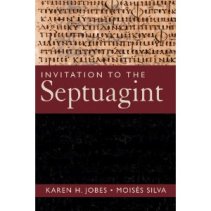
Karen H. Jobes and Moisés Silva give some reasons in their Invitation to the Septuagint. Here Septuagint blogger Brian Davidson summarizes the reasons they give for Septuagint study.

I have a list of resources for Septuagint study here. I’ve particularly enjoyed studying the Septuagint recently with the use of Bible software programs. Here and here I blog about BibleWorks (PC) and the Septuagint. Here I write about Accordance (Mac) and the Septuagint.

Stay tuned for an additional installment in my Logos 4 review, which will explore how one can profitably use Logos for Septuagint study.

And if you want to just start reading the Septuagint, you can do it for free here!

The Gospel According to Isaiah 53, reviewed

Isaiah 53 is one of the clearest prophecies of Jesus the Messiah in the Hebrew Scriptures. This chapter has changed the lives of thousands of people–both Jews and Gentiles–who have read the text and believed in the One who fulfilled these prophecies in glorious detail.

Thus begins Mitch Glaser’s Introduction in The Gospel According to Isaiah 53: Encountering the Suffering Servant in Jewish and Christian Theology (affiliate link). In three parts the book expounds how the prophecies of Isaiah 53 relate to and are ultimately fulfilled in the person of Jesus. (The full passage the book treats is Isaiah 52:13-Isaiah 53.)

The first section, a sort of exegetical prelude, discusses “Christian interpretations” and “Jewish interpretations” of Isaiah 53. The second section is a biblical theology of Isaiah 53 (with particular attention to its use throughout Scripture). The third and concluding section speaks to “Isaiah 53 and Practical Theology,” with an emphasis on how to preach the passage, both from the pulpit and in conversation.

The book is “designed to enable pastors and lay leaders to deepen their understanding of Isaiah 53 and to better equip the saints for ministry among the Jewish people.”

The first thing I noticed about the book is that it’s just as much an apologetic for Jesus-as-suffering-servant as it is an academic study of Isaiah 53. It’s not that it lacks academic substance, though. This is a meaty book, and pleasingly so.

Regarding the book’s explicitly evangelistic intent–there may be some who are uncomfortable with the description of Chosen People Ministries’ “Isaiah 53 Campaign” (including 75,000 postcards to Jewish homes and 40,000 voice blasts=robo-calls?). I’ll admit that I question the potential efficacy of pre-recorded phone messages for reaching anyone with the Gospel (though God can use anything!). But see blogger Joel Watts for his helpful (refreshing!) take on the blending of the academic and evangelistic enterprises, especially in the context of this book.

You can find a full list of contributors in the table of contents here (pdf). A few names to highlight are Walter C. Kaiser Jr., Darrell L. Bock (one of the co-editors), Craig A. Evans, and Donald R. Sunukjian. I particularly appreciated the book’s treatment of the New Testament use of Isaiah 53. The chapter by Michael J. Wilkins lists the quotations of Isaiah 53 in the NT and additional allusions to it in the Gospels. (He makes a key point, that Jesus himself understood “his mission and death in the light of Isaiah 53.”) Darrell Bock goes in depth with a comparison of the Greek and Hebrew texts of Isaiah 53:7-8, highlighting its use in Acts 8 where Philip explains the passage to the Ethiopian eunuch.

Something to critique in this book is that there were a few generalizations of Jews that I found to be unfair, particularly in the chapter “Using Isaiah 53 in Jewish Evangelism.” Mitch Glaser writes:

I think I can safely say that, in the United States, most Jewish people would recognize Isaiah as the first name of a professional athlete sooner than they would recognize the prophet of biblical literature.

Granted, he is operating from the assumption that “most Jewish people are not Lubavitch, Hasidic, or Orthodox,” but still…. What was more surprising to me: “Most Jewish people do not understand or believe in biblical prophecy” and, “Most Jewish people do not believe in sin.” Glaser does (only later) qualify these with, “We must note that all of the above does not apply to those who hold to traditional Jewish theological positions,” but he would have been better off saying something like “many secular or ethnic but non-religious Jews…” or at least supporting his statements with statistics from surveys rather than anecdotal evidence. Glaser himself is a converted Jew who has a compelling conversion story, but I still found those characterizations to be frustrating. I wonder how helpful such statements could be in advancing an evangelistic cause in conversation with another Jew.

This next thing to highlight may seem a small point to some, but as someone seeking to keep my Hebrew and Greek going, I appreciated the actual Hebrew and Greek fonts throughout the book (i.e., not just transliteration), which are clear and easy to read. I did think, however, about an intended audience of “pastors and lay leaders” who may have desired transliteration, too. (All Hebrew and Greek is translated into English.)

Darrell Bock’s conclusion summarizes all the essays of the book, with key quotations. Having this there was a big help in piecing everything together again. The Gospel According to Isaiah 53 will not be far from my reach in coming months and years. I expect I will often reference this compendium of biblical scholarship on a vital text. My hesitations about the characterizations of Jews above notwithstanding, there is a good deal here that can be useful for Christian-Jewish conversations about the Suffering Servant.

I received a free copy of The Gospel According to Isaiah 53 with the only expectations of providing an (unbiased and honest) review on this blog. Its publisher’s product page is here. It’s on Amazon here (affiliate link).

Septuagint Sunday: What IS the Septuagint? Why “LXX”?

click on image to go to source

Of all the Septuagint bloggers in the world, Brian Davidson is perhaps my favorite. He is now also a fellow BibleWorks user, as he begins his review of it here.

For this week’s Septuagint Sunday, I send you to Brian’s brief but informative posts on Septuagint terminology:

  • Here he explains the use of the word “Septuagint” and its ambiguities
  • Here he writes about what the number 70 (“LXX”) has to do with it

Thanks for your blog, Brian!

More Bells and Whistles in Accordance 10 (final installment of my review)

Here are a few more bells and whistles in Accordance 10. These are to add to the bells and whistles I mentioned yesterday.

    1. The Context Slider  

I’m in James. Wondering about wisdom.

So I right click on “wisdom” to search for the word in the rest of the Bible. I get the following results:

Great for a word search. I can scroll through the results, seeing one verse at a time–every verse containing “wisdom.” Note that next to the context slider it says there are 202 verses displayed. The frequency count for “wisdom,” though, is toward the top right of the image above, just under the search bar–212 flex hits. (I wrote more about Flex Search here.)

But what if I want to see each of those uses in context, without having to open up a bunch of new windows? Easy, I just slide the context slider one notch to the right:

Note that while my “212 flex hits” stay the same, there are now 546 verses listed. This means a bit more context is listed for each occurrence. Moving the context slider to 3, I get even more context for each use of “wisdom”:

The Context Slider goes all the way to the right for the setting “A,” which shows me all the uses of “wisdom” still marked in red, but with the context of the entire Bible surrounding it:

As you can imagine, being able to see the word search results with varying degrees of context makes for fruitful word studies.

2. Constructs

This feature looks a little more complicated, at least on first glance. But it’s well worth spending the time to figure out how to use it, because of all that it can do.

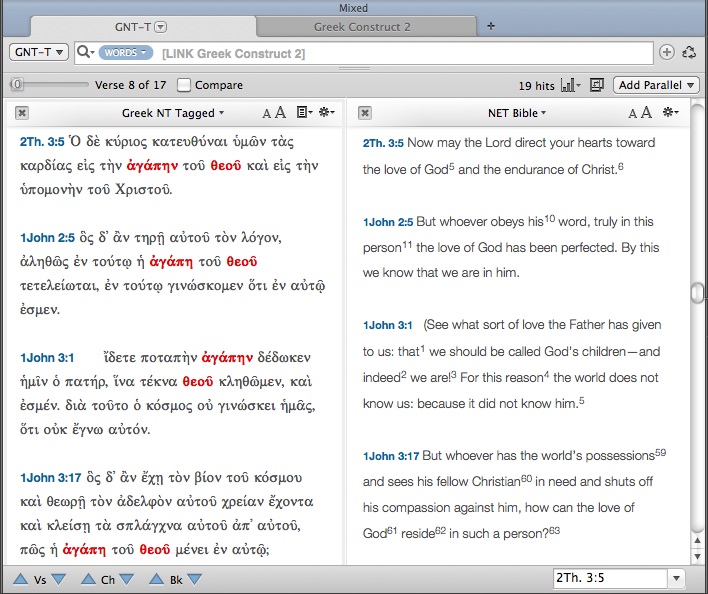
Accordance Constructs are a graphical interface that allow for more complicated searches… you know, things like, “How many times do the words God and love appear in the New Testament within seven words of each other… in Greek?” Setting up this search using the Construct feature looks like this and takes a very short time to do:

Clicking on Search at bottom right, I get the following results:

But that’s a lot of Greek to wade through. If I need an English translation, clicking on “Add Parallel” above gives me the same results, translated:

There is much more the Construct search can do–but this gives an idea of its potential utility. More from Accordance on Constructs can be found in their help files here.

3. Modules

Accordance sells a number of add-on modules. Though I have not used them, two that look to be particularly useful are a bundle for Hebrew text criticism (including the BHS text and apparatus, and new BHQ volumes with apparatus) and some volumes of the critical Göttingen text of the Septuagint (e.g., here and here). Accordance also offers add-ons of various commentaries, including the NIGTC series, NICNT, the JPS Torah Commentary, and quite a few more. Though there are certainly strong opinions in the biblical studies community as to whether one should own commentaries as physical books or as 1s and 0s, Accordance makes the latter possible with modules that integrate with the rest of the program.

———————————————————————————————-

I’ve really enjoyed learning and reviewing Accordance 10 this last week. It’s a great program. I love being able to use Bible software that is native to a Mac, and a really good software at that. Accordance can do a lot. I think what has impressed me the most has been how customizable all the panes, zones, tabs, etc. are, without sacrificing any quality. Already in the last week I’ve been able to use Accordance to speed up some tasks in both my studies and my ministry.

For ease of reference, here are all the parts of my review of Accordance 10, which this post (#6) completes.

Part 1: In which I finally try out Accordance Bible Software for Mac (new version 10!)
Part 2: 4 Cool Features in Accordance 10
Part 3: 3 Powerful Ways to Search in Accordance 10
Part 4: The Original Languages Collection in Accordance 10 meets Septuagint Sunday
Part 5: Accordance 10: Bells and Whistles

Coming soon: Review of Beale and Carson’s Commentary on the New Testament Use of the Old Testament add-on module.

I received a free copy of Accordance 10 for review. There were no expectations placed on me as to the nature (or length!) of my review, whether positive or negative.

Accordance 10: Bells and Whistles

I recently read somewhere in the Accordance Forums that an early Accordance user from the 1990s said the product should come with a warning that it may cause sleepless nights! As I’ve reviewed Accordance 10 (as a long-time Mac user but new Accordance user), I’ve already seen the wisdom in that suggestion. It’s hard to put down. Accordance is actually a really fun program to use: sleek, pleasing, productive, and really easy to customize as I’ve gotten the hang of how to move things around.

The four parts of my Accordance 10 review so far are here, here, here, and here. Specifically I’ve been reviewing the Original Languages CollectionUPDATE: final part, part 6 of my review, is here: “More Bells and Whistles.”

Now that I’m getting more comfortable with the program, I want to post about some bells and whistles in Accordance 10. These are features that really make the program stand out.

1. Instant Details: more than I thought

That Accordance has instant parsing details is great, but to be expected of any Bible software program.

Image from Accordance’s features page

But here are two cool bells and whistles about the Instant Details.

Instant Details already parse whatever word you hover over. But this same area can also be used to just as quickly give you information from a given tool that is tied to a biblical text. If you hold down ⌘ (the command key) while you hover over a word, the Instant Details will give you the information from the first tool related to the text. So you can see your top lexicon’s entry for that word, for example. Or if you hover over a verse number and press , you get the information from the first reference tool you have. For example, hovering over a verse reference and pressing the command key gives me this in my Instant Details (click on image for larger):

One other sweet feature about the Instant Details is that you can arrange the order of how parsing elements occur. This accounts for those who will come to Accordance having learned under any number of different grammars and systems. You can drag and drop elements to put them in the order you desire:

A nice touch.

2. Interlinears: however you want them

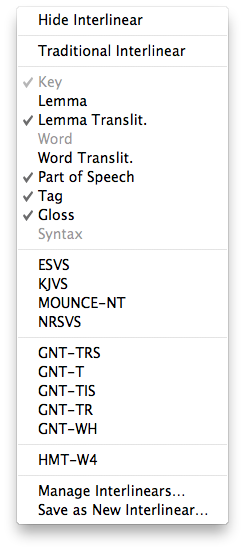
Having been trained at a seminary that prizes original languages, I am a little biased against interlinears for those who are really seeking to learn the language. (I find the “burn your interlinear” mantra I’ve heard from some quarters a little excessive, though.) Realistically, however, some exposure to biblical languages is better than none, and there are surely users who will want to make use of an interlinear. Greek and Hebrew texts come with interlinear English translation and word parsing as the default, but you can easily turn it off and back on again as needed. See the options at left, where you can set up exactly what you want to show in your interlinear. Here’s what the interlinear feature looks like with the options at left checked (click for larger):

3. It is so, so fast

When I first started using Accordance, I’d open it and then go to Safari or some other program to wait for it to load. But what I quickly realized is that I didn’t actually have to. This thing is up and running fast. I had Accordance set up so that four different workspaces would come up upon opening the program (NT, Hebrew OT, LXX, and a “Search all” workspace I created). Everything was ready to go in 8 seconds. That’s a lot of workspaces to have open fast!

Then when I opened Accordance such that it only needed to load two workspaces, that time dwindled to 5 seconds. Don’t bother surfing the Internet while you wait for Accordance to load. It’s ready to work when you are.  Searches on words are immediate, and the Instant Details give you the details, well… instantly.

Part 6 of my Accordance review will be my final review of the program itself. In that I’ll look at a few more bells and whistles: the Construct search and the context slider. After that I expect to be able to review an add-on module. Stay tuned!

I received a free copy of Accordance 10 for review. There were no expectations placed on me as to the nature of my review, whether positive or negative.

3 Powerful Ways to Search in Accordance 10

Here are three powerful and creative ways that Accordance 10 allows you to search through its texts and resources. Add these three cool features to the four I highlighted earlier: analytics, the customizable toolbar, the magnify feature, and the one-volume IVP commentary and one-volume Eerdmans dictionary that come with the Starter Collection and higher.

1. Flex Search

Here is how Accordance’s site describes Flex Search, new in Accordance 10:

Flex Search is a new feature of Accordance 10 that finds variations of the words and phrases you search for. Specifically, Flex Search will find all inflected forms of verbs and all singular and plural forms of nouns. This mode also allows words to occur out of order or to have other words in between them.

If I wonder, for example, whether “Jesus wept” might have some other verses similar to it, I type in “jesus weep” in the search bar, make sure it’s set to “Flex Search,” then enter. You can see that in the results below, even though I searched with “weep,” Flex Search brought up results with any inflection of “to weep” (wept, weeping, weep). Just under the search bar is shown the statistic “18 flex hits.” Click on the image below or open in a new tab to view larger:

Order doesn’t matter here: “weep jesus” gives me the same results as “jesus weep.” You can even combine an Exact Search with a Flex Search by placing the term you want to search exactly in brackets. This is a good move for those of us who use Google frequently, where something like a Flex Search can happen somewhat intuitively.

This option is available only in the English versions–there is no Flex Search option for Hebrew or Greek texts, for example.

 2. Amplify

From the site again:

Accordance offers a highly efficient form of searching known as amplifying, which allows you to search for any word or phrase just by selecting it in the text you are reading and then clicking the Amplify icon in the toolbar. For example, if you are reading about the Ten Commandments in Exodus 34:28 you can amplify to a dictionary article on the topic by selecting the phrase “Ten Commandments” in the Bible text, clicking on the amplify icon in the toolbar, and then choosing the desired dictionary. You can also triple-click on any word to quickly amplify to your default dictionary or lexicon. This method of searching is much faster than opening a new module and manually typing in your search.

Using this feature has taken me a little bit of time to figure out, but now that I have I’m really enjoying it.

In Mark 1 below, I double-clicked on “wilderness” to highlight it and then went to the Amplify icon in the customizable toolbar up top:

Then a whole range of options is available to me. I can look up “wilderness” in English tools and find the definition in the Eerdmans dictionary. And the triple-click option is neat, too–by triple-clicking on a selected word, you look it up in your default dictionary or lexicon.

I can think of one possible way for a future update to improve the Amplify function (I know, I know! this one just came out). I was using Accordance with two Workspaces open: Accordance’s “NT Study” and my own “Hebrew Bible.” When I tried to look up an English word from the Hebrew Bible Workspace in the Eerdmans Dictionary, it moved me over to the NT Study Workspace where Eerdmans was already open. As a result I lost my initial place and had to go back to the “Hebrew Bible” Workspace.

There may be a good explanation for this and an easy way to prevent it from happening that I just don’t know about (if I find one out, I’ll post an update here). But it would have been nice to just have the Amplify search open the dictionary in my same Workspace. UPDATE: It’s an easy fix in the Preferences section. I just had to check “Confine amplify to the same workspace.”

Workspaces, by the way, are a great way to stay organized and working on multiple projects at the same time in Accordance.

3. Search All

The word “Trinity” does not appear in the Bible. But what if I want to see what biblical resources say about the Trinity, and where in the Bible they see the various interrelating persons of the Trinity? The “Search All” bar at the top right of Accordane allows the user to search all of Accordance’s resources by word (or even by Scripture reference). The screen shot below shows in the left sidebar the resources that returned a hit. You can see that Accordance gives me all the times “Trinity” appears in the NET Bible notes! That’s quite useful.

You can also use the “Search All” bar to access images.

There are a few more things I want to cover in my Accordance 10 review, but to those of you reading–are there any features you’d like me to comment on? Or questions you have about the program and its features, how it all works together? I’d be happy to try to take these up in future posts. Feel free to leave me a comment if so.

This series of reviews is made possible by my having received a review copy of Accordance 10, Original Languages Collection. I have not been asked or expected to provide a positive review–just an honest one. Part 1 of my review of Accordance 10 is here, and part 2 is hereUPDATE: Here is part 4, a review of the Original Languages Collection. UPDATE 2: Here is part 5, “Bells and Whistles.” UPDATE 3: part 6, “More Bells and Whistles.”

4 Cool Features in Accordance 10 (Review, part 2)

I am a new Accordance user. As I said in the first part of my review of Accordance: so far, so good.

I’m working my way through some of Accordance’s training materials so I can better utilize the program as I review it. Here is Episode 77 of their Lighting the Lamp podcast series. It is at the “basic level” and provides a “first look” at Accordance 10. It’s a good place to start.

Here I highlight, in no particular order, four cool features in Accordance 10. Each of these not only has a bit of a wow factor, but will also enhance my study of the Bible, especially in its original languages.

1. Pie charts, bar charts, statistics, oh my!

In Mark 1:42 I read: καὶ εὐθὺς ἀπῆλθεν ἀπ᾿ αὐτοῦ ἡ λέπρα, καὶ ἐκαθαρίσθη. (Note: I simply checked off a box in Preferences and was able to export this Greek text as unicode from Accordance into WordPress.) Then I “right click” on ἀπῆλθεν, select “Search For… Lemma,” and I can see all its New Testament occurrences pop up in a separate window. It also notes just under the search bar that my search results in 117 hits. The empty box at the bottom is the “Instant Details” window that shows parsing information when I hover over a word. See below and click for larger or open in a new tab:
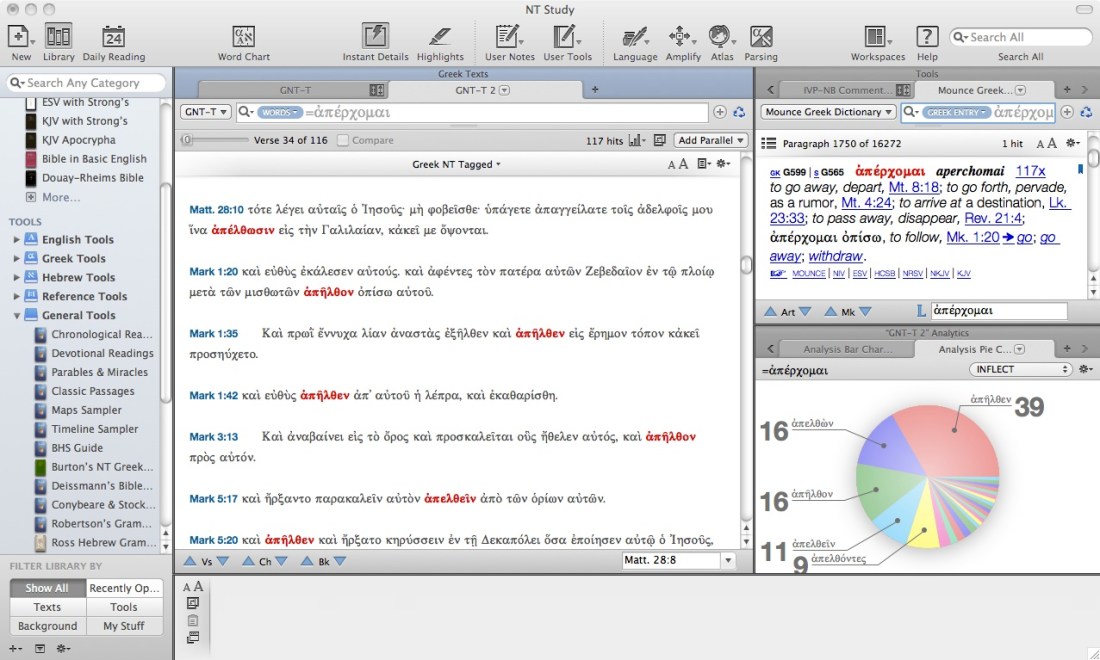
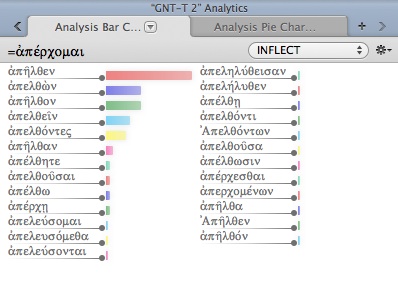
You can see I have Mounce’s Greek Dictionary open at top right. This already includes word statistic information. But–and here’s cool feature #1–check out the “Analysis Pie Chart” at bottom right! This shows the ways and number of times ἀπέρχομαι is variously inflected. Or you can see it in bar chart form, which in this case affords a bit more detail than the pie chart:

I quickly discover, in a visually appealing way, that my word at hand (ἀπῆλθεν) is the most common inflection of ἀπέρχομαι. This analysis tool allows multiple configurations. You can search by inflection, gender, tense, person, etc.

2. Customizable Toolbar

This has so far been one of the things about Accordance I’ve appreciated the most. New to Accordance 10 is the customizable Toolbar. Mine looks like this at the moment:

Users can easily add and re-arrange what they want in the toolbar, simply by “right clicking” in the toolbar area and going from there. (Note: “right clicking” for me on my Mac is just a two finger tap on the trackpad.) Right clicking on the toolbar allows you to customize it, which then gives you this:

Then, simply set it up how you want it. You can always revert back to the default, as noted at the bottom. The “separator” and “space” options are an especially nice touch. See the Accordance blog post here for more ways a user could customize Accordance 10.

3. Magnify this zone

Here’s a setup I’ve been using to work through the Hebrew text. You’ll note my library on the left, the Hebrew Masoretic Text side-by-side with the NET Bible in the middle, the Instant Details (parsing) box on the bottom, and the dictionary pane on the right. That’s a good setup for analyzing my way through the text. But if I just wanted to read the Hebrew (with the English next to it) with no other distractions, I easily could, without losing my other windows. “Magnify this zone” allows me to turn this:

into this:
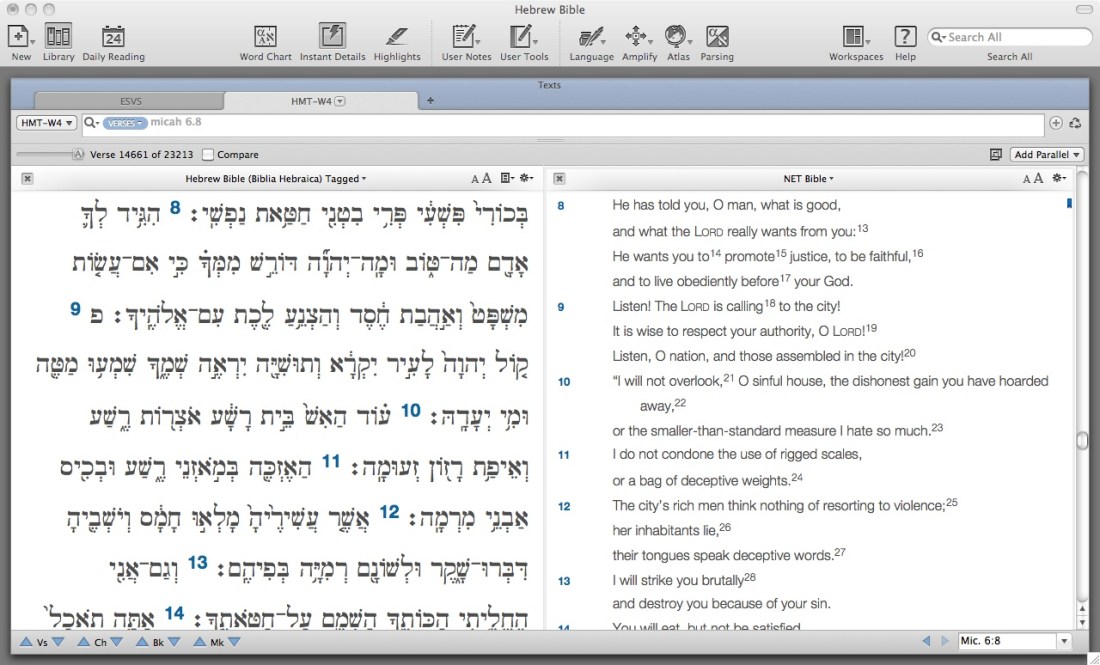
With a single click I can easily return back to my full setup when I’m done.

4. A great one-volume commentary, and a great Bible dictionary

Both the Starter Collection in Accordance and Original Languages Collection (what I’m reviewing) come with the IVP New Bible Commentary and the Eerdmans Dictionary of the Bible. The IVP Commentary is integrated into the program such that you can have it sync with you through a passage while you read and study. Each of these is a handy resource to have at the ready while working through text.

My only complaint with these has been that the IVP commentary is a “Reference Tool” while the Eerdmans dictionary is an “English Tool.” This means that they’re in two separate places in the library, which wasn’t totally intuitive for me right away. However, this separation may be due to the fact that–from what I can tell–Reference Tools follow you with verse-by-verse integration whereas you have to do a specific look-up by word for the English Tools. All the same, it’s great having access to these texts.

There are more cool features in Accordance 10. I’ll continue to review the program in coming days. You can go here for an overview of some of Accordance’s newest features.

This series of reviews is made possible by my having received a review copy of Accordance 10, Original Languages Collection. I have not been asked or expected to provide a positive review–just an honest one. Part 1 of my review of Accordance 10 is here. UPDATEPart 3 of my review is hereUPDATE 2: Here is part 4, a review of the Original Languages Collection. UPDATE 3: Here is part 5, “Bells and Whistles.” UPDATE 4: part 6, “More Bells and Whistles.”