The JPS Bible Commentary on Jonah

Jonah JPS CommentaryNahum Sarna’s JPS Torah Commentary on Genesis is easily one of the best three commentaries I’ve read on any book of the Bible. I’d put it up there with R.T. France’s Mark commentary, a technical and detailed commentary of which I read every word–France is that good, and so is Sarna.

So as I geared up to preach on Jonah during Advent (see some of the results of that unlikely pairing here), I wanted the JPS Bible Commentary in hand. It’s by Uriel Simon, professor emeritus at Bar Ilan University in Israel, where he also directed the school’s Institute for the History of Jewish Research. Dr. Simon aims for a similar approach to the one that made me appreciate Sarna’s Genesis commentary so much. In the Preface Simon writes:

The present commentary has been written under the sign of a dual commitment: academic rigor, which aims at uncovering the original meaning of the Book of Jonah; and a Jewish commitment to Scripture as the taproot of our national existence and wellspring of our religious life.

The commentary is not very long. The Preface and thorough Introduction make up 38 pages. The commentary itself has 46 pages, followed by a four-page bibliography. Each page in the commentary includes the Hebrew text, an author-modified version of the New JPS translation, and Simon’s comment on passages, verses, and individual words and phrases.


Simon’s Introduction to Jonah


The Introduction begins with a treatment of the book’s theme(s), as well as its history of interpretation. Simon realizes that he “stands on the shoulders of his predecessors,” and gives the reader a nice lay of the land of Jewish/rabinnical exegesis up to the current day. (You can read a good summary version of Simon’s treatments of potential themes in Jonah here.)

I disagree with Simon’s dismissal of “Universalism versus Particularism” as a possible uniting theme for Jonah. He does not think Jonah symbolizes Israel, “and Nineveh does not symbolize the gentile world.” Of course, it is my being a Christian (as Simon would expect) that contributes to this read, but neither did I think Simon’s case against the gentiles as anything more than just “supporting characters” was compelling. I don’t think Jonah has to symbolize Israel–and the book doesn’t even have to be an indictment against God’s chosen–for the text to still have “panhumanist connotations” of the extension of God’s mercy to all people (even vile oppressors of the innocent!).

I do find the author compelling, though, when he speaks of the “Compassion: Justice versus Mercy” motif as one that is “compatible with the entire narrative from beginning to end and encompasses most of its elements.” Simon explains:

Jonah foresaw both the submission of the evildoers of Nineveh, terrified by their impending destruction, and the acceptance of their repentance by the merciful God; but he was totally wrong to believe that he would be allowed to escape to Tarshish. Subsequent surprises undermine his pretense to knowledge‑-the fish that saves him from death but imprisons him in its belly until he gives up his flight and begins to pray; and the plant that saves him from his distress but vanishes as suddenly as it appeared, so that he can feel the pain of loss and open his heart to understand the Creator’s love for His creatures. Only when the proponent of strict justice realizes his own humanity can he understand the fundamental dependence of mortals on human and divine mercy.

The Introduction also treats Jonah’s place in the canon, its literary genre and features, structure (it’s got “seven scenes”), style, links to other biblical books, vocabulary, date of writing, textual history (there is an “excellent state of preservation of the text”), and a section on the unity of the book and its prayer/psalm in Jonah 2. I’m not totally opposed (in theory) to Simon’s idea that the prayer of that chapter was a later addition, but its absence of “confession and an appeal for forgiveness” don’t have to make it an interpolation–it could just point more to the character of Jonah, in all its complexities and with all his foibles.

Regarding the historicity of Jonah and the large fish (which is “really external to the [meaning of the] story” itself), Simon has a great insight:

The repentance of the Ninevites, from a psychological standpoint, is less plausible than the physical possibility of the miracles that happened to Jonah. There is nothing like it anywhere else in the Bible. What is more, their repentance, unlike miracles, cannot be ascribed to divine intervention, because it is emphatically described as a human action (3:10).


 The Commentary Proper


The questions that arise as one reads the text (reprinted in the commentary in Hebrew and English) so often seem to be the ones that Simon answers. Regarding “Nineveh, that great city” in Jonah 1:2, Simon gives historical background, but only insofar as it serves Jonah’s literary purposes:

Nineveh’s size is mentioned, not to emphasize the difficulty of the task, but to highlight its importance–as is the size of the city, so is the magnitude of its wickedness….

The reader, in other words, will find just about anything needed to profitably make her or his way through Jonah.

Like Sarna does for Genesis, Simon goes in depth with Hebrew word meanings in a way that even a non-Hebrew reader will (usually) be able to understand. For example, when the king of Nineveh calls that city to repentance in Jonah 3:7, Simon comments:

In the hif’il (causative), z-‘-q generally means “call to an assembly, muster” (e.g., Judg 4:10; 2 Sam 20:5). Here, though, it means to “proclaim or spread a message”…. The narrator probably selected this verb to reinforce the formal linkage with what took place on the ship–in view of the danger of foundering the sailors cried out to their gods (1:5), while the king of Nineveh had the criers (cf. Dan 3:4) cry out the message of repentance for his subjects to hear.

Simon highlights little nuances readers might miss: the “great fish” of Jonah 2:1 echoes the “great city” (1:2), “great wind” (1:4), and the sailors’ “great fear” (1:10). Everything in Jonah is big–and therefore important–it seems.

There’s more in this well-written and carefully-prepared commentary that deserves further engagement, but this review is already long enough. Don’t be fooled by the commentary’s low page count–its stated 52 pages do not include the nearly 40-page introduction. That may still feel short for a commentary on four chapters of Scripture, but it’s as substantive as most readers will need. If you’re working your way through Jonah, Simon’s JPS commentary is one of three or four you should make sure to use.


Many thanks to the folks at University of Nebraska Press/Jewish Publication Society for sending me the copy of the Jonah commentary for review. The book’s JPS product page is here; you can order it through Nebraska Press here. Find it on Amazon here.

Göttingen Septuagint (Genesis): Lexus of the LXX


The Wire Season 4


Man say if you wanna shoot nails, this here the Cadillac, man.
He mean Lexus, but he ain’t know it.

–Snoop to Chris, Season 4, Episode 1, The Wire


Having recently re-watched the fourth season of the best television show in history, I need now to amend my assessment two years ago that the Göttingen Septuagint is the Cadillac of Septuagint editions. It’s the Lexus of the LXX.


The Göttingen Septuagint


Vandenhoeck & Ruprecht in Göttingen, Germany publishes the Göttingen Septuagint, more formally known as Septuaginta: Vetus Testamentum Graecum Auctoritate Academiae Scientiarum Gottingensis editum.

The series of critical texts with apparatus spans more than 20 volumes and covers some 40 biblical books (counting the minor prophets as 12), with more continuing to appear.

But, as I remarked two years ago when I confused Cadillacs and Lexuses, the Göttingen Septuagint is not for the faint of heart, or for the reader who is unwilling to put some serious work in to understanding the layout of the edition and its critical apparatuses.


The Contributions of John William Wevers


Enter John William Wevers. If Göttingen is the Lexus of LXX editions, Wevers is its chief mechanic. His Notes on the Greek texts of the Pentateuch–though provisional in nature, Wevers intimated–remain some of the best resources for carefully studying the Septuagint. And his Text Histories on those same books (now free online, thanks to the Göttingen Septuaginta-Unternehmen) guide the reader through the transmission of the Greek text in its various manuscripts.

Better yet, before his passing Wevers translated much of his own Göttingen-Pentateuch introductions from German into English. That enduring gift can be found here.


Göttingen-Genesis


Published in 1974, Wevers’s Genesis includes a 70+-page introduction, Wevers’s reconstructed Greek text of Genesis, and two critical apparatuses at the bottom of each page that highlight readings from various manuscripts.

The introduction includes these sections:

  1. The Textual Witnesses (Greek and other versions)
  2. The Text History (“Here only information necessary for the use of this edition is given”)
  3. Re: This Edition
  4. Signs and Abbreviations

A challenge to using the Genesis volume is the scarcity of material available about the Göttingen project in general. Further, the introduction is in German and the critical apparatuses contain Greek, abbreviated Greek, and abbreviated Latin. A few things come in handy:

  • Wevers’s Genesis introduction is here in English.
  • As for deciphering the apparatus and abbreviations, Wevers offers such a key in the introduction, and the print edition comes with a handy insert (in German and Latin, but not unusable to those without command of those languages)
  • Miles Van Pelt has made available his own two-page summary of sigla and abbreviations (here as PDF).
  • Seeing the need, I wrote a two-part primer (here and here, two of my most-visited posts on this blog) to reading and understanding the Göttingen Septuagint–the focus was largely on Genesis, and I draw on those posts for what follows

So equipped, the reader (whether she or he knows German or not) is ready to work through the Greek text itself.


Tour of a Page


Instead of using a text based on an actual manuscript (as BHS, based on the Leningrad Codex, does), the Göttingen Septuagint utilizes a reconstructed text based on a thorough examination of evidence from manuscripts and translations.

Because it is an editio maior and not an editio minor like Rahlfs, any page can have just a few lines of actual biblical text, with the rest being taken up by the apparatuses. Here’s a sample page from Genesis 1 (image used by permission).

Note the #s 1-4 that I’ve added to highlight the different parts of a page.


Page reproduction by permission of publisher (annotations are mine)


1. The reconstructed Greek critical text (“Der kritische Text”)

With verse references in both the margin and in the body of the text, the top portion of each page of the Göttingen Septuagint is the editorially reconstructed text of each biblical book. In the page from Genesis 1 above, you’ll notice that the text includes punctuation, accents, and breathing marks.

Regarding the critical text itself, Wevers writes in the Genesis introduction:

Since it must be presupposed that this text will be standard for a long time, the stance taken by the editor over against the critical text was intentionally conservative. In general conjectures were avoided, even though it might be expected that future recognition would possibly confirm such conjectures.


2. The Source List (“Kopfleiste”)


The Kopfleiste comes just below the text and above the apparatuses in Genesis. Wevers notes it as a list of all manuscripts and versions used, listed in the order that they appear in the apparatus on that page. A fragmentary textual witness is enclosed in parenthesis.


3. and 4. Critical Apparatuses (“Apparat I” and “Apparat II”)

The critical apparatuses are where the user of Göttingen can see other readings as they compare with the critically reconstructed text. Because the Göttingen editions are critical/eclectic texts, no single manuscript will match the text of the Göttingen Septuagint.

The first critical apparatus will be familiar in its aims to readers of BHS. Regarding the second apparatus, Wevers writes:

In view of the fact that the materials presented in the second apparatus [are] not at least in theory a collection of variants within the LXX tradition, but rather one such of readings from other traditions, especially from the “three”, which have influenced the LXX tradition, these readings are given in full.

“The three,” sometimes referred to in Greek as οι γ’, are the texts of Aquila, Symmachus and Theodotion.

In other words–there is virtually no stone unturned here in the quest to reconstruct a Greek text of Genesis.


Concluding Evaluation


Serious work in Septuagint studies uses the Göttingen text, where available, as a base. Wevers’s scholarship and care for the text is clear as one makes her or his way through the Genesis volume. It’s the starting place for studying the Greek text of Genesis.

Vandenhoeck & Ruprecht’s production of the book is stellar, too. It’s got a sewn binding and is beautifully constructed–built to last and look good on the shelf, or in your hands:


Goettingen Genesis


You can find the volume here at V & R’s site, and here at Amazon. ISD distributes the book, as well, and carries it here.


Many thanks to V & R for the review copy of this fine work, given to me with no expectation as to the content of my review. Find more V & R blog posts here.

A Bundle of Septuagint Resources in Olive Tree, Under $50

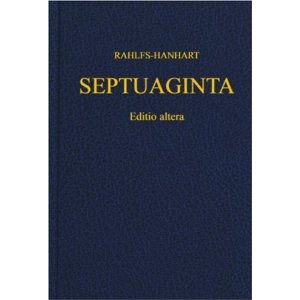
Rahlfs LXXWant to read the Old Testament in Greek on all your devices? This is the cheapest way I’ve seen to get started: until midnight PST tomorrow (1/6/15) night, you can get this Septuagint bundle for less than $50. It includes

  • The Rahlfs-Hanhart Septuagint text
  • Its critical apparatus
  • The Kraft-Wheeler-Taylor parsings of each word in the text
  • The LEH Greek-English Lexicon of the Septuagint (Lust, Eynikel, and Hauspie)

This is really an incredible deal, given that the Rahlfs-Hanhart text in print is about $50 (and doesn’t include running parsings). The LEH Lexicon in print runs anywhere from $40 to $80.

What can Olive Tree do, you ask? See my gathered posts here, including my recent review of a five-volume dictionary set that is still on sale.

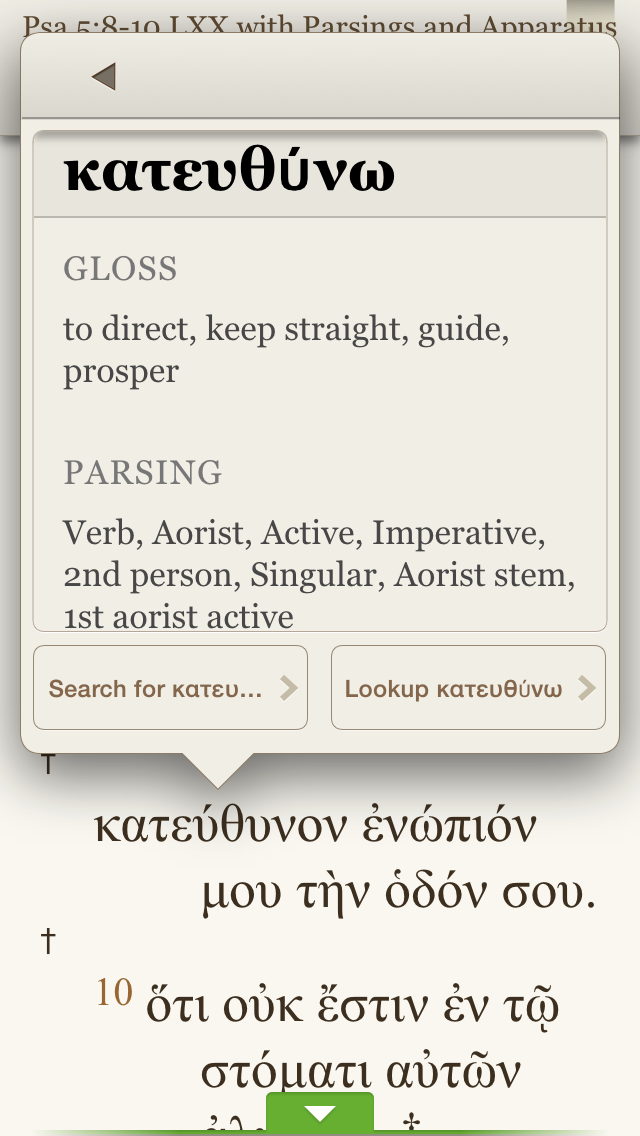
The advantage to having the above combo in Olive Tree is that you can tap any word in the Rahlfs-Hanhart Greek text and get instant parsing information.


Parsing


You can instantly access that word’s lexical entry in the LEH lexicon. I especially appreciate LEH’s inclusion of word frequency counts, according to sections of the LXX:


LEH Entry


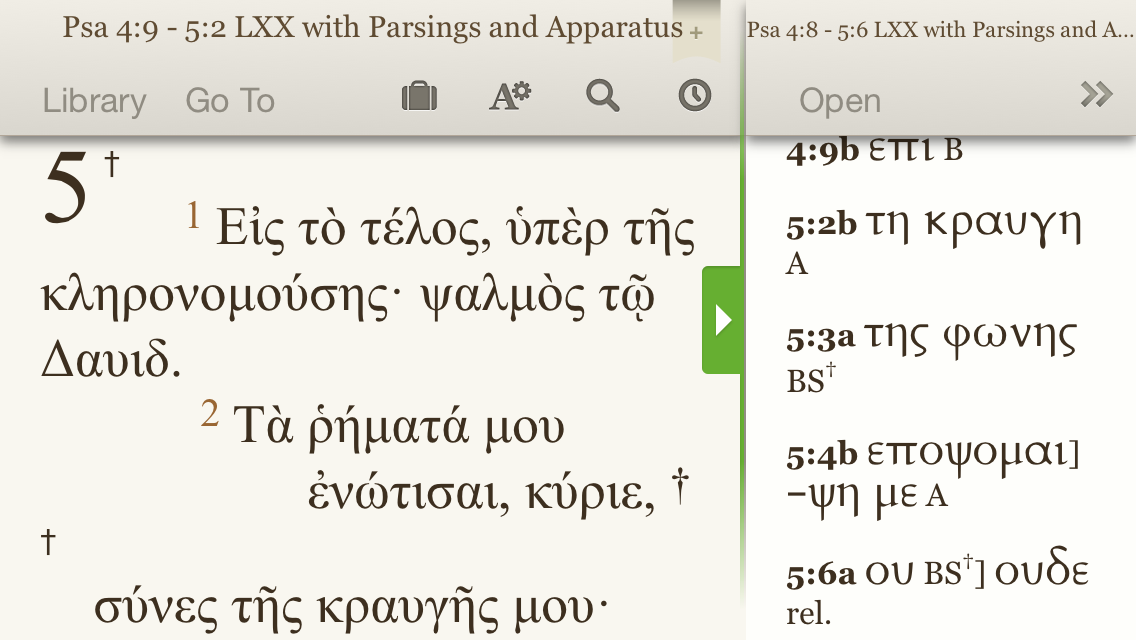
Using the split window setup, here’s what the Rahlfs text with apparatus looks like:


Rahlfs with Apparatus


Though Rahlfs never intended his apparatus in this volume to be fully critical, it does help you at least compare LXX readings as found in Vaticanus (B), Alexandrinus (A), and Sinaiticus (S).

And because Olive Tree is fully cross-platform, you can sync any notes you take or highlights you make and they appear on any device on which you have Olive Tree.

Find the whole bundle here, on sale for just a little while longer.

New Interpreter’s Dictionary of the Bible, $99 in Olive Tree

NIDB Olive TreeAn underrated but really good Bible dictionary is the New Interpreter’s Dictionary of the Bible (NIDB). Published by Abingdon, the five-volume set is edited by Katharine Doob Sakenfeld and includes contributions of nearly 1,000 scholars.

For a short time the dictionary set is $99.99 in Olive Tree Bible software. Below I offer–from my perspective as a preaching pastor and Bible reader–my take on the set, with a focus on Olive Tree’s iOS Bible Study App.


What The NIDB Is and How It Has Helped Me


There are more than 7,000 articles in NIDB. The contributing scholars are diverse in terms of gender, ethnicity, and denominational background–a refreshing mix of voices. The dictionary balances reverence for the biblical text with rigorous scholarship–though the dictionary is rarely arcane.

The NIDB has been eminently useful to me in my weekly sermon preparation. Last fall, for example, when preaching through Genesis, I knew I’d have to make sense somehow of the “subdue” command that God gives the first humans regarding their relationship to the earth. The dictionary’s “Image of God” entry helpfully clarifies:

While the verb may involve coercive activities in interhuman relationships (see Num. 32:22, 29), no enemies are in view here–and this is the only context in which the verb applies to nonhuman creatures.

The same article puts nicely the implications of humanity’s creation in God’s image: the “image of God entails a democratization of human beings–all human hierarchies are set aside.”

This sort of blend between technical detail and pastoral application is present throughout the dictionary.

I’ve also found useful background for my Greek reading. This year, for example, I’m reading through the Psalms in Greek with a group of folks (see here). In the “Septuagint” entry in NIDB I find this:

The 4th-cent. CE “Codex Vaticanus” contains all of the books of the Hebrew Scripture or Protestant OT, and the following material that is today classified as deuterocanonical: 1 Esdras, 2 Esdras, Ps 151, the Wisdom of Solomon, Ecclesiasticus or Ben Sirach, the additions to Esther (several of which were originally composed in a Semitic language; others of which are original Greek compositions), Judith, Tobit, Baruch, the Letter of Jeremiah, and the additions to Daniel (Azariah and the Three Jews, Susanna, and Bel and the Dragon).

The entry goes on to describe other Septuagint manuscripts, with hyperlinks in Olive Tree to related entries.


iOS Features in Olive Tree


Olive Tree logo


Olive Tree is as cross-platform as a Bible study app gets: it runs on iOS (iPhone and iPad), Mac, Windows, and Android. The app itself is free, and you can get some good texts free, too, so you can preview the app before you buy any resources in it.

I’ve got the Olive Tree app on Mac, iPhone, and iPad Mini. It’s one of the best-executed iOS Bible study apps I’ve seen. It is visually appealing, highly customizable (especially with gestures and swipes), and easy to learn.

When reading the New Interpreter’s Dictionary of the Bible (or anything else), here are a few features that have impressed me:

You can navigate with “flick scrolling” (how iBooks is set up) or “page scrolling” (like Kindle). This will make just about any user feel at home in the app. Flick scrolling (how you’d navigate a Web page) feels more natural to me, so I use that.

Dictionary entries are easy to get to. You can simply tap on “Go To” and type in the entry you’re looking for. The auto-complete feature saves having to type very much on the iPhone’s small keyboard:


NIDB Go To


You can search the entire contents of NIDB by word. If I wanted to see not just the entry for “Septuagint,” but every time the NIDB mentions the Septuagint, I would simply type that word in to the search entry bar:


NIDB Search


Then I can select a result and read the given entry.

The full-color photos are zoomable. The NIDB contains full-color photographs that help visualize various entries. You can select the photograph and pinch-zoom for more detail.


NIDB iPad


I’ve noted this before–there is a great deal of customizable “Gestures/Shortcuts” preferences in the “Advanced Settings” menu. Olive Tree is the most versatile Bible study app in this sense. For example:

  • Two-finger swipe left and right takes you through your history within the app. I can swipe between NIDB, and the last NIV Old Testament passage I was reading, and a commentary, and…. No need to go through menus.
  • Two-finger tap gets you from any screen to your library; right away you can get at your other resources.


Concluding Assessment and How to Buy


One of my favorite features of Olive Tree’s apps is that you can view two resources at once that aren’t tied together by Bible verse. It’s like having split windows on an iPad. So you can have the NIDB open in the top half of your screen, and a Bible text or other resource open in the bottom half–even to unrelated topics if you want.

The New Interpreter’s Dictionary of the Bible is about as good a Bible dictionary as you’ll find. If you can use it to complement the Anchor Bible Dictionary (also available in OT), you’d be very well set with Bible dictionaries.

Olive Tree has done a great job, especially with its iOS apps. As much as I loved my print copy of NIDB, I unloaded it not long ago since I can essentially carry it around with me now. And getting at its contents is even easier with the enhancements Olive Tree provides.


Thanks to Olive Tree for the NIDB for the purposes of this review, offered without any expectations as to the content of the review. You can find the product here, where it is currently on sale for $99.99.

Greek Psalms in a Year: Resources for Reading

LXX Psalm 1
LXX Psalm 1

Greek Psalms in a Year starts this coming Thursday. The two primary loci of activity (at least online) are the Facebook group and now a dedicated sub-section of the Accordance Forums. (Thanks, Accordance, for hosting!)

Follow along or contribute to either place for what is going to be a challenging and rewarding year-long activity.

Here is the reading plan, compiled by Russell Beatty.

In this post, I offer a sampling of resources–electronic and in print–that could be of help in reading through the Psalms in Greek. Do you know of anything not mentioned here? Please add it in the comments. You can also contact me with any questions or comments about the endeavor.


Greek LXX Texts: Electronic


Greek LXX Texts: Print

 
  • Rahlfs
  • Göttingen
  • Oxford University Press (out of print!): The Comparative Psalter (Hebrew MT, RSV, Rahlfs LXX, NETS) (Amazon)
  • Psalter Synopse (Hebrew, LXX, two German editions) (Amazon)
 

English Translations of LXX: Electronic


English Translations of LXX: Print


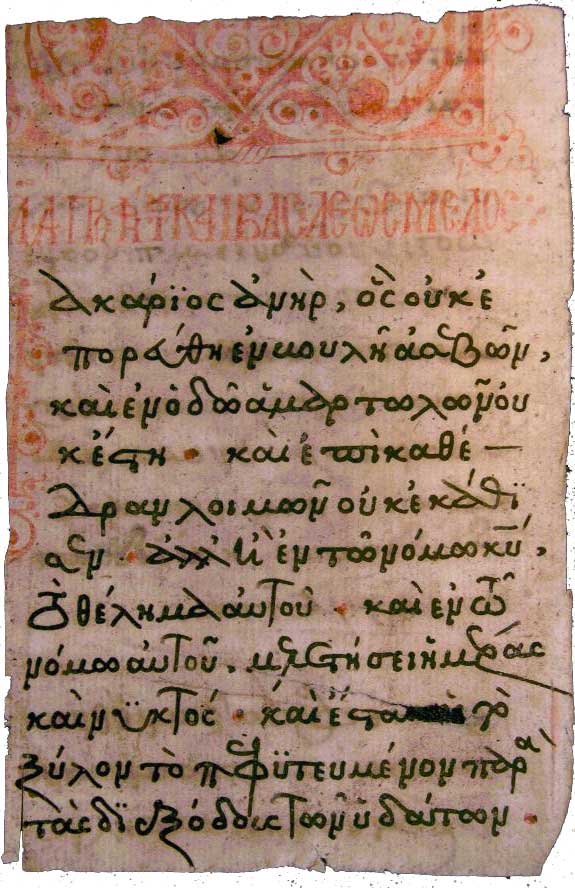
Images or Transcriptions of the Greek Text


Transmission/Reception of the Greek Text

 
  • Albert Pietersma’s article: “The Present State of the Critical Text of the Greek Psalter” (PDF)
 

Monographs and Collections of Essays

 
  • A Question of Methodology: Collected Essays on the Septuagint, by Albert Pietersma (Peeters)
  • The Old Greek Psalter: Studies in Honour of Albert Pietersma (The Library of Hebrew Bible/Old Testament Studies) (Amazon)
  • Psalms 38 and 145 of the Old Greek Version, by Randall X. Gauthier (Brill)
  • Emanuel Tov, The Greek and Hebrew Bible: Collected Essays on the Septuagint (Atlanta: Society of Biblical Literature, 1999) (Amazon)
 

Sermons and Devotionals on the Psalms


Septuagint Lexicons


Vocabulary Help


  • This. An amazing resource via Daniel Semler for Greek Psalms vocab acquisition, set up both for Anki and Mental Case

Happy reading!

F.F. Bruce’s Atlas for Young Readers

Bruce Bible History AtlasLast week we received a kindness in the mail from a new friend in Israel–F.F. Bruce’s Bible History Atlas.

My 7-year-old son, who had been looking forward to receiving it, came home from school and smiled widely when I had him open it.

He ran outside to share the good news with his younger siblings, who were running around with sticks and dressed up as a spaceman and ladybug, respectively. He was excited.

His first excited question to me when he came back into the house was, “Where is the battle page?” We have again been reading about the Maccabees recently in The Sacred Bridge (though, of course, I had to for now edit out the forced circumcision portion of that narrative!), so he was eager to find the Maccabees and Hasmonean era in Bruce’s atlas, which we were easily and quickly able to locate.

The atlas covers all of biblical history–both Testaments and everything in between.

The kind folks at Carta publish the Bruce atlas, as well as The Sacred Bridge. Their product page for Bible History Atlas (one of many fine atlases they offer) is here.

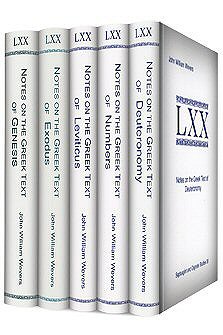
John William Wevers’s Notes on the Greek Text… Coming to Logos

Wevers Notes on Greek Text


The best (only?) complete set of books on the Greek Pentateuch is now up on Pre-Pub through Logos Bible Software: John William Wevers’s Notes on the Greek Text.

The Society of Biblical Literature’s book page has a helpful write-up of the Deuteronomy volume, which gives a sense of what this series is about:

Wevers [spent] most of his adult life studying the Septuagint, the last thirty years being devoted to the Pentateuch. The author considers the Greek text to be the first commentary on the Pentateuch ever written (in the third century B.C.E.) and not merely a collection for emendations of the Hebrew text. The work focuses on how the translator accomplished his task and on the vocabulary and syntax of the resulting text, rather than on either scholarly opinions on the text or how interpreters subsequently used the text. The Notes are intended for students who would like to use the Greek intelligently but are not specialists in Hellenistic Greek or LXX studies.

You can find the 5-volume set on pre-pub at Logos here. Wevers also wrote valuable LXX-Pentateuch text histories, which are available free online in .pdf form, detailed here.

Coming Soon: Greek Psalms in a Year

LXX Psalm 1
LXX Psalm 1

It’s funny–I was just thinking the other day about how much I missed Greek Isaiah in a Year. More than 200 of us read through the Septuagint text of Isaiah in a year, roughly five verses a day. Both the readings and the discussion were rich.

I didn’t do anything like that this past year, though the Greek Isaiah in a Year Facebook group I’d created stayed active, as folks went after it a second time.

Just this afternoon I learned that Russell Beatty, a member of the Greek Isaiah group, has started a Greek Psalms in a Year group, to launch January 1, 2015.

That group is on Facebook, and you can see the well laid out reading plan here.

I preached through some Psalms this past summer, which greatly deepened my love for that book of the Bible.

I can’t wait to get started–feel free to contact me or request to join the Facebook group if you’d like to read along with us.

Words on the Word Cited in Brill Book on Digital Humanities

You Google yourself about every three months, too, right?

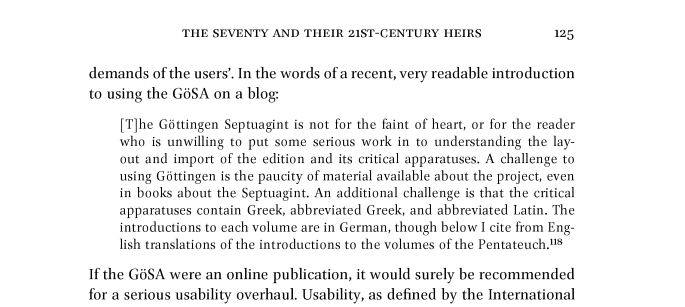
To my surprise, a few months ago I found that Words on the Word had been quoted in a Brill book about digital humanities in biblical studies. (Apparently “digital humanities” is an academic field in which this blog participates.)

Here is one of the citations:

WotW in Brill


Brill Digital HumanitiesThe book is called Digital Humanities in Biblical, Early Jewish and Early Christian Studies, edited by Claire Clivaz, Andrew Gregory, and David Hamidović. Words on the Word makes its appearance in the chapter called “The Seventy and Their 21st-Century Heirs. The Prospects for Digital Septuagint Research.”

The footnote in the image above cites this primer I wrote on the Göttingen Septuagint; part 2 of the primer also receives mention.

Here is the publisher’s description of the book:

Ancient texts, once written by hand on parchment and papyrus, are now increasingly discoverable online in newly digitized editions, and their readers now work online as well as in traditional libraries. So what does this mean for how scholars may now engage with these texts, and for how the disciplines of biblical, Jewish and Christian studies might develop? These are the questions that contributors to this volume address. Subjects discussed include textual criticism, palaeography, philology, the nature of ancient monotheism, and how new tools and resources such as blogs, wikis, databases and digital publications may transform the ways in which contemporary scholars engage with historical sources. Contributors attest to the emergence of a conscious recognition of something new in the way that we may now study ancient writings, and the possibilities that this new awareness raises.

You can find the book at Brill here and here at Amazon. Looks fun! But, of course, now I’m biased.

NIV Application Commentaries, As Low as $4.27 Each

NIVAC sale


Zondervan’s NIV Application Commentary series is on sale, with each of the ebooks selling at $4.99–or less on Amazon.

I really liked Psalms vol. 1 in this series. There are a lot of really good volumes in NIVAC; I just picked up Genesis (now that I’m almost done preaching through it this fall-ha!), Peter Enns’s Exodus, and a few others.

All the Table of Contents now are hyperlinked, so navigating via Kindle or iBooks should be relatively manageable. You won’t get the same sort of search power you’d get in Accordance or Logos, but the price is tough to beat.

See everything here on Amazon or here at Zondervan’s page.