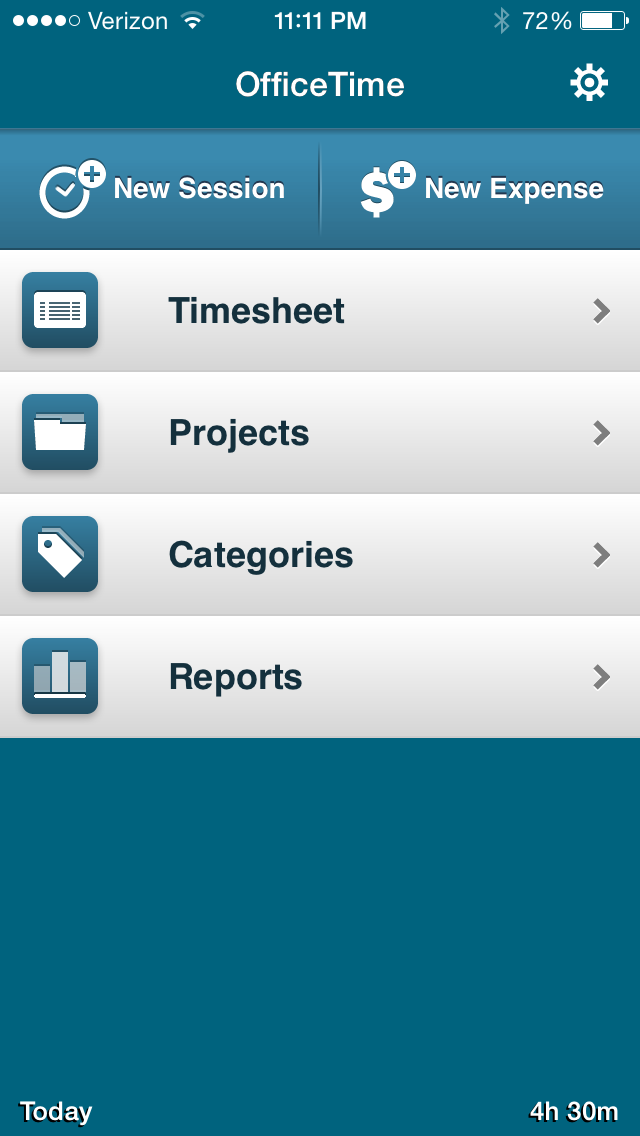
The best iPhone time tracker I’ve seen is OfficeTime. It is simple, fast, effective, and easy to get in and out of quickly to start tracking time and get right back to work.
You can set up your Projects and Categories (I use these as two levels of task grouping), and tap on each to see how much time you’ve spent in a certain part of your work. I don’t use the Expenses feature of the app, but if you were a sub-contracting consultant keeping track of work for multiple clients, OfficeTime would be immensely helpful in tracking billing.
Pulling up a new time/task entry is easy:
“Notes” allows you to write more details about what task you’re working on.
Not only can you look at all your time entries in a week by Project and Category, but you can see (as below) a virtual Timesheet of your week.
The iPhone app can sync automatically to the desktop version of OfficeTime, though you have to actually be on the same wireless network to do it. Similarly, the iPad app can sync to a computer (and vice versa), but the data cannot sync automatically between iPad and iPhone apps. That is one of the few drawbacks I’ve found in OfficeTime.
I’ll post more in a future review about the desktop app, and also report back on exporting features.
The lack of a full-bodied sync option hasn’t really stopped me, though, since I can keep all the data on my phone and then sync with my work computer when I’m in the office.
OfficeTime has a free Mac trial version, and a free iOS version to try here. The paid iOS version is $7.99 and works on both iPhone and iPad.
If you are the time tracking sort, and want a full-bodied way to keep track on the go, OfficeTime officially rates the Words on the Word title of AppTastic.
Thanks to the makers of OfficeTime for giving me a download for the review. Check out the app’s iOS page here. See my other AppTastic Tuesday reviews here.
One good monograph to read on the Septuagint is First Bible of the Church. And if you want to get in-depth with the critical edition of the LXX, I have offered reviews of the Göttingen Septuagint in Logos and Accordance softwares. And, perhaps as important, I suggest how one might actually make sense of that critical edition, noted here and here, with an ever-elusive third part of the primer still to come.
I have very recently reviewed the Genesis volume of the Göttingen Septuagint, found here.
Happy LXX Day!
(The above is a slightly modified re-post of my 2014 Happy LXX Day post.)
Don’t spend too much time checking out new productivity apps (hint: that’s an easy time drain to rationalize away), but if you’re looking for a calendar app, a to-do app, or even a couple good desktop clients for blogging, there are some good options for iOS and OSX on sale right now.
The iOS sale includes Calendars 5, Fantastical 2 (my new go-to calendar app), Workflow, Duet Display (lets you use your iPad as another screen for your computer), and a handful more. You can find them all here.
The Mac App Store sale includes Blogo and Desk, two sleek apps that let you post to your blog from a desktop client. Both are half off, and you can see the rest by going to the “Featured” section of your App Store computer app.
Today they’ve announced that there is a free demo version of Accordance 11 available. I can’t recommend their software highly enough. See my full review of Accordance 11 if you want to learn more, or just go here to check out the free demo and see what you think.
This post has gone too far in trying to convince people to override their objections to spend more:
2. I already have enough books.
Even if you think you’ll never read through everything in your library, adding more books will make it more powerful and increase the value of the books you already own.
In other words, “If you buy more books to search, you’ll have more books to search.”
Dear friends at Logos, do we not already succumb enough to an insufficiency mentality in the world? I don’t have enough. I need to have more. My Bible study and teaching prep is good, but if I just had that one more commentary series, life would be awesome!
I’m as guilty of this mentality as anyone (probably more so)–and I want to fight it. Bible software marketing copy that taps into the culturally-rooted materialism that Christians are supposed to stand against? Not okay.
One other “reason” gave me pause:
4. I can’t afford a new base package.
If a base package isn’t in your budget right now, you have a couple of options.
You can take advantage of interest-free payment plans and spread out the cost over up to 24 months. That means you only pay a fraction up front, pay for the rest over time, and start using your new software right away.
Let me help with the rewrite:
If a base package isn’t in your budget right now, you have one option: don’t buy one right now.
“Our mission is to serve the church,” you say. How does enabling and even encouraging churchgoers and pastors to take on new debt serve the church?
I think it’s time for some serious evaluation of the sort of marketing mantras that (however unintentionally) undermine Kingdom values of sufficiency and wise financial stewardship and promote instead the harmful values of incessant accumulation and overspending.
Saying, “What I have is enough,” and curbing credit-card-style overspending are actually two excellent reasons not to upgrade to Logos 6.
UPDATE: The “6 Reasons” email I received from Logos had no author’s name on it. I didn’t see an author’s name on the blog version of the post, either, until just before this post was about to go live. I direct my critique, though, to Logos as a whole, since the individual post is emblematic of Logos’s marketing approach in general.
Sure, there’s a chance that over-reliance on a monetized chore chart can have negative effects on children. But we parents also want to teach our kids about the importance of work, responsibility, and the basics of financial management.
There’s still not an iPhone app for making you a better parent. In fact, probably less time on apps in general makes better parents. However, a number of us moms and dads already spend time each day managing tasks, finances, and other activities on a phone… so why not a chore chart?
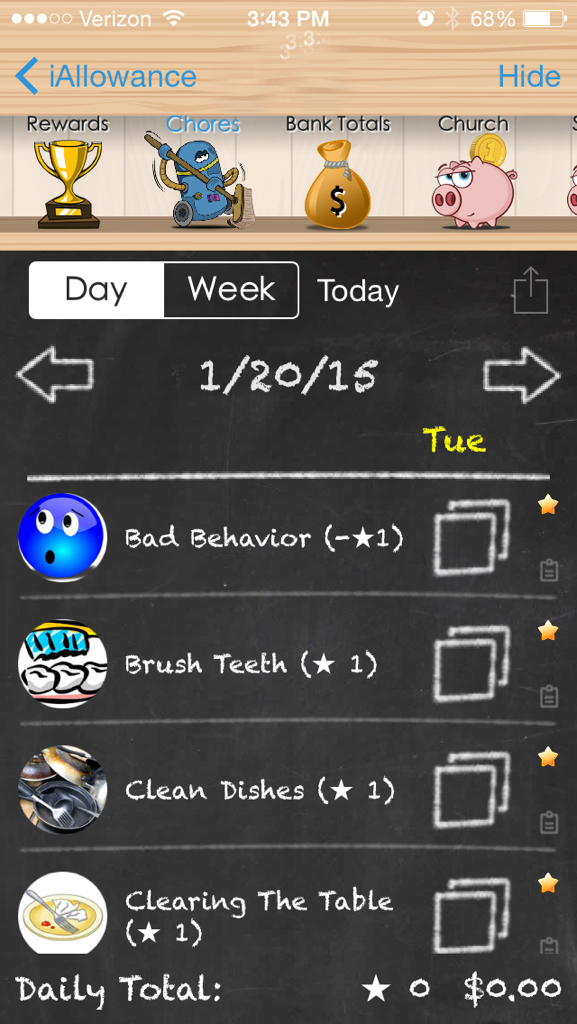
Those are my sweet kids (names blurred out–you see their names on the app).
They’ve got their own corner of the app where we track their stars (earned or docked for behavior) and money (allowance, and stars converted to money).
The app has a bunch of pre-set chores you can select to track for each kid–at a frequency of your choosing.
(The spotting by the time is not from the app–that’s where the child’s name goes)
And you can add your own. (We added, “Make the bus on time”–everyone gets a star when that happens!)
You can set how many stars equate to a monetary amount, and then have the app make the transfer for you. We were paying our kids 10 cents a star, but we were doling out a lot of money! So we changed it to 5 cents a star.
You can also set up different accounts for each child. We have one for Church, one for Savings, and one for Spending. The Totals screen shows you all that, as well as Stars and Time (one of the few features I haven’t used in the app):
iAllowance is a really a great (and fun) app. It syncs via Dropbox or iCloud with an iPad. As a universal app, if you buy it, you can use it (and sync it) on any iOS device.
The kids love it, too. It’s been an effective motivator, and really fun for them to tap their stars at the end of the day–or tap on “Bad Behavior” and see a frowny face. 😦
Any time you tap next to a chore (which you can do in the Day view or Week view) you get an accompanying sound effect, too. And the allowance deposits happen automatically, in the amounts and to the accounts that you specify.
The app runs smoothly, and the developer is one of the most responsive (if not the most responsive) developers I’ve ever been in touch with.
I can’t say whether a incentive-based program will work for you and–if it will–whether you should run it from a mobile device. But I can say that both the overall setup of stars and allowance, as well as this particular app, have really helped perk up some listening ears around here!
Now… I’ve got to go give myself a star for posting another Apptastic Tuesday review, Blizzard 2015 notwithstanding.
Thanks to the developer of iAllowance for giving me a download for the review. Check out the app’s site here. You can find the full (paid) version here, and try the free version here.
Last week on AppTastic Tuesday: Rules! This week: Captio.
The goal of Captio is a simple one: to very quickly pull up a screen into which you can type text or stick a photograph, and then email it to yourself.
It works in iPhone in both portrait and landscape mode. Here’s the New Note screen, which lets you (a) enter text, (b) select a photo from your phone, or (c) take a new photo:
You might quickly pull up Captio to jot down a reminder or bit of information you want to access later. Then you tap Send, and your text or image is sent to your email address.
You can adjust some settings–for example, have a prefix of “Captio” or “Remember” or anything else in the subject of the email that Captio sends:
And, what is best, you can send it to any email address. This is especially helpful if you have a to-do system (like Evernote or OmniFocus) that allows you to email items directly into those apps.
This is where I’ve found Captio most useful. It can take Evernote and (especially) OmniFocus a few seconds to load and sync–Captio, by contrast, gives you a text entry screen as soon as you tap it.
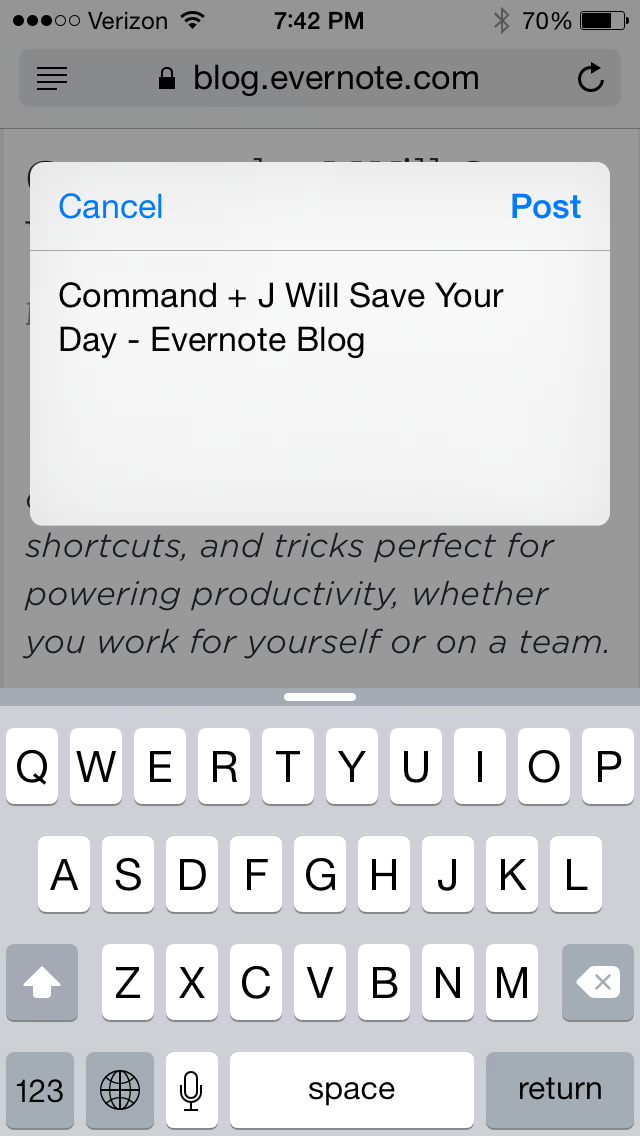
Captio is also available within other apps via the Share Extensions:
I’ve not personally seen a need to use the Share Extension–it works great, but if I’m saving a Web article to read later, I’ll just use the Evernote Share Extension anyway. Or the OmniFocus Share Extension to create a task from a photo. But for folks who primarily rely on email to keep reminders (not a good idea, but a widespread practice), Captio can help from just about anywhere on your phone or iPad.
Captio also stores all the notes you send, right on your device, so you can use it with or without Internet/data connections.
And, though all the shots above are from an iPhone, Captio is a universal app. So for $1.99 (at the time of this post), you can use it on both iPhone and iPad.
Thanks to the makers of Captio for giving me a download for the review. Check out the app’s site here.
Having recently re-watched the fourth season of the best television show in history, I need now to amend my assessment two years ago that the Göttingen Septuagint is the Cadillac of Septuagint editions. It’s the Lexus of the LXX.
The Göttingen Septuagint
Vandenhoeck & Ruprecht in Göttingen, Germany publishes the Göttingen Septuagint, more formally known as Septuaginta: Vetus Testamentum Graecum Auctoritate Academiae Scientiarum Gottingensis editum.
The series of critical texts with apparatus spans more than 20 volumes and covers some 40 biblical books (counting the minor prophets as 12), with more continuing to appear.
But, as I remarked two years ago when I confused Cadillacs and Lexuses, the Göttingen Septuagint is not for the faint of heart, or for the reader who is unwilling to put some serious work in to understanding the layout of the edition and its critical apparatuses.
The Contributions of John William Wevers
Enter John William Wevers. If Göttingen is the Lexus of LXX editions, Wevers is its chief mechanic. His Notes on the Greek texts of the Pentateuch–though provisional in nature, Wevers intimated–remain some of the best resources for carefully studying the Septuagint. And his Text Histories on those same books (now free online, thanks to the Göttingen Septuaginta-Unternehmen) guide the reader through the transmission of the Greek text in its various manuscripts.
Better yet, before his passing Wevers translated much of his own Göttingen-Pentateuch introductions from German into English. That enduring gift can be found here.
Göttingen-Genesis
Published in 1974, Wevers’s Genesis includes a 70+-page introduction, Wevers’s reconstructed Greek text of Genesis, and two critical apparatuses at the bottom of each page that highlight readings from various manuscripts.
The introduction includes these sections:
The Textual Witnesses (Greek and other versions)
The Text History (“Here only information necessary for the use of this edition is given”)
Re: This Edition
Signs and Abbreviations
A challenge to using the Genesis volume is the scarcity of material available about the Göttingen project in general. Further, the introduction is in German and the critical apparatuses contain Greek, abbreviated Greek, and abbreviated Latin. A few things come in handy:
As for deciphering the apparatus and abbreviations, Wevers offers such a key in the introduction, and the print edition comes with a handy insert (in German and Latin, but not unusable to those without command of those languages)
Miles Van Pelt has made available his own two-page summary of sigla and abbreviations (here as PDF).
Seeing the need, I wrote a two-part primer (here and here, two of my most-visited posts on this blog) to reading and understanding the Göttingen Septuagint–the focus was largely on Genesis, and I draw on those posts for what follows
So equipped, the reader (whether she or he knows German or not) is ready to work through the Greek text itself.
Tour of a Page
Instead of using a text based on an actual manuscript (as BHS, based on the Leningrad Codex, does), the Göttingen Septuagint utilizes a reconstructed text based on a thorough examination of evidence from manuscripts and translations.
Because it is an editio maior and not an editio minor like Rahlfs, any page can have just a few lines of actual biblical text, with the rest being taken up by the apparatuses. Here’s a sample page from Genesis 1 (image used by permission).
Note the #s 1-4 that I’ve added to highlight the different parts of a page.
Page reproduction by permission of publisher (annotations are mine)
1. The reconstructed Greek critical text (“Der kritische Text”)
With verse references in both the margin and in the body of the text, the top portion of each page of the Göttingen Septuagint is the editorially reconstructed text of each biblical book. In the page from Genesis 1 above, you’ll notice that the text includes punctuation, accents, and breathing marks.
Regarding the critical text itself, Wevers writes in the Genesis introduction:
Since it must be presupposed that this text will be standard for a long time, the stance taken by the editor over against the critical text was intentionally conservative. In general conjectures were avoided, even though it might be expected that future recognition would possibly confirm such conjectures.
2. The Source List (“Kopfleiste”)
The Kopfleiste comes just below the text and above the apparatuses in Genesis. Wevers notes it as a list of all manuscripts and versions used, listed in the order that they appear in the apparatus on that page. A fragmentary textual witness is enclosed in parenthesis.
3. and 4. Critical Apparatuses (“Apparat I” and “Apparat II”)
The critical apparatuses are where the user of Göttingen can see other readings as they compare with the critically reconstructed text. Because the Göttingen editions are critical/eclectic texts, no single manuscript will match the text of the Göttingen Septuagint.
The first critical apparatus will be familiar in its aims to readers of BHS. Regarding the second apparatus, Wevers writes:
In view of the fact that the materials presented in the second apparatus [are] not at least in theory a collection of variants within the LXX tradition, but rather one such of readings from other traditions, especially from the “three”, which have influenced the LXX tradition, these readings are given in full.
“The three,” sometimes referred to in Greek as οι γ’, are the texts of Aquila, Symmachus and Theodotion.
In other words–there is virtually no stone unturned here in the quest to reconstruct a Greek text of Genesis.
Concluding Evaluation
Serious work in Septuagint studies uses the Göttingen text, where available, as a base. Wevers’s scholarship and care for the text is clear as one makes her or his way through the Genesis volume. It’s the starting place for studying the Greek text of Genesis.
Vandenhoeck & Ruprecht’s production of the book is stellar, too. It’s got a sewn binding and is beautifully constructed–built to last and look good on the shelf, or in your hands:
You can find the volume here at V & R’s site, and here at Amazon. ISD distributes the book, as well, and carries it here.
Many thanks to V & R for the review copy of this fine work, given to me with no expectation as to the content of my review. Find more V & R blog posts here.
Today begins what will be a mainstay of Words on the Word in 2015: AppTastic Tuesdays. First up: the iOS app Rules!
Rules! is part zone-out tapping, part memory-training app. The gameplay itself is fast-paced, fun, easy, and aesthetically pleasing. Watch this short trailer to get caught up:
The actual tapping of icons is easy–the game is quite touch-responsive and fast. And the rules are clear enough:
When you complete what rule 1 calls for, you move up to rule 2. Having completed rule 2 on the screen, you then apply rule 1 to the remaining icons. There are 100 levels of rules, though I have barely made it past 15.
When the game introduces a new rule, you get a screen like this:
But then after completing rule 13, it tells you simply, “Now follow rule 12,” “Now follow rule 11,” “Now follow rule 9,” and so on.
So it’s more than about the gameplay itself–you’ve got to memorize the rules as you go; you’ve got to know them by number.
This makes it a less-than-ideal zone-out game. Threes is by no means boring but mindless enough that you can come home to it at the end of a long day. Rules! is not so. It demands more of your mind.
You will probably find yourself, as I did, using some mnemonic device to remember 8-10 rules at once, so you can perform the appropriate actions on the screen in front of you.
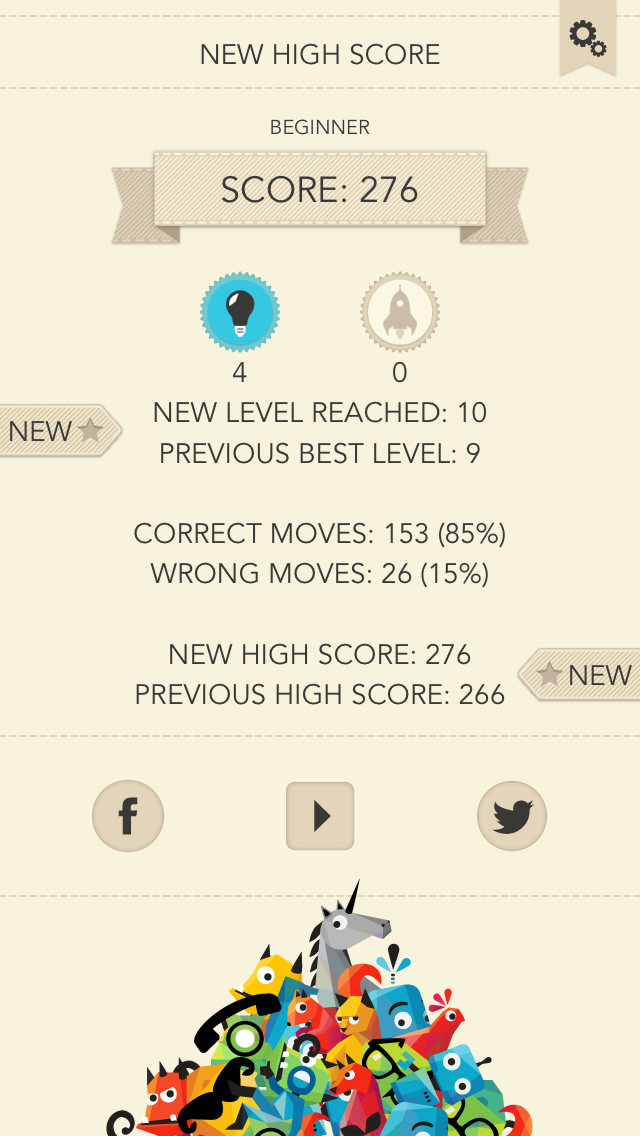
There are three game modes: Beginner, Expert, Timeless (i.e., no countdown clock). The scoring rewards you for speed and accuracy:
The need to memorize a host of rules in order to do well caused me to lose interest more quickly with Rules! than I have with other iOS games.
But Rules! especially excels in two areas: (1) its accompanying music is pretty, well-written, and good for focusing, and (2) its layout and design is gorgeous. Even the fail screen looks good:
So, for $1.99 in the App Store, if you’re up for a mental challenge with good music and beautiful design, check it out and see if you can–as one player on Twitter recently did–get through all 100 levels.
Thanks to the makers of Rules! for giving me a download for the review. Check out the app’s site here.
Want to read the Old Testament in Greek on all your devices? This is the cheapest way I’ve seen to get started: until midnight PST tomorrow (1/6/15) night, you can get this Septuagint bundle for less than $50. It includes
The Rahlfs-Hanhart Septuagint text
Its critical apparatus
The Kraft-Wheeler-Taylor parsings of each word in the text
The LEH Greek-English Lexicon of the Septuagint (Lust, Eynikel, and Hauspie)
This is really an incredible deal, given that the Rahlfs-Hanhart text in print is about $50 (and doesn’t include running parsings). The LEH Lexicon in print runs anywhere from $40 to $80.
What can Olive Tree do, you ask? See my gathered posts here, including my recent review of a five-volume dictionary set that is still on sale.
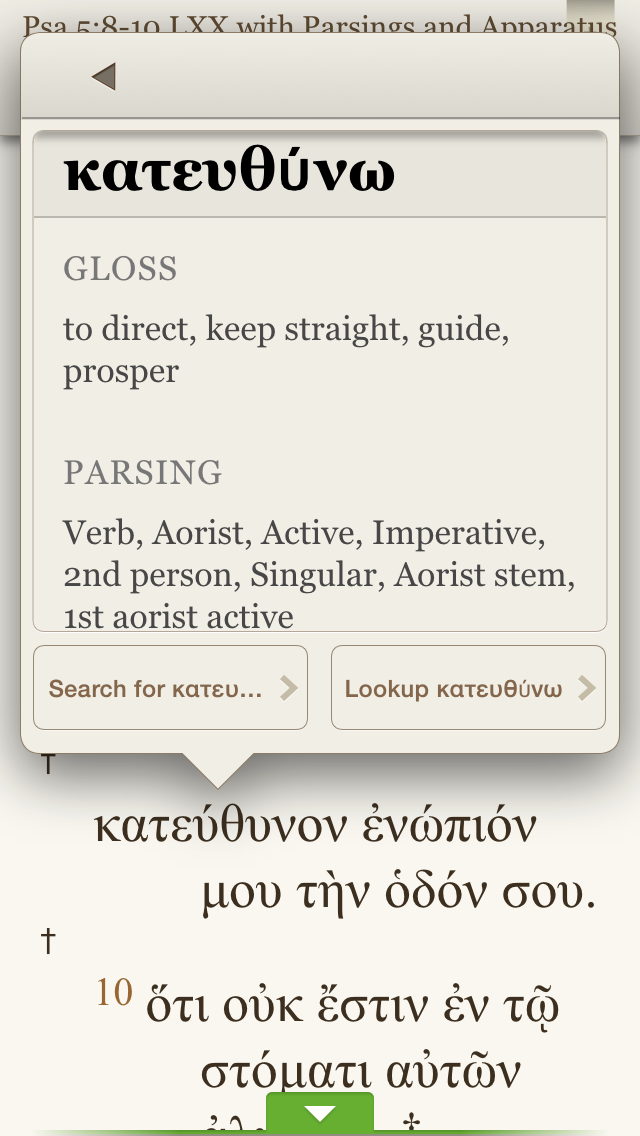
The advantage to having the above combo in Olive Tree is that you can tap any word in the Rahlfs-Hanhart Greek text and get instant parsing information.
You can instantly access that word’s lexical entry in the LEH lexicon. I especially appreciate LEH’s inclusion of word frequency counts, according to sections of the LXX:
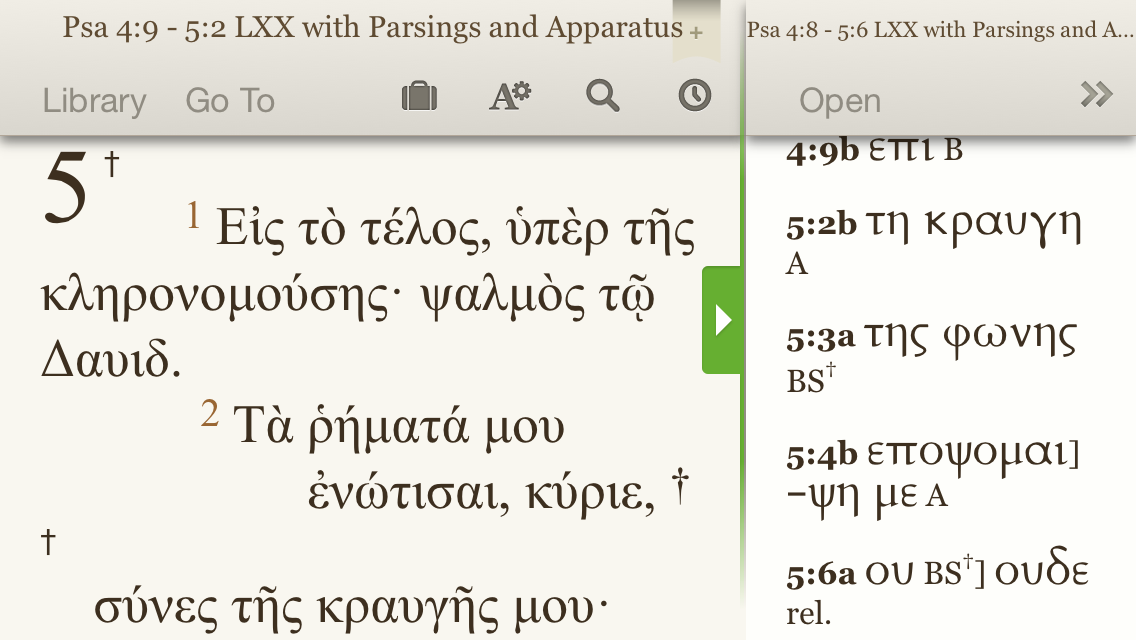
Using the split window setup, here’s what the Rahlfs text with apparatus looks like:
Though Rahlfs never intended his apparatus in this volume to be fully critical, it does help you at least compare LXX readings as found in Vaticanus (B), Alexandrinus (A), and Sinaiticus (S).
And because Olive Tree is fully cross-platform, you can sync any notes you take or highlights you make and they appear on any device on which you have Olive Tree.
Find the whole bundle here, on sale for just a little while longer.



















 Words on the Word