I’ve written a good deal about Paul since starting this blog last summer. I have been particularly fascinated by his use of the Old Testament, an interest that really grew through a great class I took last fall: Use of the Old Testament in the New, taught by Dr. Roy E. Ciampa.
Lars Kierspel has contributed a volume on Paul to the Kregel Charts of the Bibleseries. (I reviewed Hebrews in that series here.) “Given the nature of the apostle’s life and letters,” Kierspel writes, “This book is not for the lazy reader.” The charts, even though they are perhaps easier to grasp visually than prose text, “demand every ounce of intellectual and creative energy to avoid consuming them as biographical and theological fragments.”
As with the Hebrews volume, the charts in Paul are of varying lengths. Some are a single page (#42, “Formal Structural Components of Paul’s Letters”) while others are several pages long (#54, “Key Words in Romans” and #71, “Similarities between the Pastoral Epistles”). All contain additional information in the “Chart Comments” section at the back of the book, which is more than 40 pages. (It’s this section that helps the charts pack a much more powerful punch than one might expect.)
The book has four parts:
A. Paul’s Background and Context
B. Paul’s Life and Ministry
C. Paul’s Letters
D. Paul’s Theological Concepts
The book begins well with a chart on “Roman Emperors Before and During Paul’s Life and Ministry.” The comments section notes, “While Paul might not have seen any of the Roman emperors in person, the chart shows that their decisions and ideas impacted the apostle’s ministry both positively and negatively.” His chart #7 on “First-Century Judaisms: Different Groups” rightly suggests that during Paul’s time, there was not one monolithic Judaism, but rather multiple Judaisms, though they did share “common characteristics” (chart #8) like monotheism, circumcision, etc.
Kierspel gives at least a “Snapshot” chart for every one of Paul’s letters. This makes it a great reference for preachers going through a book of Paul’s, as I recently did with Galatians. Chart #77 has a list of “Key Texts and Their Interpretations” (which is really not a chart so much as it is prose text) that surveys all of Paul’s letters in three pages. When preaching on the fruit of the Spirit recently, I found Kierspel’s “Vices” and “Virtues” charts (which used both English and Greek) to be particularly helpful.
The author is balanced in addressing disputed issues in Paul, such as authorship of various letters, or Paul’s view on women in ministry. So his chart #19 (“Paul’s Coworkers”) and #104 (“Women: Equal and Subordinate to Men”) and #105 (“Women in Ministry”) highlight various viewpoints and where the reader can go to research more. The 32-page bibliography at the back of the book is impressive, though there are (probably inevitably) some omissions (Stendahl, for example).
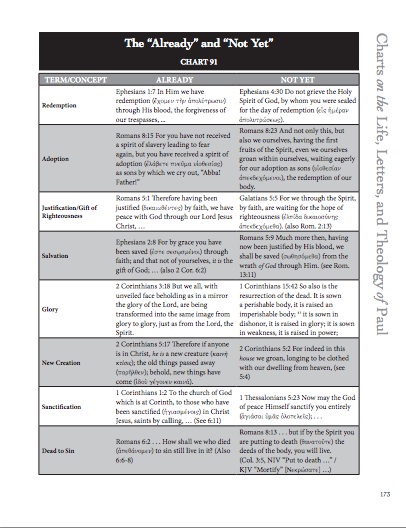
Here’s a sample chart:
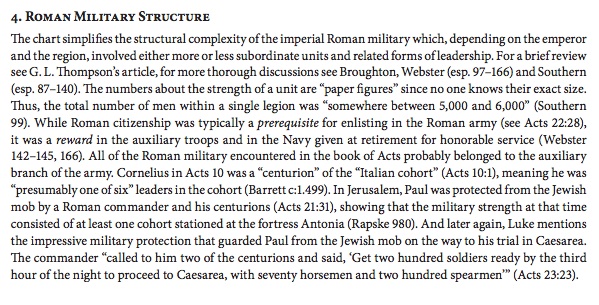
And here is a comments section, from the back of the book:
As with the Hebrews charts book, there is no accompanying CD-ROM or digital content. This felt like a missing piece. For a teacher to make use of a chart in class, she or he would have to copy from the book or scan it in to project on a screen. It ought not to be too difficult for future printings/editions to come so equipped. A professor could circumvent this issue and just require the whole book for each student in a given course, which would make sense for an introductory course on Paul.
There were a few formatting errors sprinkled throughout the book. Also, for a “charts” book, it’s pretty text-heavy. But I didn’t find that made it any less valuable a reference for me.
One would benefit by reading the charts book straight through, as it serves as a good introductory overview to Paul’s ministry, writings, and theology. But it also serves well (and perhaps better) as a reference tool that students, pastors, and professors all will appreciate having. Kierspel makes information and insight on Paul easy to access and digest. This one is now on my short list of initial references for study of Paul.
Kregel sent me a copy of the book for review. Its product page is here, and it’s on Amazon here. The Table of Contents (which lists all the included charts) is here (pdf); read an excerpt here (pdf).
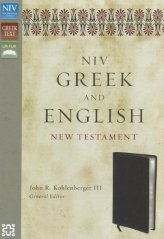
Zondervan continues to publish great resources for learning and using Biblical Greek and Hebrew. I reviewed their Greek and Hebrew Reader’s Bible here. Now they have published a “diglot,” a Bible with two languages side-by-side, on facing pages, for the New Testament.
This is also known as a “parallel Bible,” so that the reader can easily see both the Greek and English side-by-side. It’s not an interlinear Bible, though (English interspersed line-by-line with Greek), so you can easily just read all English or all Greek any time you want to. Both the Greek and English section headings are the same (in English), which makes it easy to stay on track when reading through. Each page is single column format.
The Greek text is not the scholarly NA27 or NA28 critical edition. Rather, it is the Greek text that the NIV translators agreed on as the textual basis for translation. The few times (and there aren’t a ton of instances) when this Greek text differs from the NA27, footnotes provide additional information.
Greek font preference can be subjective, but I find this one pleasing and easy to read:
The italics are for an Old Testament quotation.
The leather/Italian Duo-Tone version has a single ribbon for marking one’s place. Its feel is pleasant and flexible, yet durable. It’s a well-made Bible.
I wondered when reading whether not having the critical Nestle-Aland Greek in front of me would be a problem, but (a) the differences are minor and (b) if one’s goal is just to read Greek (not do textual criticism), whether or not one has Nestle-Aland is not hugely important. Besides that, there are possibly places where the NIV translators have made a better textual choice than the NA folks! (We’ll find out when we get to see all the original “autographs” in heaven, I suppose.)
There is also a 146-page Greek to English dictionary included at the back (Mounce Concise) which has word frequency information, a short gloss/definition, and verse references where words are used. It’s basic, but a good dictionary, especially for quick look-ups when doing daily reading.
One advantage to this diglot over other diglots (RSV and NET versions) is that the Greek is always on the left-hand page and the English is always on the right-hand page. In these other two diglots (perhaps for ease of printing?) it changes every two pages, so that this left-hand page is Greek, this other left-hand page is English. It’s a small thing, but it makes it easier to use.
As for the English version employed, this is the 2011 NIV, the update to both the 1984 NIV (New International Version) and the 2001/2005 TNIV (Today’s New International Version). Much ink (and many bytes) have been spilled over the differences between these three and the controversy surrounding the TNIV. (Much ado about not-much, in my opinion.) The TNIV opted to be more gender-inclusive than the 1984 NIV in how it translated masculine Greek words, so “brothers” would be “brothers and sisters.” If Paul clearly has men and women in view (he often does), “brothers and sisters” is the best way to translate the masculine Greek noun. But this gender inclusivity (I prefer “gender accuracy”) displeased some, and so now the TNIV is off the shelf (as is the old NIV) with the NIV (2011) in its stead.
The 2011 NIV seems to either lean more toward the TNIV or to split the difference on gender. For example, take Galatians 1:11 in the three versions:
NIV (1984): “I want you to know, brothers, that the gospel I preached is not something that man made up.”
TNIV: “I want you to know, brothers and sisters, that the gospel I preached is not of human origin.”
NIV (2011): “I want you to know, brothers and sisters, that the gospel I preached is not of human origin.”
Here are Galatians 1:1-2. Note how the new NIV matches neither of its predecessors.
NIV (1984): “Paul, an apostle—sent not from men nor by man, but by Jesus Christ and God the Father, who raised him from the dead—and all the brothers with me….”
TNIV: “Paul, an apostle—sent not with a human commission nor by human authority, but by Jesus Christ and God the Father, who raised him from the dead—and all the brothers and sisters with me….”
NIV (2011): “Paul, an apostle—sent not from men nor by a man, but by Jesus Christ and God the Father, who raised him from the dead—and all the brothers and sisters with me….”
Rodney Decker has a thorough (and I mean thorough) review of the new NIV here.
Although I never had the pleasure of seeing a TNIV-Greek diglot (I don’t think Zondervan published one?), this one is the next best thing. Especially for preachers and students and Greek-learners who want to stay close to the NIV, this diglot is yet another great language resource from Zondervan.
Thanks to Zondervan for the review copy. See a sample file here (pdf). You can find purchasing information about the book at Amazon or at its Zondervan product page.
[M]y mother still asks what I do for a living, and my father knows but still gets tripped up on the final syllable of Sep-tu-a-gint.
This is not an academic introduction, but what Law has elsewhere called a “narrative history” of the origins, understandings, and uses of the Septuagint. He has in mind as his audience “those who are interested in the history of the Bible and in its use in the early centuries of the Christian Church but who may never have considered the Septuagint’s role in that story.” Further, he writes, “[W]e who call ourselves specialists in this field have not communicated very well to those outside of our societies.”
Law’s prose promises to connect with his audience. It’s accessible, engaging, and generally easy to read.
Chapter 7 picks up just after Law has examined some of the “textual artifacts” in the Septuagint that “were otherwise lost once the Hebrew Bible was formed and all variety extinguished” (like Esdras, Sirach, Maccabees, etc.). The Septuagint text(s) had been “produced in a period of textual plurality,” the close of which period Law now addresses.
Chapter 7, “E Pluribus Unum”
Law looks at the kaige recensions (revisions) found in the Greek Minor Prophets Scroll among the Dead Sea Scrolls:
To put it simply, these revisers were part of a process lasting several centuries through which some Jewish scribes were working to modify the oldest Greek translations so that they would conform to the tradition behind the Hebrew Bible.
At long last, he continues,
The many textual streams that were flowing dynamically during the third and second centuries BCE, delivering a variety of biblical forms, were soon damned up [AKJ: I think “dammed” is intended here] in favor of a unified current that would propose to carry forward a single, authoritative text into the Common Era.
The collection of books deemed “scripture” came to be called the canon. And while Law acknowledges that popular support was needed to constitute the canon, ultimately ecclesial leadership exerted significant influence over which books were finally included. Law understands canonization, then, as (among other things) “a mechanism used by authorities to define the boundaries of their groups, to determine who is in and who is out, partly by declaring which writings are in and which are out.”
Chapter 8, “The Septuagint Behind the New Testament”
In chapter 1 (“Why This Book?”) Law had said that the New Testament quotes the Old “almost entirely from the Greek.” In chapter 8 (and especially chapter 9) he further unpacks that claim. When Bible readers look up an OT quotation they have seen in the NT, and the OT verse differs, this is due “in many cases” to the fact that English Old Testaments or Spanish ones translate the Hebrew Bible, whereas the New Testament writers use “almost exclusively the Greek Septuagint.” In other words, they are quoting using a different text base than our Old Testaments use.
Score a point for Law in terms of reaching out beyond the Academy. What churchgoer hasn’t asked this question? When a New Testament writer says, “It is written…” only to lead you to an Old Testament passage where it isn’t exactlywritten in that way, it can cause confusion. Law’s explanation of this dynamic is clear and concise. In chapter 9 (which exceeds the scope of this review) he will give specific examples–all without using Hebrew or Greek!
Law notes that if canonization was not complete by the time of the writing of the New Testament (not all agree with him here), then we should expect the New Testament writers to use a variety of text forms. Indeed, to speak of the or a Septuagint is a misnomer: “[W]hile we can say the new Testament writers overwhelmingly used the ‘Septuagint,’ we must admit that the Septuagint itself was not a singular entity.” (See Göttingen.)
“How did the New Testament writers encounter the scriptures?” Law asks. Only the wealthy elite owned anything written, so interaction with the Scriptures “would have been through hearing them read aloud.” And this was in a liturgical context. Highlighting Paul and his use of Scripture in Romans 15, Law shows how Paul was aware of the fuller context of the OT passages he cites, implying a knowledge on Paul’s part that goes beyond just what he heard in public services of worship.
Some Words on Law’s Words on the Word
Overall When God Spoke Greek is engaging and easy to read–yet still stimulating. Law is a master of his material, and that his knowledge and insight goes deeper even that what is contained on these pages is evident.
In chapter 8, Law points out that the Septuagint and its language had a marked influence on the theology of the New Testament writers. I’m glad to see this important point in a book for a more general audience. I can’t quite agree that as a result “the theological outlook of the Hebrew and the Greek versions of many of the books are on different trajectories and thus lead to different conclusions.” What constitutes “many”? Two-thirds? Half? And how “different”? The non-expert could take this to mean that the Septuagint and Hebrew Bible create different theological systems altogether, when taken as a whole.
Enoch Scroll Fragment
Law extends his argument to include “not only apocryphal but also pseudepigraphal works” as exerting influence on NT writers. (He shows 1 Enoch’s impact on Jude and the Gospels’ “Son of Man” language.) And it’s true that an NT entirely dependent on a Hebrew text in the tradition of the Masoretic Text would not have had access to 1 Enoch. But in my view the author overstates the case when he says that the Greek vs. the Hebrew texts produce “different trajectories and thus lead to different conclusions” with regard to “theological outlook.” Or at least I would have liked him to specify more just what he meant here. After all, Law notes earlier in the book, part of the reasoning behind the creation of a Septuagint in the first place was that Jews who were living in a Hellenistic world had to ask: “how does an immigrant religious community that has been transplanted from another cultural universe retain its convictions and its distinctiveness?” This driving question–surely present to the minds of the translators–ought to temper the idea that there are different theological trajectories in “many of the books.”
LXX in the NT, “almost exclusively”?
Similarly, I was a little uncomfortable with Law’s claim that the writers of the NT use “almost exclusively” and “almost entirely” the Greek Septuagint. This is sexier rhetoric, but perhaps at the expense of precision–the latter of which doesn’t have to be sacrificed in a work intended for a more general populace.
Moisés Silva, in his “Old Testament in Paul” article in the IVP Dictionary of Paul and His Letters, has a list of 108 instances when Paul cites Hebrew Scriptures. He lists times when Paul’s Greek agrees with the LXX text and the Hebrew we now have, times when Paul’s Greek agrees with one but not the other, and times when Paul’s Greek agrees with neither. Of course, as Silva acknowledges, such a list is subjective and presupposes interpretive decisions. (And I don’t agree with all of Silva’s analysis in his lists.)
Would such a list would have served Law well (as an appendix)? Perhaps. The chapter following these two under consideration is full of examples. But as it is, there are some instances, both in Paul and in the Gospels, where the NT Greek either is closer to the Hebrew we have today (against the OT Greek we have) or diverges from both. In this latter category (“Paul ≠ LXX ≠ MT“), Silva lists 31 instances.
This is all actually very complicated. In chapter 9 (“The Septuagint in the New Testament”) Law will note how John 1:23 uses the Septuagint of Isaiah 40:3 rather than the Hebrew of Isaiah 40:3. He says, “In John 1:23, the evangelist quotes Isaiah 40:3 from a Greek version but makes a small adaptation for his own message” (my italics). So for any of those 31 instances Silva cites, Law might say something similar–that the LXX is followed, but with adaptations. It’s impossible to prove with certainty one approach over the other, but I do want to raise all this since I think saying the NT writers use the Septuagint “almost exclusively” is (a) not quantified as much as I’d have liked and (b) liable to produce a more cut-and-dried take on NT writers’ use of Scripture than actually exists.
R.T. France, in his Jesus and the Old Testament, and Archer and Chirichigno’s Old Testament Quotations in the New Testament have comparable lists. Some might discount the (at least partially) apologetic nature of Archer and Chirichigno (“We must therefore conclude that the New Testament use of the LXX implies nothing against verbal inspiration of Scriptural inerrancy”). But by their count there are 33 citations “in which the New Testament adheres more closely to the MT than the LXX does, indicating that the apostolic author may have consulted his Hebrew Bible directly in the preparation of his own account or letter.” (If he had a Hebrew Bible!) So, too, France says:
Summarizing the results so far, we may now say that of the sixty-four Old Testament quotations in the sayings of Jesus which may be regarded as certain or virtually so, twenty are to some degree independent of the LXX, and of these twenty, twelve are closer to the MT at this point. The addition of a further ten cases of likely or possible allusions to the MT against the LXX further strengthens the impression that it is wrong to speak of the Old Testament quotations in the sayings of Jesus as basically LXX form.
“St. Paul Writing His Epistles,” by Valentin de Boulogne (17th Cent.)
These statistics are just starting points, and highly open to debate. (One man’s “agrees with the MT against the LXX” is another woman’s “disagrees with both.” See also the top of the third page of Karen Jobes’s 2006 article with the same title as Law’s book.) But I would have loved to see Law engage the conversation on this level of detail. Indeed, if there was the textual fluidity (i.e., pluriform accepted texts) in the NT writers’ times that Law says there was (and I have a hard time arguing with him here)… what does it really mean to say that the NT writers use the LXX “almost exclusively”? Perhaps this work is not the place for him to engage further detail about the “dizzying variety of textual forms” present to scripture readers in the first century. But his presentation of the NT writers’ use of the LXX left me (even reading as a non-specialist) wanting more.
So I hope Law writes more on this subject. And I hope he keeps writing for a popular audience. No doubt some in the academy will critique that he did not write for a specifically academic audience. (He has elsewhere.) I hope his future popular writings (if there are any) don’t shy away from the greater level of nuance and elaboration I mention above.
Law used to have on his blog, “I shall not rest until there is a Septuagint in the hand of every woman, man, girl and boy.” Writing this book is a concrete step in that direction.
——————————————————
Thanks to Brian LePort at Near Emmaus for hosting the blog tour, and thanks to Oxford University Press for the review copy. Here are the other posts in the tour thus far.
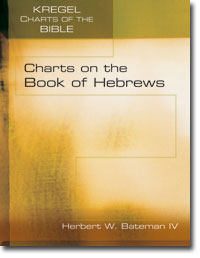
Hebrews can be a hard book to grasp. Whether in Greek or English (or any other language), the development of the book’s logic–especially early on–requires careful attention. One hears about Jesus’ priesthood, which makes the most sense when examined against the backdrop of the Old Testament priesthood and sacrificial system. Angels and Moses and Aaron all make appearances, which are central to what the author of Hebrews says about Jesus. And then there is Melchizedek to reckon with!
Herbert W. Bateman IV, then, has a great idea in wanting to offer “information about Hebrews succinctly in visual format for today’s student and congregant.” He does this (effectively) with a book of charts, consisting in four major parts:
Part 1: Introductory Considerations In Hebrews
Part 2: Old Testament and Second Temple Influences In Hebrews
Part 3: Theology In Hebrews
Part 4: Exegetical Matters in Hebrews
Some charts are just one page (#87, “Positions on the Warning Passages in Hebrews”) or a few pages (#34, “Old Testament People Named in Hebrews”), while others are longer–nearly 10 pages of “Major Textual Issues in Hebrews” (#97) and nearly 20 pages of the (Greek) words that are unique to Hebrews (#103 and #104, listed both alphabetically and by chapter, respectively).
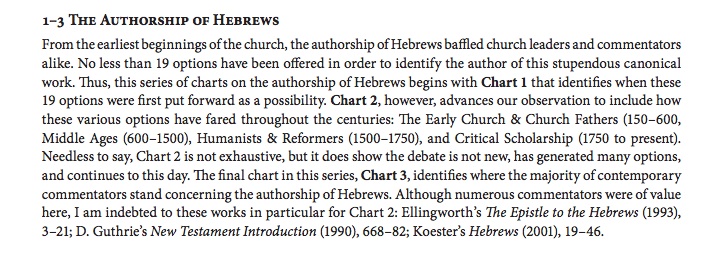
There is not much that this book leaves uncovered. Bateman covers the authorship and dating and genre questions thoroughly and succinctly. There are also helpful summaries of how various Hebrews commentaries have understood different aspects of the book. He explains and diagrams the tabernacle in the Old Testament, comparing it with its description in Hebrews (charts #35-#38).
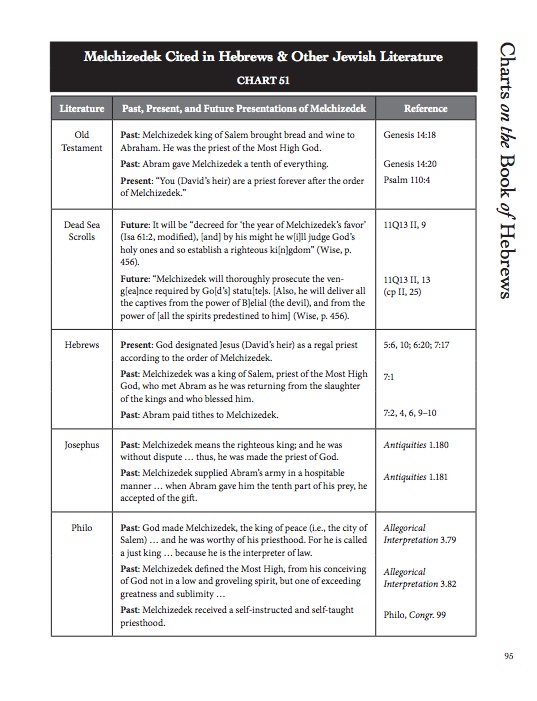
Five pages on the not-well-known Melchizedek examine that figure in both biblical and extra-biblical context (Josephus, Dead Sea Scrolls, etc.). The theology charts found in the third part of Bateman’s book could easily be used in a congregational setting, especially the “Portraits of God” (#56) and Jesus (#57) in Hebrews. The final section looks in detail at Hebrews through interpretive, textual, rhetorical, and lexical lenses.
The “Chart Comments” at the back of the book add even more to the already substantive charts. A dozen-page bibliography concludes the work.
Here’s a sample chart:
And you can see here some comments on the first three charts, from the back of the book:
It’s remarkable how much ground Bateman covers in this appealing, visually organized medium. Seminary classroom teachers or church Sunday school teachers could make great use of these charts.
The one downside to this book, however, is that there is no accompanying CD-ROM or digital content. For a teacher to use a chart, she or he would have to copy from the book or scan in a chart for use in a class Powerpoint. A clean .jpg or .pdf file from the publisher would have eased this process for the user of this book. Hopefully future editions will come so equipped.
Though these charts are produced with a group in mind, any individual (with whatever level of knowledge about Hebrews) could benefit from using the charts for private or small group study. Even though these are charts, this is also the kind of book one could just sit down and go through. Bateman has provided a top-notch resource for an important biblical book.
Kregel sent me a copy of the book for review. Its product page is here, and it’s on Amazon here. The Table of Contents (which lists all the included charts) is here (pdf); read an excerpt here (pdf).
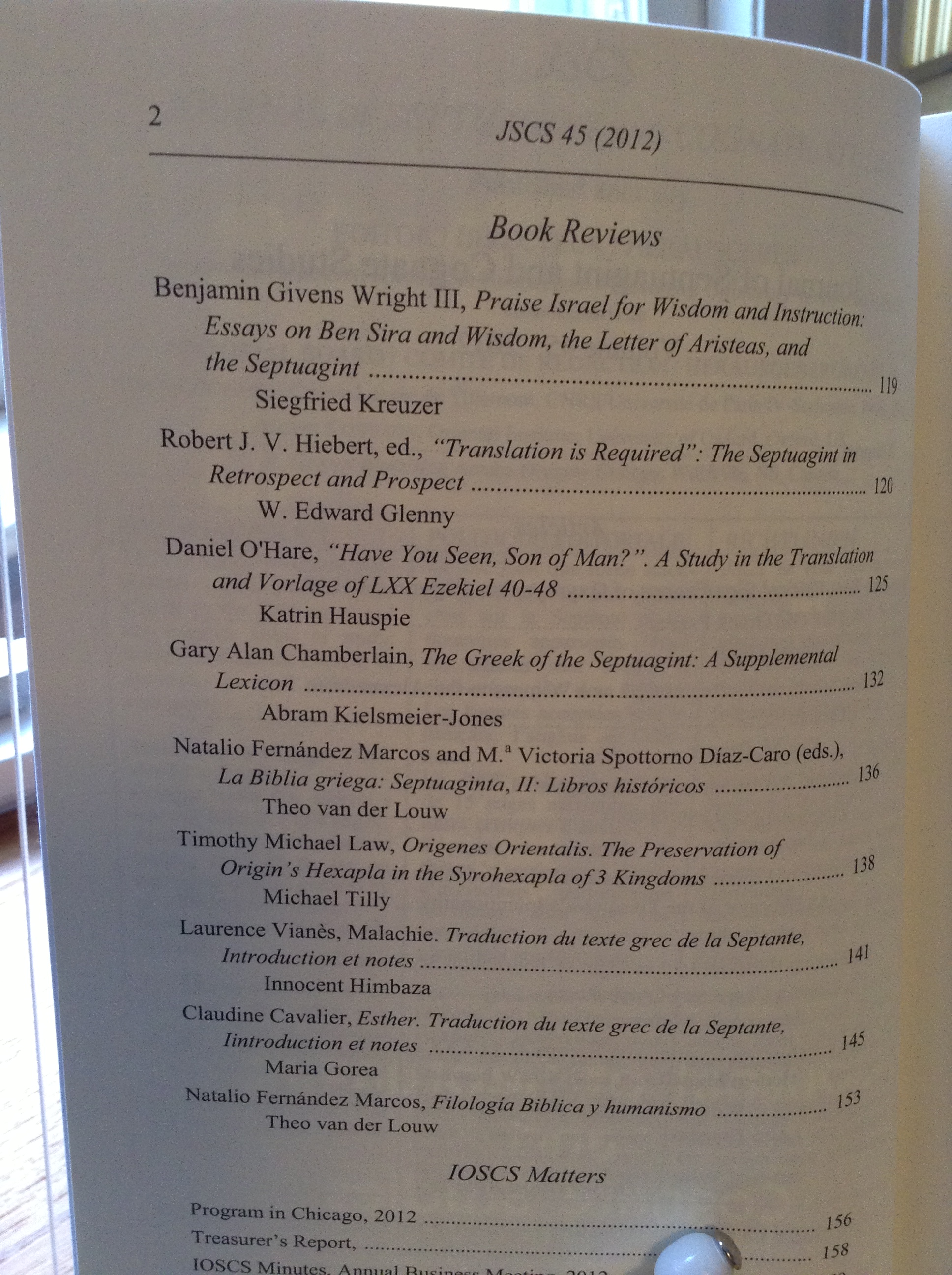
I’ve just received the new Journal of Septuagint and Cognate Studies (JSCS) in the mail today. This issue publishes my review of a Greek Septuagint lexicon. I find lexicons (more or less, dictionaries) significantly more challenging to review than books or even commentaries. (But enjoyable.) I’m glad this one has been published.
See the full contents of this year’s journal here. Photos below.
I don’t really think there is such a thing as a “literal” translation of the Hebrew or Greek Bible. Too much is lost when going from any one language to another to be able to claim literalism. As Dave Brunn points out, to translate is to necessarily change the form. The only way one could keep the form of Hebrew or Greek is to leave the text in Hebrew or Greek.
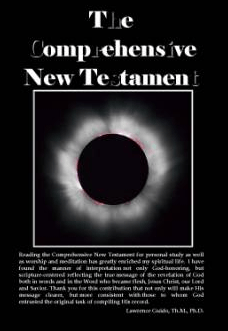
The Comprehensive New Testament claims to be “the most accurate translation of the Nestle-Aland 27th edition Greek New Testament ever produced” (Preface, i), which first struck me as a rather grandiose claim. However, the editors of that work seem to agree with Brunn in saying that “no translation can perfectly reproduce the simplicity and beauty of the original words” (i). Their claim to accuracy is not a claim regarding their original English translation of the Greek New Testament. Rather, it means that they use the Greek of the NA27 as their underlying text. Other translations may begin with that as a base, but will make textual decisions that means their underlying Greek is not identical to the NA27.
There are four primary features to The Comprehensive New Testament:
1. It is “standardized to the Greek New Testament text of the Nestle-Aland 27th edition and the United Bible Societies 4th edition.”
Why this edition of the Greek text? Editors T.E. Clontz and J. Clontz note the Protestant and Catholic agreement on the text tradition (“Alexandrian”) of the NA27 as the basis for English translations of the New Testament.
The editors seem to agree with the idea that no translation is truly literal, yet they still want to “translate the right words–and not words created by scribal mistakes or editorial changes” (i). I agree with them that the “words given through the apostles deserve our best efforts in return.”
One should still be clear, though, that even if the NA27 represents the best manuscript tradition, we don’t have the original autographs. I do believe we probably have something very close to that, but it certainly doesn’t threaten my high view of Scripture to think that there might have been a few “scribal mistakes or editorial changes” between the time of writing and the earliest manuscripts we have access to. The editors aren’t claiming access to the autographs, though, just to the NA27.
There is now a 28th edition of the Nestle-Aland text, with a few changes made from the NA27. How does this come into play? Of course, The Comprehensive NT was published before the NA28 by about 5 years, but it does raise a question for possible future editions of this volume. (I.e., did the NA27 have the wrong text? Does the NA28 have it right now? etc.)
All of these are minor quibbles, though, and no textual variants seem to make major theological differences to our faith. Indeed, the editors note that “throughout the 15,000 variations translated in this New Testament, we find the same message, and the same gospel” (i). Agreed.
The reader of this volume should understand, however, that even using the NA27 at all times doesn’t remove textual ambiguity. For example, in Galatians 1:2 Paul uses the Greek ἀδελφοὶ to describe those “who are with me.” This post is not the place to engage seriously the issues surrounding translation and gender, but given the amount of female ministry companions Paul generally had, the translation found in the NIV (2011) of “brothers and sisters” is almost certainly the more accurate translation. (In Greek, a masculine plural noun like adelphoi could be all males or a mixed group of males and females.) The editors have retained the underlying Greek, but have translated it in a way that not all will agree with.
Also, to take another example, in Romans 16:7, there is debate around whether Paul names Junia (female) or Junias (male) as an apostle. The prevailing scholarly theory is that he has Junia (female) in mind, but the Greek word itself is not conclusive, since he uses the accusative case Ἰουνιᾶν, which itself could be male or female.EDIT/UPDATE 7/24/13: Earlier printings of NA27 did indeed have Ἰουνιᾶν (male), but as of 1998, printings now contain the unequivocally female Ἰουνίαν (Junia). The Comprehensive NT has “Junias” (male) in translation. It’s impossible to prove with 100% certainty one view over the other, but even with a solid base of the NA27 at every turn, there are still ambiguities to be resolved in translation.
2. The Comprehensive NT contains “complete textual variant mapping.”
The editors encourage and facilitate the use of multiple translations when studying the Bible. To this end they offer “complete textual variant mapping” so one can easily see what other translations have for given words and verses. The preface says this is “something that no other translation offers” (i.e., “footnotes for translations beyond our own”). That’s not entirely true, as the NA27/NET diglot offers the same feature (see here).
It’s a useful and time-saving feature, though… a sort of compendium of English translations.
The Junia example above (Romans 16:7) notes the many translations that have Junia over Junias (NESV, HCS, KJV, etc.). They ascribe “Junias” (male) to the Alexandrian tradition while saying that “Junia” (female) is from the Byzantine tradition. Unless I’m missing something, it’s not quite this simple, as the NA27 itself can easily be understood as referring to a Junia. Here it’s not a question of text tradition, but rather of interpretation and translation.
The notes don’t contain rationale for the translation of the New Testament, but they don’t purport to, either.
3. It scores high on a readability scale, only requiring “a sixth grade reading level.”
I don’t doubt the high score, but the presence of words like “behold” and “begotten” (in John 3:16) and “hallowed” (in the Lord’s Prayer) stood out to me as something that a sixth grader would probably need to ask about. The New Living Translation, by comparison, has “one and only” for John 3:16 and “may your name be kept holy” instead of “hallowed be your name” in Luke 11. These latter translations, I think, are better suited to a younger age group and reading level. This translation is not abnormally wooden, though, as some “literalistic” translations (e.g., the NASB) can be. I’m just not sure I’d fill a middle school youth room full of these Bibles (intriguing cover image notwithstanding!).
4. There are nearly 300 pages of “references for the Dead Sea Scrolls, Philo, Josephus, Nag Hammadi Library, Pseudepigrapha, Apocrypha, Plato, Egyptian Book of the Dead, Talmud, Old Testament, Patristic Writings, Dhammapada, Tacitus, Epic of Gilgamesh.”
Many of these pages also include excerpted text from the above.
This is the best feature of this book, in my opinion. Anyone who wants to thoroughly research the early Christian and early Jewish literature that has to do with a given New Testament verse will save loads of time by referring to the reference list.
From Genesis and Jubilees and Sirach on Abraham in Romans 4 to a juicy quote by Papias that claims Matthew “composed the oracles in the Hebrew language,” this section is a great scholar’s companion. The preface provides a concise and helpful overview of the texts covered (e.g., Pseudepigrapha: “claim various Old Testament individuals as authors”).
Accordance Bible Software has released The Comprehensive NT, and one can see the advantage to using a hyperlinked, electronic version of these references (see here). As one reviewer noted, having this extensive list of cross-references will save many a trip to a theological library.
Whatever my critiques above regarding the translation itself, the hundreds of pages of cross-references alone make purchasing the less than $20 book an easy decision. I know of no other single work that gathers so many references in one place, sorting them by New Testament verse. It’s a great starting point for research papers or in-depth Bible studies that want to take into account other extra-biblical writings.
Find out more about The Comprehensive New Testamenthere or here. Thanks to Cornerstone Publications for the review copy. The translation and cross-references are also available in Accordance Bible Software, here.
KRISTA DALTON (Thursday, July 25th, http://kristadalton.com/blog/)
5 Gog and his Not-so-Merry Grasshoppers
6 Bird Droppings, Stoned Elephants, and Exploding Dragons
ABRAM K-J (Saturday, July 27th, https://abramkj.com/) 7 E Pluribus Unum
8 The Septuagint behind the New Testament
AMANDA MacINNIS (Wednesday, July 31st, http://cheesewearingtheology.com/)
11 God’s Word for the Church
12 The Man of Steel and the Man who Worshipped the Sun
There still (shocking!) aren’t that many books about the Septuagint, so I’m sure this will be a welcome addition. Law writes on his blog, “I shall not rest until there is a Septuagint in the hand of every woman, man, girl and boy.”
I think he’s kidding (but not sure about this), but TML loves his LXX. I’m looking forward to being part of the review. More to follow here.
What was the world–or, better, what were the worlds–in which early Christians lived?
Seven Events that Shaped the New Testament World answers that question by highlighting seven key “events” in the seven or so centuries surrounding Jesus. Here, from the table of contents, is what the book covers:
1. The Death of Alexander the Great (323 BCE)
2. The Process of Translating Hebrew Scriptures into Greek (ca. 250 BCE)
3. The Rededication of the Jerusalem Temple (164 BCE)
4. The Roman Occupation of Judea (63 BCE)
5. The Crucifixion of Jesus (ca. 30 CE)
6. The Writing of the New Testament Texts (ca. 50-ca. 130 CE)
7. The Process of “Closing” the New Testament Canon (397 CE)
Author Warren Carter uses each of the seven “as entry points, as launching pads, to talk about these significant and larger realities.” As one reviewer (whom I read before I read this book) pointed out, these events are not all “events,” per se. Events 2, 6, and 7 above are extended processes. Similarly (as the same reviewer also noted), the writing of the New Testament and the closing of its canon didn’t shape the NT world; they emerged from it.
That’s perhaps just a technicality, though. Carter seeks to be “transparently selective,” using “each event as a focal point for larger cultural dynamics and sociohistorical realities” of New Testament times.
Here is author Warren Carter introducing his book:
Carter’s analysis of how historical events shape culture–and how that should influence how we read and understand the New Testament–is incisive and engaging. Early on he writes, “Hellenistic culture did not suddenly replace all other cultures but entangled itself with local cultures to create multicultural worlds.” Given my interest in the Septuagint, I really appreciated his take on that Greek translation as “a way to negotiate a multicultural world.” He deftly explains to readers the intersection between Jewish, Greek, and Roman cultures.
Photographs, sidebars, and occasional footnotes contribute to the level of detail Carter provides. And yet his tone is conversational, and his narrative re-tellings engaging. Last summer I wrote about how I wanted to see Mark Wahlberg or Matt Damon in a film adaptation of 1 Maccabees. Carter’s narrative (ch. 3, “The Rededication of the Jerusalem Temple (164 BCE)”) is nearly as engaging as such a movie would be. In addition to telling the narrative, he has a sidebar on “identity markers” that unpacks the role played by boundaries of identity in Jewish and other religious traditions. His explanation of the difference between 1 Maccabees and 2 Maccabees was easy to follow and illuminating.
The conversational tone at times was a little too conversational for me. There is frequent reference to “the early Jesus movement,” when “early Christianity” would have sufficed. So, too, “Jesus-followers” could just have been called “Christians,” which I would have found less distracting. Of course, a biblical scholar will note that any of these terms are “problematic,” but the more conventional ones would have made for a smoother read, in my view. And I could have done without reference to early Christians as “reading with Jesus-glasses on” and statements like, “Only bad boys were crucified in Rome’s world,” not to mention the description of Alexander the Great as “a macho man, an action figure.”
I also thought that his emphasis on cultural backdrops was occasionally too strong. For example, comparing Jesus to Alexander, he writes, “In many ways, this presentation of Jesus as the man with great power who rules everything imitates and competes with the presentation of manliness that we have seen with Alexander, the world conqueror.” To speak about Jesus in terms of degrees of “manliness” is perhaps a category mistake. Carter’s mention of Philippians 2 and Jesus’ self-emptying is spot on, of course–I’m just not sure that Paul has imperial powers and the social construction of “manliness” in mind when he writes to Philippi.
Theologically conservative/evangelical readers will bristle a little bit at Carter’s statement about the New Testament that readers today “need to discern when to read against the grain” when it comes to groups that the NT seems to exclude. I don’t read Paul and the NT as “not always gracious to women,” as Carter does, and don’t think he somehow needs to be explained away in this manner. Of course, not all who read this review will agree with me either!
Those criticisms being present, Carter succeeds in the book’s aim: “The seven chapters of this book provide an orientation to some important aspects of the early Jesus movement and the New Testament. Reading it will enlighten you about the beginnings of the Christian movement and help your understanding of the New Testament.”
Though I did not agree with Carter on all his assessments, his description of seven key “events” (as well which events he chose to highlight) has enhanced my understanding of and appreciation for the context into which Jesus came and in which the church was born. As long as one reads critically (as one should always do), Carter provides a wealth of helpful information that is accessible to just about any student of the Bible.
Thanks to Baker and NetGalley for the e-galley to review. The book is on Amazon here. Its Baker product page is here. You can download a sample pdf of the book here. There is also a helpful interview with Carter here.
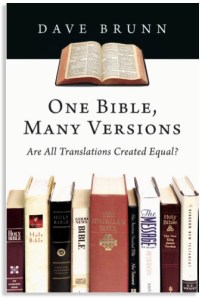
“Are literal versions really literal?” So asks Dave Brunn in One Bible, Many Versions: Are All Translations Created Equal? Brunn is a missionary and educator with extensive Bible translation experience. Noting that the Bible is “virtually silent” on “the issue of translation theory,” he seeks in his book to answer questions like:
“How literal should a Bible translation be?”
“What makes a translation of the Scriptures faithful and accurate?”
“What is the significance of the original form and the original meaning?”
He examines versions as diverse as the Message, the New Living Translation, the New International Version, the English Standard Version, and quite a few others. He lists examples on both the word level and the sentence level to show that “every ‘literal’ version frequently sets aside its own standards of literalness and word-for-word translation,” when slavish literalism would compromise meaning in the target language. For example, the New American Standard Bible–hailed as one of the most literal English translations–takes Genesis 4:1 (Hebrew: [Adam] knew [Eve]) and translates knew as had relations with. This accurately captures the meaning of Gen. 4:1, but it is not word-for-word.
So, too, with the ESV: Mark 9:3’s “no cloth refiner on earth” becomes “no one on earth” (among many, many examples Brunn gives).
At issue here is the relationship between form and meaning. He writes:
The form includes the letters, words, phrases, sentences, paragraphs, and so on. The meaning consists of the concepts or thoughts associated with each of the forms. Both elements are essential in all communication. …[I]t could be hard to argue that one is more important than the other.
To translate, Brunn points out, is to necessarily change the form. The only way to keep the form of Hebrew or Greek is to leave the text in Hebrew or Greek. There is no such thing as “consistent formal equivalence” between “any two languages on earth.” Brunn (rightly, in my view) suggests that it is okay (even necessary) “to set aside form in order to preserve meaning,” but that one should not sacrifice meaning for the sake of preserving form. Besides, he points out, no translation (not even the most “literal” one) sacrifices meaning every time for the sake of formal, word-for-word equivalence.
Brunn drives his point home especially well by making reference to other languages. Perhaps folks argue about literalness in English translations because of English’s linguistic/familial relationship to Greek. But what about non-Indo-European languages, Brunn asks? “As long as the debate about Bible translation stays within the realm of English translation, the tendency will be to oversimplify some of the issues,” he writes. “I believe that many well-meaning Christians have unwittingly made English the ultimate standard.” His examples of translation challenges going from English to Lamogai (the language into which he worked with others to translate the New Testament) reinforce his idea that word-for-word equivalence is simply not possible across languages. (Lamogai, for example, uses gender-neutral terms to refer to siblings, whereas Greek and English do not.)
The translations that people fight over have more in common than we may first realize. Brunn calls for unity among Christians when it comes to what translations we use. “If we set any two English Bible versions side by side,” he says, “We could easily find hundreds of instances where each version has the potential of strengthening and enhancing the other.” (Indeed, there are even times when less “literal” versions like the NIV or NLT seem to stay closer to the original languages at the word level than versions like the ESV or NASB.)
Knowledge of Hebrew and Greek is not needed to profitably use One Bible, Many Versions, though Brunn does have footnotes for “readers who are already knowledgeable in translation issues.” His numerous charts clearly show the difference between form and meaning in multiple translations.
Brunn gives good guidelines for Bible readers and translators alike, as they seek to discern what translations to use and how to think about translation theoretically. Especially in the second half, the book felt a little repetitive–I didn’t think Brunn needed as many examples to make his point that literal translations don’t consistently adhere to their own standards. Though perhaps those who need more convincing will appreciate the extensive charts.
What I was most impressed by was Brunn’s obvious high regard for Scripture, together with a pastoral sense of how to navigate the so-called Bible translation debates. In addition to these, the care with which he analyzed translations and compared them to each other made it easy to follow (and agree with) him. Whether you’re interested in Bible translation or exploring the differences between various versions, One Bible, Many Versions is an engaging and informative guide.
Brunn has a Website here; the book’s site is here.
Thanks to IVP for the review copy. You can find the book on Amazon here, and its IVP product page here.
Being a parent is very simple. There is no reason for you to constantly go to other adults who do not know your toddler for advice or conspiring. What happens at home stays at home. …When it comes to being a good parent, the most important resources are the words that come out of your child’s amazing mouth. If your child is too young to speak, guess accurately on the first try.
And now, s/he has written a parenting guide. The chapter titles alone produce enough laughs to make the book worth the price:
Chapter 1: “Why Did You Do That?”: The Ins and Outs of Toddler Behavior and How to Leave It Alone
Chapter 5: Sleep: Weaning Yourself Off It
Chapter 18: Potty Training Simplified/Eliminated
Bunmi has tapped into the psyches of Every Parent because HT, in all the quirky specifics of his/her behavior, is Every Toddler. (“Give a toddler a rag and a spray bottle, and your house will be sparkling before you know it. First it will be soaking, and your mobile phone may have water damage, but after a thorough wipe-down, the results will please you.”)
This Child’s Guide to Parenting is thorough–HT includes everything from media recommendations (music, books, TV) to hygiene (“leave well enough alone”), from restaurant behavior to grandmas and grandpas (“you should learn as much as possible from your child’s grandparents”). Interspersed between chapters are letters from parents to HT and homework assignments (sample: “Visit the toy store and get all the things. Next, go to a field. Run until nightfall”).
The Honest Toddler is hilarious, brilliantly written, and often pointed in its humor (see: HT’s disdain for Pinterest). I was impressed by how much this little toddler had to say. Although, now that I think about it, my toddlers have always had a lot to say.
The open parent who reads this book will be perhaps re-conditioned: temper tantrums are just “loud responses,” toddler ignoring is simply “selective acknowledgement,” and whining is “a legitimate form of speech.”
Honest Toddler, for all his/her impossible demands (duh), has some great advice. Facebook, for example: “Toddlers are tired of hearing Facebook notifications during story time. We’re sick of having to sit in parked cars, fully strapped in, while you make sure you get the last word on a virtual dispute with an acquaintance. This website is a distraction. Log off. Permanently.”
Communication: “Did you know that there are more than four hundred different meanings for ‘no’ in Toddler English?” (with a sample chart). Packing for vacation: “There’s no such thing as minimalism when it comes to packing for a trip with small children.”
Readers of HT’s blog, FB, and Twitter feed will recognize some material here (the “toddler-approved recipes” and physics breakdown of car napping), but not much. This is 256 pages of sheer, highly original, creative genius.
There are occasional moments of dark-ish humor (“There’s nothing special about a child [i.e., infant] who can’t go anywhere without a blanket over her legs”), but, then again, this was written by a toddler.
And, HT, if you’re reading: make sure your mom lets you watch Daniel Tiger’s Neighborhood. You’ll like it way better than Caillou.
If you’re a parent of a toddler or know one, The Honest Toddler is essential reading, if only to relax and laugh enough to keep one’s head in the game of toddler parenting. (If you’re interested in the possibility of a free copy, I’m giving one away here.)
I have to stop now; my own two-year-old just woke up to join us in watching the late-night basketball game and blogging, and now is requesting–you guessed it–Daniel Tiger and some water.
Many thanks to Scribner (imprint of Simon & Schuster) for the review copy, given to me for the purposes of an honest review. Find the book’s product page here. It’s on Amazon here.
And thanks especially to Bunmi/HT for making me a better parent. Or at least a parent who is able to laugh a little bit more and cry a little bit less as I raise my little ones.















 Words on the Word