Quick Update on the World’s Other “Words on…” Blog (and its New Co-Author)

BD KAVAJ case
Yay for co-authorship! (Image via Brian Davidson)


I’ve had fun getting the new Words on the Goods off the ground the last couple months. This site’s sister blog now has its first co-author, Brian Davidson. I’m excited about the possibilities having multiple writers opens up.

Words on the Goods focuses on reviewing high-quality, high-utility gear, as well as the best productivity and life management apps.

Here are a few highlights from recent weeks:

Find Words on the Goods at www.wordsonthegoods.com. If you scroll to the bottom, you can sign up to follow or subscribe to the blog.


This week’s blog sponsor is MailButler, the feature set you always wished your Mac Mail had (and that I’m glad mine does). Find out more about it here or download and try it free here.

Word Counter App for Mac OS X

Word Counter iconWord count is by no means the best measure of effective writing, but it’s a useful metric for tracking your progress.

The Mac Word Counter app by Christian Tietze lives in the menu bar and automatically tracks your word count across apps. This is especially helpful for us writers who can’t seem to settle on a single app for writing.

Even when Word Counter is out of site, you can have its menu bar icon display your running word count for the day:


0_Menu Bar


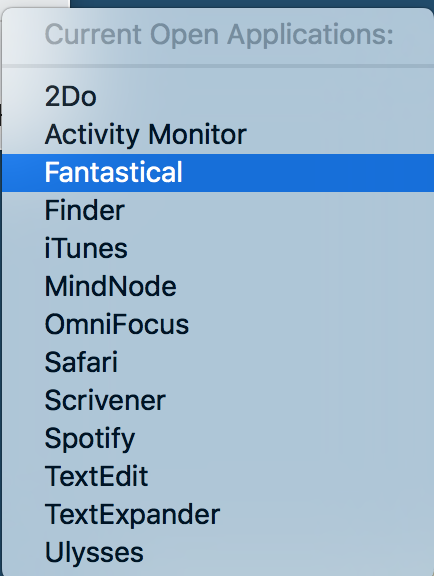
You can specify which apps you want Word Counter to track:


2_Add Apps


3_Add Apps 2


Once you’ve added your apps, just click on the menu bar icon to see a breakdown:


4_Word Count in Menu Bar


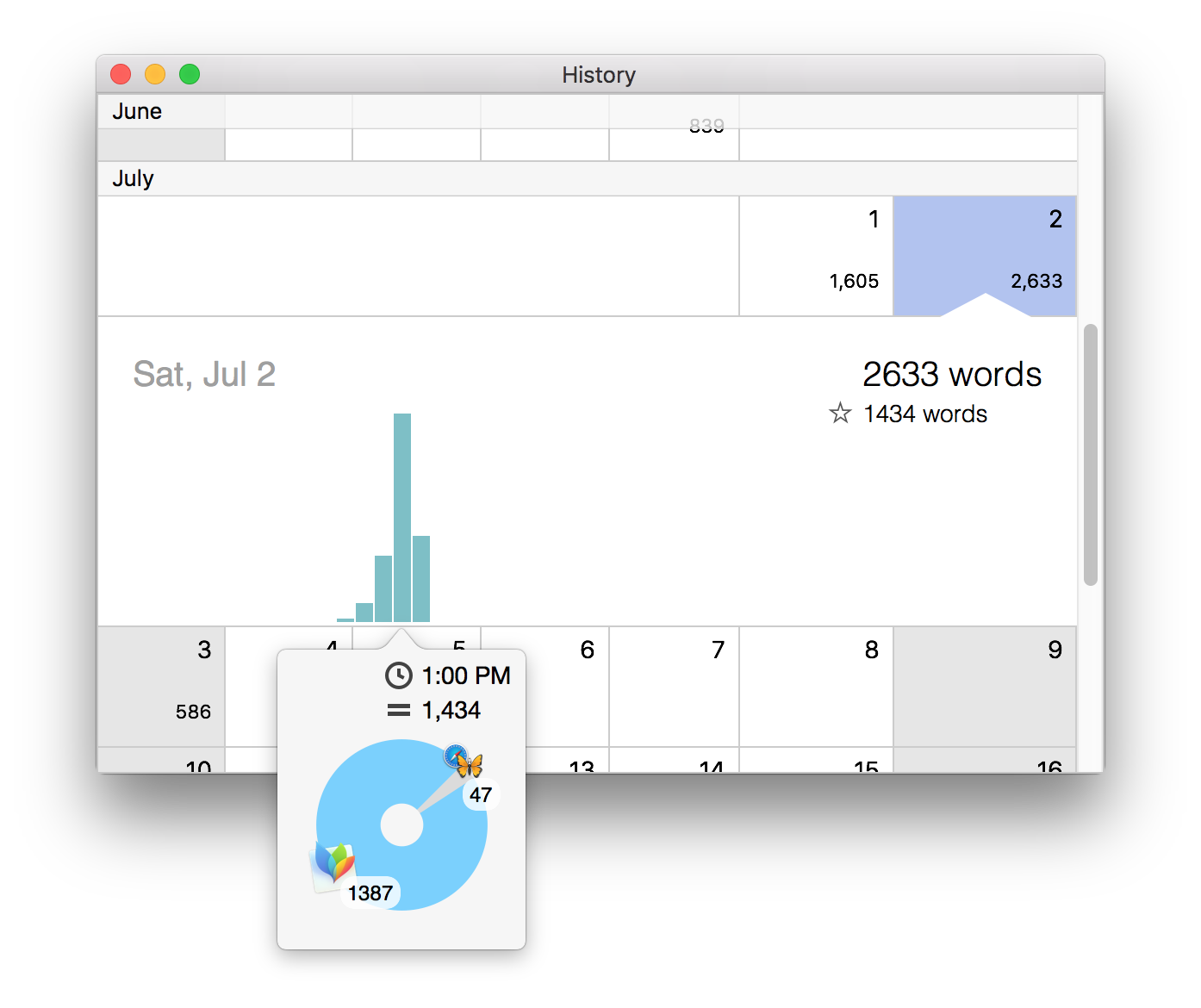
Hovering over the bars gives you an hour-by-hour, app-by-app breakdown of your progress. Very cool!

You can look at your day-by-day word count history, which is also impressively sub-divided into hours and apps:


5_Word Count History


And that’s honestly probably enough for most of us–a detailed word counting tool that is easy to access, updates automatically, and tracks multiple apps.

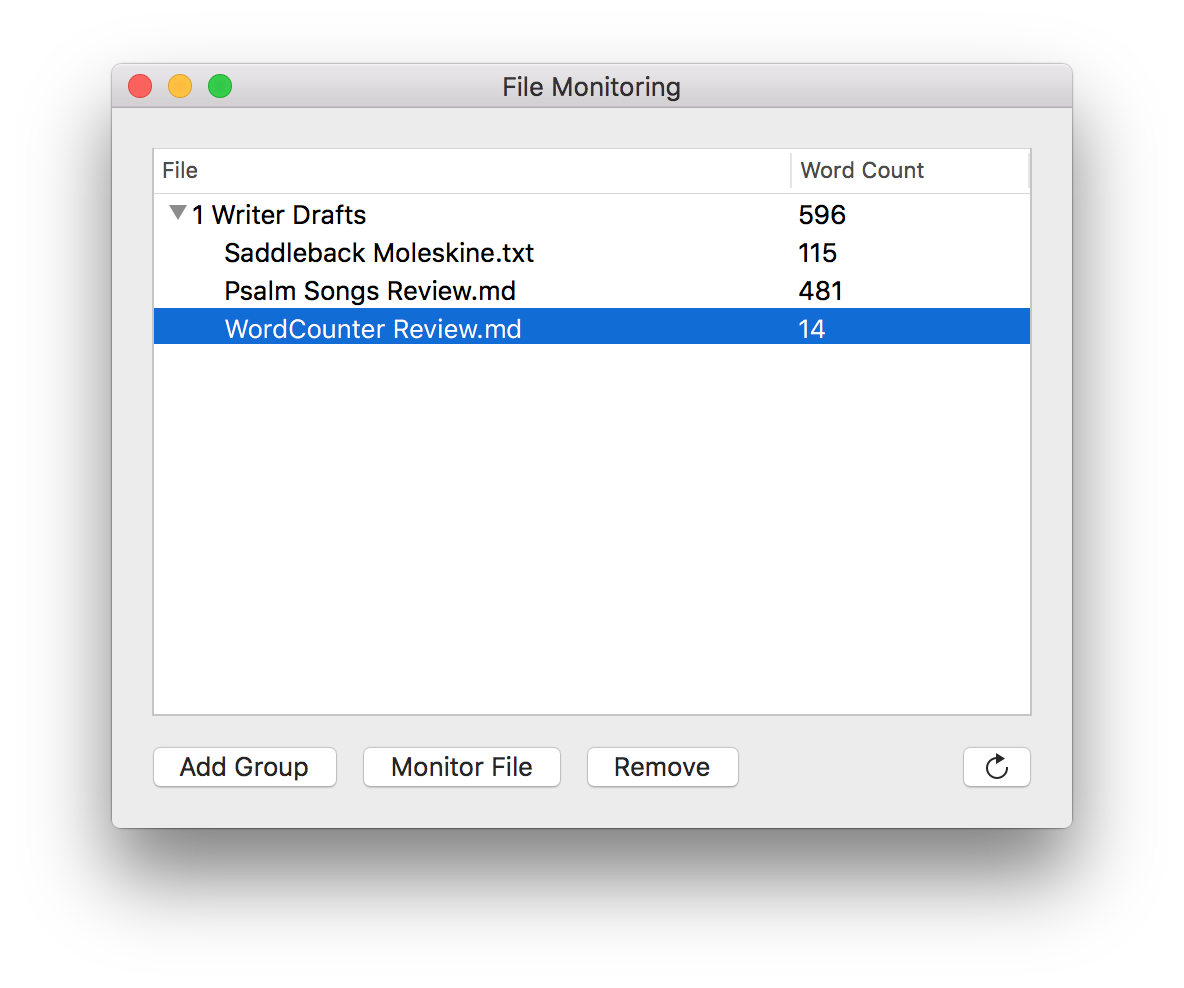
But there is also a nice additional feature of being able to track word counts on individual files. This comes in handy especially for a file you’re working on via Dropbox across multiple machines. Word Counter will track the word count for you via Dropbox, no matter what device you typed the words on.


9_Refresh


The only downside to this feature is you have to manually refresh (icon at bottom right hand corner in the image above) to get the word count to update. (UPDATE: I’ve just learned it does refresh on its own every few minutes.)

Word Counter does provide a solution to the as-of-yet-non-existent word count feature in OmniOutliner.

The only other possible area for improvement is that when you add a file for tracking from the File Monitoring window, you have to select “Monitor File” and go find it in Finder, rather than being able to just drag and drop a file from an already-open Finder window. This would be a nice feature for a future update.

The app is easily worth its $9.99, and there’s a free 14-day trial so you can test it out. Find it here.


Thanks to the dev at Word Counter for the promo code so I could review the app.

A Smooth Note-Taking Workflow for Drafts 4 and Logos in iOS

I’ve got a sweet Logos–>Drafts 4 workflow I’ve been using on the iPad for a few months now. (I find Logos’s iOS app to be significantly zippier than its Mac counterpart.) Allow me to demonstrate, using Harold W. Hoehner’s excellent Ephesians commentary.


1. Open up Logos in iOS.


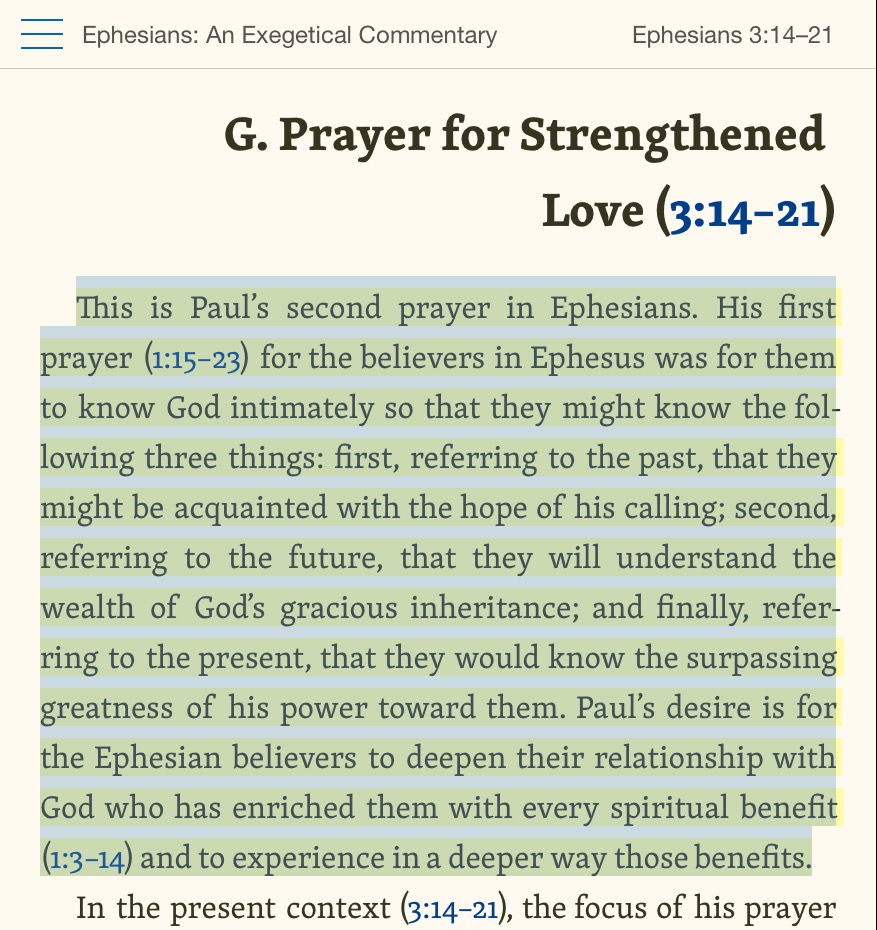
Here’s Hoehner’s lovely commentary.


IMG_0383


2. Tap selected text to bring up highlighting and share options.


I’ve got Drafts open with Logos in Split View, just so you can see them together. All these steps work with Drafts not visible, however.


IMG_0384


3. Select Drafts in the share option.


IMG_0385


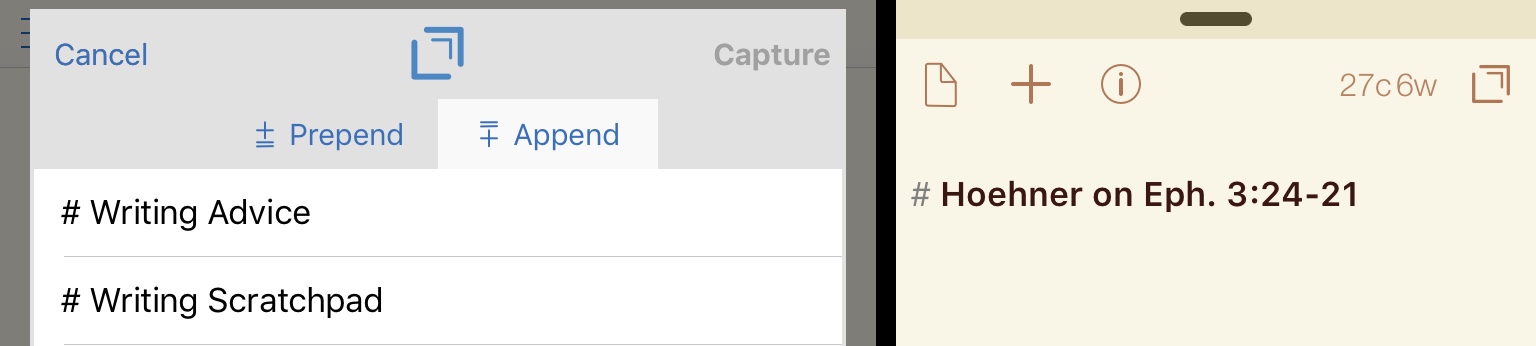
4. Now you can “Capture” to send the selected text right to Drafts OR prepend (add to the beginning) or append (add to the end) to an existing draft. (!)


IMG_0386


If you do Prepend or Append, Drafts comes up to let you choose where to put your text.


IMG_0387


5. When you’re done repeating this process for as much text as you want to copy, you can merge individual drafts, if needed.


IMG_0388


IMG_0389


IMG_0389


You can even choose your own text or symbol to separate merged drafts:


IMG_0390


From here it’s easy export from a single draft to Ulysses or MindNode, and on goes my sermon preparation! Drafts4 has been the most indispensable app in my attempt to do as much sermon preparation as possible on the iPad.


Thanks to Logos for the Hoehner commentary so I could write up the workflow–review of the commentary itself to follow. The Logos mobile apps are free, available here: iOS / Google Play.

A Three-Volume, Multi-Thousand Page Commentary for Psalms Study

Engagement with the Psalms—reading them, owning them, singing them, praying them, and taking cues from them—is vital for robust worship and spiritual formation in the church. If they truly are “a Bible in miniature,” as Luther has said, they offer the opportunity for the church to grow in its spiritual and emotional maturity.


Descriptive, Prescriptive


The writers of the Psalms give language to the whole range of emotions: from gratitude to fear, from joy to lamentation, from petition to thanksgiving, from intimate, private prayers to national, corporate prayers. In this way they are eminently descriptive of the human experience.

The Psalms also prescriptively guide the reader into various postures of prayer, so that the one praying does not only ever approach God with petitions, or only ever with complaint, and so on. The cognitive and affective come together in the Psalms in sometimes unexpected ways. Psalms of lament, for example, often begin with a loud “Why?” (stressing the affective) yet end with a determined profession of faith like, “But I will trust in you still….” In this way they stress the use of cognitive powers in prayer—external life evidence notwithstanding!

The Psalms express (descriptively) and call forth (prescriptively) a whole spectrum of human experience in relationship to God. They teach us to bring our whole selves to God in worship.


Preaching the Psalms


But how to preach them? One will need to take into account intercultural realities. Understanding the role of a shepherd in ancient society will certainly help with Psalm 23. And soul-searching is required.


Psalms of Summer


A good set of commentaries helps, too. I preached some Psalms a couple summers ago, and found these two options quite helpful.

Just completed, too, is Allen P. Ross’s three-volume, multi-thousand page commentary on the Psalms, published by Kregel Academic.


Ross’s Commentary, in Three Volumes


Ross Psalms Vol. 1


Volume 1 has more than 150 pages of introductory material, covering:

  • “Value of the Psalms” (Ross says, “It is impossible to express adequately the value of the Book of Psalms to the household of faith”)
  • “Text and Ancient Versions of the Psalms”
  • “History of the Interpretation of the Psalms”
  • “Interpreting Biblical Poetry”
  • “Literary Forms and Functions in the Psalms” (the best starting place, I thought)
  • “Psalms in Worship”
  • “Theology of the Psalms”
  • “Exposition of the Psalms”

I haven’t seen the just-released third volume, but Kregel was kind to send me the first two volumes for review. In what follows I interact with those books. Volume 1 covers Psalms 1-41; Volume 2 treats Psalms 42-89.


The Commentary Layout (Psalm 42 as Case Study)


Even in the Table of Contents you can get a sense of where Ross will go with a given Psalm, as each Psalm listed includes summary titles. Psalm 1 is “The Life That Is Blessed.” Psalm 23: “The Faithful Provisions of the LORD.” Psalm 46: “The Powerful Presence of God.” Psalm 51: “The Necessity of Full Forgiveness.”

Introduction to the Psalm

Then there follows Ross’s introduction to the Psalm. He provides his own translation from Hebrew with extensive notes, analyzing the text and textual variants. Psalm 42:2, for example, he translates:

My soul thirsts for God, for the living God.

When shall I come and appear before God?

His footnote offers a point of interest: “This first ‘God’ is not in the Greek version; it simply reads ‘for the living God.’” He often has the Septuagint in view, which I especially appreciate. On Psalm 42:9, for example (“I say to God, my rock…”), he notes:

The Greek interprets the image with ἀντιλήμπτωρ μου εἶ, “you are my supporter/helper.”

Not that every footnote “will preach,” but they don’t need to—Ross offers a wealth of insight that will help preacher, student, and professor better understand the text as it has come down to us.

Still with each Psalm’s introductory material, the “Composition and Context” session sets the Psalm in its biblical-literary context and explores background information (where available). Regarding Psalm 42, Ross says:

And Psalm 42 is unique in supplying details of the location. The psalmist is apparently separated from the formal place of worship in Jerusalem by some distance, finding himself in the mountainous regions of the sources of the Jordan. There is no explanation of why he was there; and there is no information about who the psalmist was.

Ross Psalms Vol. 2Reading the commentary, one trusts that were there such information, Ross would have unearthed and presented it!

Then there is a summary “Exegetical Analysis,” followed by an outline of the Psalm. Anyone looking to get their bearings quickly with a Psalm will find this one of the most helpful sections. Here is Ross again, with his summary of Psalm 42:

Yearning in his soul for restoration to communion with the living God in Zion and lamenting the fact that his adversaries have prevented him, the psalmist encourages himself as he petitions the LORD to vindicate him and lead him back to the temple where he will find spiritual fulfillment and joy.

Commentary in Expository Form

After each Psalm’s generous introduction, Ross presents the commentary proper (“Commentary in Expository Form”). It’s as detailed as one would expect and hope. Here he is, for example, on Psalm 42:3-4 (“They must endure the taunts of unbelievers”):

In the meantime, the psalmist must endure the taunts of his enemies—enemies of his faith. In this he is an archetype of believers down through the ages who are taunted for their faith. This has caused him tremendous grief, so much so that he says his tears have been his food night and day (see Pss. 80:5 and 102:9; Job 3:24). The line has several figures: “tear” (collective for “tears”) represents his sorrow (a metonymy of effect); “food” compares his sorrow with his daily portion (a metaphor); and “day and night” means all the time (a merism). The cause of his sorrow is their challenging question: “when they say to me continually, ‘Where is your God’?” (see Pss. 74:10 and 115:2). The unbelieving world does not understand the faith and is unsympathetic to believers. “Where is your God?” is a rhetorical question, meaning your God does not exist and will not deliver you—it is foolish to believe. For someone who is as devout as the psalmist, this is a painful taunt.

This blend of careful attention to the text and reverent devotion to the God who breathed it is typical of the Ross’s rich comments.

Message and Application

Though Ross already offers theological interpretation in the commentary proper, the Message and Application section is one any reader will appreciate. He often reads (in a good way) through a New Testament and Christological lens, as with Psalms 42-43:

But in the New Testament the greatest longing of those who are spiritual is to be in the heavenly sanctuary with the Lord, for that will be the great and lasting vindication of the faith. Paul said he would rather be at home with the Lord—but whether there or here, he would try to please the Lord (2 Cor. 5:8–9). And Paul certainly knew what it meant to be persecuted for his faith. But the marvelous part of the desire to be in the heavenly sanctuary is that the Lord Jesus Christ desires that we be there with him, to see his glory (John 14:3; 17:24). Throughout the history of the faith believers have desired to go to the sanctuary to see the LORD (see Ps. 63); in Christ Jesus that desire will be fulfilled gloriously.

Those looking for a dispassionate commentary or for one that does not find Jesus in the Hebrew Bible will be better served looking elsewhere. To my mind, this dynamic is one of the great strengths of these volumes.

Toward the end of a Psalm, then, Ross boils it down to an italicized expositional message. This is one of the (many) highlights of the commentary, as it pulls everything together from Ross’s careful exegesis into the world of the listener. Here is how he puts Psalm 23:

The righteous desire to be in the presence of the Lord where they will feed on his Word, find spiritual restoration, be guided into righteousness, be reminded of his protective presence, receive provisions from his bounty, and be joyfully welcomed by him.

Where to Get It


Here is where to find these fine books:

Volume 1: Amazon / Kregel

Volume 2: Amazon / Kregel

Volume 3: Amazon / Kregel


Thanks to Kregel for the review copies of both books, given to me for the purposes of reviewing them, but with no expectation as to the content of this post.

Brand New from Carta: The Illustrated Josephus (The Jewish War)

Josephus Carta


Josephus–affectionately dubbed Brosephus in my household–now comes to you, via Carta Jerusalem, with full-color illustrations. I’m still coming back to these three new titles, but in the meantime, here’s a bit of info about Carta’s Illustrated The Jewish War by Josephus.

The publisher describes it thus:

A modern reading of Josephus’ ancient text, profusely illustrated, and placed against its geographical historical background.

• 40 maps illustrating the events recorded by Josephus referenced to the latest scholarly research (The Carta Bible Atlas, The Sacred Bridge: Carta’s Atlas of the Biblical World, and more);

• 175 illustrations of sites, archaeological finds, landscapes, artifacts, and artist’s renditions;

• Easy name search for: Persons (red); Places (blue); References (green).

The Sacred Bridge, as I suggested in probably the longest review I’ve written on this site, is pure gold. R. Steven Notley, a co-author of The Sacred Bridge, has written the introduction for this new volume. It is not very long, but Notley does not need many words to orient readers well to the subject at hand.

Make sure to check out the sample pages here.

The translation is William Whiston’s. The illustrations, maps, and other images (not to mention the color coding that makes even a small-font, tour de force like The Sacred Bridge readable) look to be a nice enhancement to Josephus’s text.
I’ve not seen more than the sample pages, but a possible desideratum could be additional study notes, or footnoted annotations throughout the text to keep the reader oriented to The Jewish War. The images appear to serve that purpose in at least some measure, and promise to make for yet another beautiful book from Carta.

Through the end of June the discount code 30-off will get you 30% off the hardcover volume (retails at $60). The book is to be published in early June. You can find it here.

Probably the Best Broadly Evangelical Systematic Theology

Erickson Introducing Christian DoctrineMillard J. Erickson’s massive Christian Theology is now in its third edition (published in 2013). The hallmark of the 1,200-page book is its evangelical perspective, concern for application to life, and balance in covering multiple perspectives fairly.

There’s also a newly updated abridged version of the work, Introducing Christian Doctrine, which clocks in at a more modest 512 pages.

Introducing Christian Doctrine begins each chapter with an easy-to-grasp one-page summary, featuring “Chapter Objectives,” a short “Chapter Summary,” and a detailed “Chapter Outline.” This makes navigating the work a breeze, especially if you’re after a particular topic–as I am currently, since my five-year-old keeps asking me about heaven!

Erickson offers an engaging read from the beginning:

To some readers, the word “doctrine” may prove somewhat frightening. It conjures up visions of very technical, difficult, abstract beliefs, perhaps propounded dogmatically. Doctrine is not that, however. Christian doctrine is simply statements of the most fundamental beliefs the Christian has, beliefs about the nature of God, about his action, about us who are his creatures, and about what he has done to bring us into relationship with himself. Far from being dry or abstract, these are the most important types of truths. They are statements on the fundamental issues of life: namely, who am I, what is the ultimate meaning of the universe, where am I going? Christian doctrine is, then, the answers the Christian gives to those questions that all human beings ask. (4)

Readers can count on, even in this abridged version, a thorough survey of biblical references and concepts from which to derive a solid theology. Erickson covers well the expected basics: revelation, the nature of humanity, salvation, eschatology, and so on.

Balanced as he is, there are occasional areas that deserve further nuance, even in the unabridged version. In the larger edition, for example (preserved in the abridgement), Erickson says, “Jesus did not make an explicit and overt claim to divinity” (611). He means that Jesus never explicitly said, “I am God,” although verses like “I and the Father are one” seem to counter Erickson’s claim here. What follows, though, is a great read on Jesus: there are what can only be divine “prerogatives Jesus claimed” (611).

The Unabridged Version

To take just one example, Jesus forgives the sins of a paralyzed man in Mark 2:5-10. The teachers of the law object, “Who can forgive sins but God alone?” They are right, of course, that only God can forgive sins. Jesus here is exercising a divine role: “But I want you to know that the Son of Man has authority on earth to forgive sins” (Mark 2:10). Jesus also exercises an authority reserved only for God when he re-casts the Decalogue in his Sermon on the Mount with a refrain of, “But I say to you.” And when Jesus raises Lazarus from the dead in John 11, he displays power over life and death themselves, a power available to no mere human being. This is not to mention Christ’s own resurrection, showing his divine power over death.

Erickson offers some nice turns of phrase, too. Speaking of God’s age, he says God “is no older now than a year ago, for inifinty plus one is no more than infinity” (91). Together with the Scriptural support Erickson gives for God’s being “infinite in relation to time” (91), one easily sees how useful Introducing Christian Doctrine can be in church settings.

The abridged version does a impressive job at condensing Christian Theology without significantly compromising or neglecting the content. One surprising move in the abridged version is that the chapters are re-ordered and numbered differently from the full edition.

This may be inevitable with an abridgement, but most readers will want to be able to know how the two titles relate, for purposes of accurate cross-referencing and further reading. Future editions ought to bring the abridged chapter numbering in line with that of the fuller version. Even the section headings change, so that Part 5 of the condensed version is “The Person and Work of Christ” (spanning chapters 23-27), while Part 5 of the unabridged edition is “Humanity” (chapters 20-24).

The annotated Table of Contents (see them here) in Introducing Christian Doctrine do, however, allow the reader to easily locate a given theme and sub-topic.

There’s much more to interact with in Erickson’s book, but it’s the best broadly evangelical theology of which I’m aware. Erickson blends academic thoroughness with pastoral concern, an approach I love.

And now, some link love: You can find the condensed Introducing Christian Doctrine here (Amazon), here (Baker), and in electronic form here (Logos) and here (Olive Tree). The fuller, unabridged Christian Theology is here (Amazon), here (Baker), and in electronic form here (Logos) and here (Olive Tree).


Thanks to Baker Academic for the copy of Introducing Christian Doctrine, which they sent me for review, but with no expectation as to this review’s content.


The (Leather) Gospel, According to John

I’ve had hit-or-miss success in 2016 with Bible memorization. It’s entirely possible I’m being too hard on myself, but I also know I struggle to consistently work at the parts of the Bible I’m trying to memorize this year.

A tool won’t necessarily make me a better memorizer, but thinking it could help, I sprang for the Saddleback Leather Gospel of John Bible portion. You readers of this blog know I like good leather. You know I like pocket notebooks. And of course I like pocket notebooks with leather covers. So why not have a portable Scripture portion covered in leather?

This has actually been a desideratum of mine for some time, so I was really excited to see that Saddleback Leather has just released a set of three books of the Bible (John, Proverbs, and Revelation), each stitched into a leather cover. These are not inserts that can be exchanged–they are permanently stitched to their covers.

Lemme show you.


0_Two Balms
Lip Balm, Life Balm


The book is passport size (think 3.5″ x 5″ Baron Fig Apprentice rather than 3.5″ x 5.5″ Field Notes or Word. Notebooks). This means it’s a great front pocket fit.


1_Pocket View


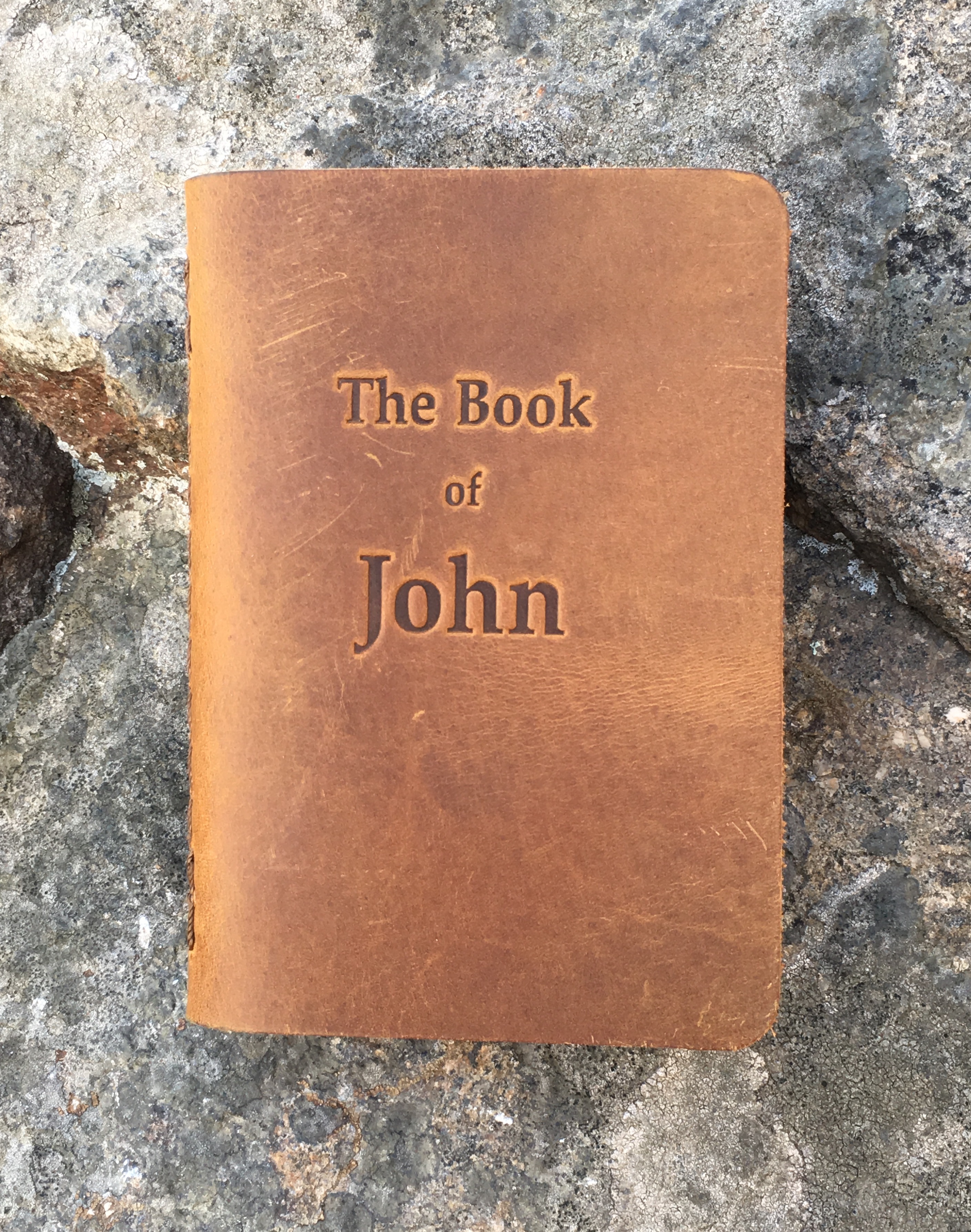
Here it is, front and back:


Words of the Word on the Rock
Words of the Word on a Rock


3_Back on Rock
Rock on, You Rock on the Rock


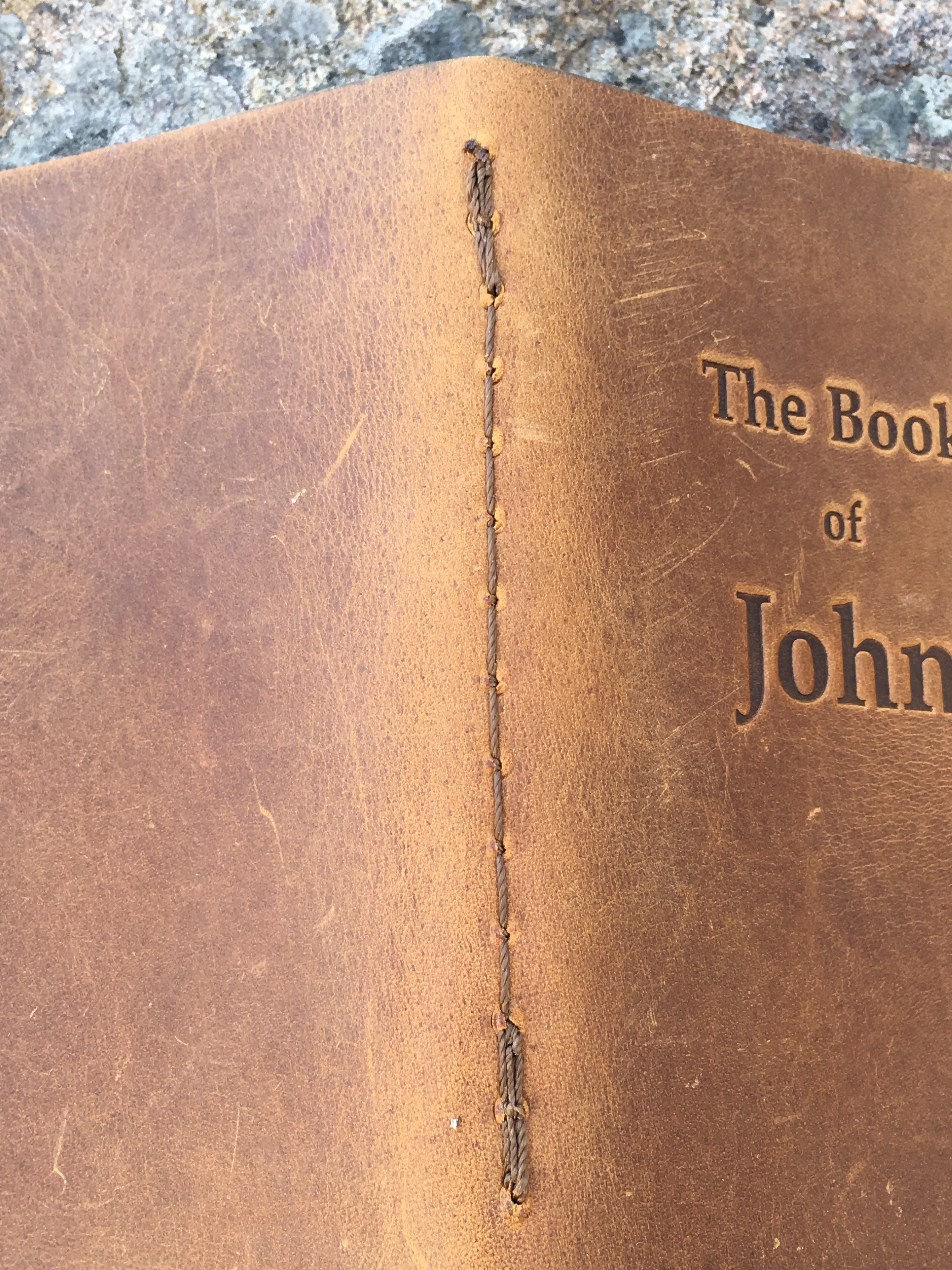
Here’s a look at how the uber-tough paper is stitched into the leather:


4_Inside Stitching


5_Outside Stitching


That paper, by the way, is “YUPO synthetic paper: 100% recyclable, waterproof, tree-free, durable, and easily wipes clean.”


7_Inside Stitching Up Close


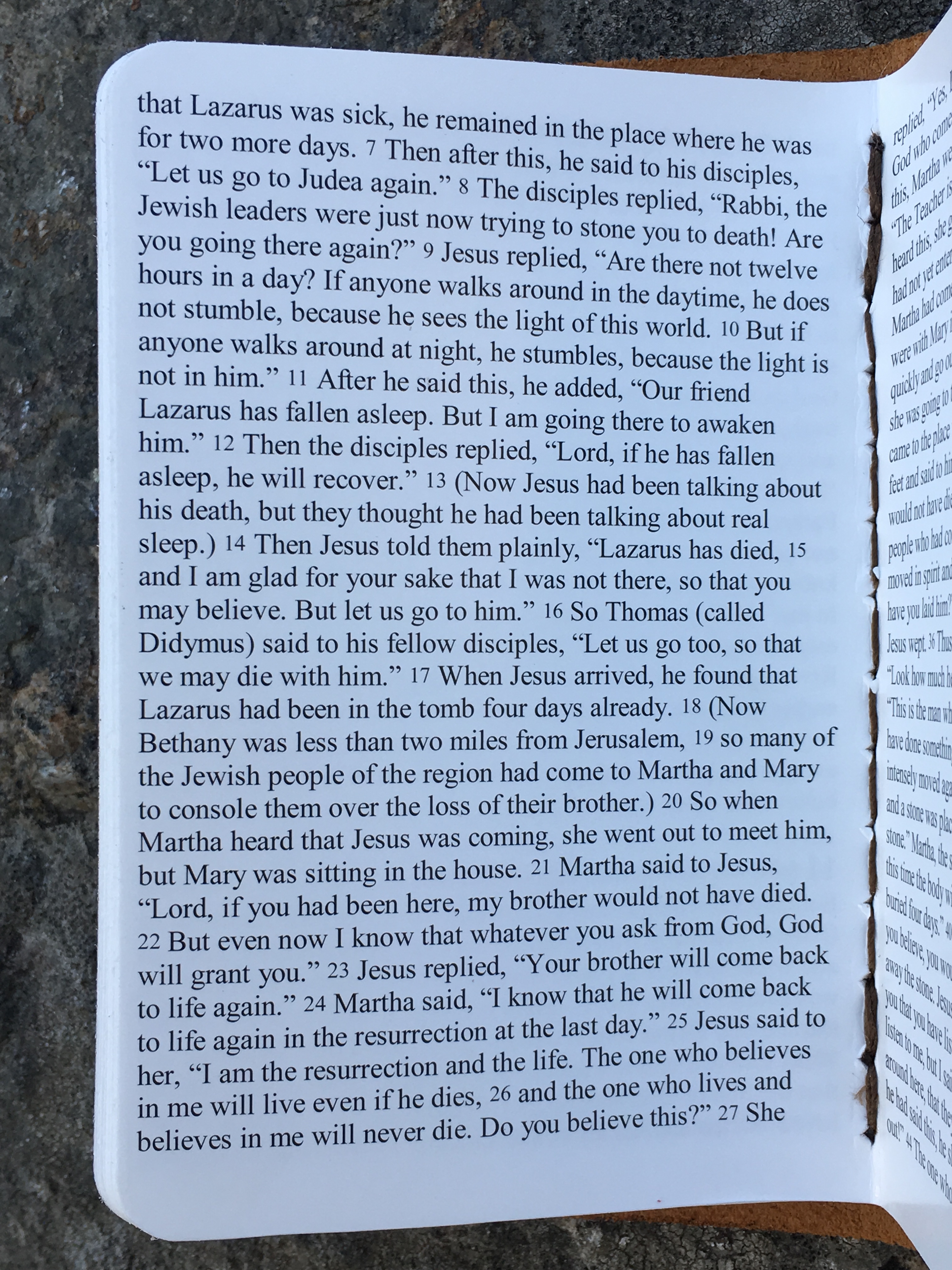
Bible production is notoriously challenging, and I’m quite sure this piece was no exception. A bummer is that there is virtually no margin to the pages. The font is small, but the lack of white space is the larger issue:


8_Full Page Text


This especially becomes a problem as some pages don’t lay 100% flat:


Crammed margins
Crammed margins


The leather is full grain and wonderful, as with all of Saddleback’s stuff. It smells good, of course. It will last forever. The paper looks just as tough, too. I don’t quite feel like trying to rip it to see if it’s truly tear-free, but it’s the kind of paper you could take on a camping trip and not have to worry.

Surprisingly, given the excellent workmanship on Saddleback products, the leather stitching was a little crooked, even though it’s machine-stitched:


6_Outside Stitching Up Close


6a_Stitching Not Straight


The insides are the NET Bible, which I appreciate as a translation for its rich footnotes. Those are not included here, which is inevitable, since the font is already small to get John to fit in.

There are 30 pages (15 sheets), including–oddly–five blank pages at the end, which means that one less sheet could have been used. (Maybe these are for notes?)

Back to why I got this thing–to memorize. The NET Bible does not lend itself well to memorization. Consider John 1:1-5 in the 1984 NIV:

In the beginning was the Word, and the Word was with God, and the Word was God. He was with God in the beginning.

Through him all things were made; without him nothing was made that has been made. In him was life, and that life was the light of men. The light shines in the darkness, but the darkness has not understood it.

Here it is in the NET Bible:

In the beginning was the Word, and the Word was with God, and the Word was fully God. The Word was with God in the beginning. All things were created by him, and apart from him not one thing was created that has been created. In him was life, and the life was the light of mankind. And the light shines on in the darkness, but the darkness has not mastered it.

I dislike the translation of the generic Greek ανθρωπος as “man” in the 1984 NIV. “Humanity” or “humankind” is better in 2016–even the NET footnote cedes this option, but the text alone just gives you “mankind.” And though the footnote in fuller NET editions explains “the Word was fully God” well, NET has other such turns of phrase that make the version less than ideal for memorization.

There are also no paragraphs in this text. This means the 71-verse John 6 is a single paragraph in the Saddleback Leather Gospel of John. There is a single blank line between chapters, but especially with those five blank pages at the end, could not paragraph separations for greater readability have been employed?

One more minor production quibble: the cover text (“The Book of John”) is ever so slightly left of center, and the branding on the back is a little off-center. These are not really noticeable (like the stitching is), and maybe it’s just that I’ve come to expect near perfection from Saddleback!

I still, however, think it is absolutely awesome that Saddleback is making these things, so even though the NET Bible here isn’t quite the pocket-sized, leather-covered panacea I was seeking for Bible memorization (I know: I have issues), I would still buy this again, even if only to support the effort and have it to keep with me.

I imagine the production of these little books will only improve in time–if you’re going to get one, maybe give it a couple months and see if the next few production runs iron out the quality and layout issues.

(Personally, I’d love to see an easier-to-memorize version available in the future, too, like the NIV or NRSV.)

Saddleback’s site is here, with many wonderful leather things. You can also check out my review of their pen/sunglasses case as well as their leather Bible Cover.

Here is the Gospel of John via Saddleback, as well as a larger set of three books of the Bible, similarly bound.


This was not a review sample–I paid for it, but was fortunate to have received a handsome discount code (as a newsletter subscriber) for the item.

Honing in on Your CQ (Cultural Intelligence)

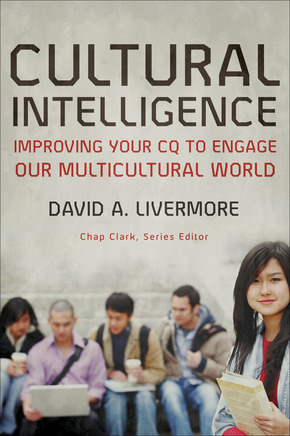
CQDavid Livermore’s goal in Cultural Intelligence is to effect cross-cultural transformation, rather than just impart information (12). Across the barriers of difference and “the barrage of cultures around us” (11), we still “have so much in common” (11). As we navigate the tensions of sameness and difference, Livermore notes, “These points of difference are where we find both our greatest challenges and our greatest discoveries” (11). Yet Livermore wants more than just cultural awareness. He says, “We must actually become more multicultural people so that we might better express love cross-culturally” (12).

Undergirding all levels of cultural intelligence is Livermore’s call to love, coupled with a robust theology of the Incarnation. I appreciated this theological and practical grounding. He writes, “The language of God is Jesus. The incarnation is the ultimate form of contextualization, the fullest embodiment of cultural intelligence” (33). As a result, Livermore warns those who think the Gospel can only be expressed in “one right way” (34). Jesus himself was a culturally situated figure, and yet a liminal one. The Gospels show Jesus’ interaction with 1st Century Palestine’s institutions and structures, where sometimes he embraced and other times he protested against the cultural values and practices of his day. Even if some readers will find his theological exposition familiar territory, it is nonetheless compelling.

CQ (cultural intelligence quotient) goes beyond educating ourselves about culture—even if it must start there. CQ “measures the ability to effectively reach across the chasm of cultural difference in ways that are loving and respectful” (13). An important step toward a fuller expression of love across lines of difference is growth in self-awareness. One must not only learn about other cultural mores and traditions, but one must know one’s own cultural heritage, and how that shapes one’s identity.

Livermore divides Cultural Intelligence into four basic types, which constitute the major sections of the book. First, there is Knowledge CQ, which pertains to a basic “level of understanding about culture and culture’s role in shaping behavior and social interactions” (48). This is CQ at the level of cognitive awareness. There are several important kinds of awareness: my awareness of my culture, my awareness of your culture, and my awareness of your perception of my culture (49). Livermore provides some practical metrics to help readers measure their Knowledge CQ: fluency in other languages, awareness of how other cultures resolve conflict, knowledge of cultural differences in how Christianity is expressed, lack of projecting our values onto others’ cultures, and so on (58, 61). Especially helpful is Livermore’s division of culture into three domains: socioethnic culture, organizational culture, and generational culture (93). His description of these domains addresses what would otherwise have been a concern of mine: that “culture” is not just a racial-ethnic phenomenon. I’ve worked at churches where the socioethnic culture and even generational culture were similar, but the organizational culture (“shared personality”) between the two was vastly different. Ministry methodologies and initiatives that worked in one church simply would not fly in the other.

Second, there is Interpretive CQ, which is metacognitive, since it relates to thinking about how one thinks. Interpretive CQ is essentially applied Knowledge CQ. If Knowledge CQ is basic exegesis, Interpretive CQ is hermeneutics. A key virtue here is that of empathy: “noticing what’s apparent about another person and trying to tune into her or his thoughts, emotions, and feelings” (158). Livermore connects Knowledge CQ and Interpretive CQ together into “cultural strategic thinking.”

Third, Livermore outlines Perseverance CQ, which is “our level of interest, drive, and motivation to adapt cross-culturally” (213). Anyone who has sought to form deliberate partnerships (or even just close friendships) across cultural lines is aware of the potential for discomfort, miscommunication, misunderstanding, and frustration, especially as intimacy builds. Perseverance CQ is the desire to push through these feelings for the sake of expressing love across the cultural gaps the author describes. Livermore offers an important set of questions and considerations:

What fuels our motivation? Why are we reaching into a new cultural context in the first place? We have to honestly face the motives behind our service, travel, and work. And we have to bear in mind that we are the Other to billions of other people. (225)

To push back, one may find oneself in cross-cultural relationships without deliberately engaging in service, travel, and work. They may exist “at home,” so to speak. Even so, the questions are worth asking. And the emphasis of othering the self that pops up throughout Cultural Intelligence is a needed (if difficult) perspective.

Finally, there is Behavioral CQ. This is the on-the-ground evidence that we love the Other. Livermore describes it as “the extent to which we appropriately change our verbal and nonverbal actions when we interact cross-culturally” (233). True CQ leads to action. We will not be able to “accomplish flawless cross-cultural behavior” (240), but we can become more faithful in “reflect[ing] Jesus to the Other through culturally intelligent communication” (241).

Cultural Intelligence concludes with a practical “What now?” chapter with “Twenty-four Ways to Advance Your CQ” (242). Then follows a CQ self-assessment, which is a brilliant inclusion. I first took the CQ self-assessment six years ago. I was surprised then to have tested so high (“excellent”) in the last two modes of CQ: Perseverance and Behavioral. Re-taking the test in 2016 I oddly dipped in Perseverance and Behavioral CQ, but went up in my “Cultural Strategic Thinking” (Knowledge and Interpretive CQ).

I wonder whether this is because my cross-cultural awareness has grown over the years, while my comfort with my own culture (and my being content with that comfort, to some degree) has led me to make cross-cultural stretching less of a priority. It’s not that I don’t interact with people from different cultures on a regular basis (whether socioethnic, organizational, or generational cultures); it’s just that given the choice I might default to monocultural settings, since they are “easier” (in some senses) to navigate. This is especially true when it comes to workplace and organizational culture. This may be sin I need to repent of—or just a reflection of my plate being over-full already, and the fact that my focus is strained until I graduate from seminary! I found the assessment to be somewhat limited, with its forced choices.

Readers will likely note at the beginning of Livermore’s book that the tasks the author sets out could be more difficult for “white” people who think of themselves as people who “have no ethnicity.” The outdated (but still present!) “Ethnic Foods” aisle is instructive here. “Ethnic” is understood all too often in opposition to “non-ethnic,” or “regular,” which then becomes culturally normative. The insidious danger is when this move happens subconsciously. Everyone has ethnicity, and all foods (and churches) are “ethnic.” The question is rather, “Of which ethnicity?” Livermore’s book reads, in some senses, as being geared toward such a person. However, even those who have done more extensive reflection on their own ethnic and cultural identity can benefit from his work.

Cultural Intelligence is an excellent primer for anyone seeking to enhance their cross-cultural fluency. Livermore is patient with the reader, but not overly so—he’s not afraid to challenge where needed. His truth-telling and practical step-by-step explanations combine to have a powerful impact. Anyone who gets lost in the various interdisciplinary concerns of the book will have a handy Glossary to refer to. Church leaders, Christians, and concerned citizens alike should carve out the time to not just read but also work through the concepts of the book—maybe even with someone with whom they have cultural differences.

You can find the book here at Amazon or here at the publisher’s page. Go here to read a .pdf sample.

OmniOutliner for Mac and iOS, Reviewed

OmniOutliner-for-Mac-1024The rise of the brilliant app 2Do notwithstanding, I continue to utilize OmniFocus as my task management hub. I was eager, then, to try out The Omni Group’s outlining app, OmniOutliner.

Think of OmniOutliner as a thought structuring app, suitable for both creating and organizing content. You can use it for any of the following scenarios:

  • making a grocery list
  • taking notes in class
  • writing a paper (and re-arranging sections easily)
  • planning and following through with a project
  • tracking and categorizing expenses
  • writing and editing your podcast script

There are multiple other uses for the app–I’ve made good use of it in sermon preparation, as you’ll see below. Right away the Mac and iOS apps take you to a templates screen so you can get started without delay:


Templates
On this and all images in the post, click or tap to enlarge


What’s Awesome About OmniOutliner


Getting content into OmniOutliner is fairly easy. It’s not as intuitive as just opening a blank Word document and typing, but it’s simple enough to open an outline and start writing.

Once you’ve gotten your outline going, being able to fold and unfold (collapse and expand) entire parts of the outline is a huge asset. If I’ve broken a book review down into parts, for example, I can just collapse the sections I don’t want to see at the moment:


Book Reviews Two Columns


Then there is the organizing power of OmniOutliner: you can take any node and indent or outdent it. You can drag sections of the outline around to quickly re-order them. And you can make batch edits when selecting multiple parts of your outline.

Perhaps the most helpful feature to me has been the ability to add notes to content, which you can then either hide or show. In this simple outline, I’ve set the note at the top to display (in grey), while the one toward the bottom remains hidden.


OmniOutliner Simple


You can show the sidebar, which allows you to move back and forth between a lot of content in one outline. When preaching on David’s odious sin against Bathsheba and her husband, I utilized an outline that included both my sermon structure and accompanying research. You can see that reflected in the sidebar, at left, even while my Topic column could remain focused on a smaller portion.


Outline in OmniOutliner


You can add media (audio recordings and video) to your outline. Your files would be huge, but if you wanted to use OmniOutliner for classroom notes, you could also add a live recording of the session, straight into your outline.

And then there is the styling. My goodness. You can tweak every aspect imaginable of your outline.

OmniOutliner Style PaneI found this feature set to be impressive but overwhelming. For my purposes, I didn’t need to do a whole lot by way of formatting, but the options are there should you need them.

To that end, the help files for OmniOutliner are incredible. So is their support team! There are user manuals you can download in multiple formats, and they are outstanding. In a couple of sittings, I read some 100 pages of the iBook version of the OmniOutliner for iOS manual. Yes, it was that interesting! Other app developers should take notes.

OmniOutliner is also available as a universal iOS app, working on both iPhone and iPad. You can sync across devices using Omni’s own server or your own.

The keyboard shortcuts available for iPad make OmniOutliner a serious contender for best writing app for those who are trying to make a serious go of it on iPad instead of computer. Omni Group’s Ken Case announced the shortcuts last November.

This means that the iOS OmniOutliner app is close to parity with the Mac app. This rarely seems to be the case with other apps, where iOS versions tend to lag behind their desktop counterparts.

OmniOutliner has had Split View and Slide Over in iOS for just about as long as iOS 9 has been released.

One other really cool thing: you can import the OPML file format from a mind map to move from mind mapping straight into OmniOutliner.


MN and OO with note


If that workflow interests you, read more about it here.
 

What’s Lacking


A few things are lacking in OmniOutliner:

  • I’ve experienced a couple of crashes when exporting my outline to other formats
  • The precision and plethora of styling options makes the app feel wooden and clunky at times, especially when you want to just sit down and write
  • If I want constant access to, say, a section of text in the second half of my outline, while I work on the first half, there is no way to split the screen or freeze a section so I can see easily disparate parts of my outline at once
  • There is no word count feature (!). Omni has indicated this could come in 2016, but not having it has kept me from making OmniOutliner my go-to writing app
     
    (Note: if you have OmniOutliner Pro for Mac (twice the price of the regular OO), you can go to the forums for an AppleScript that will help you with word count, but this is more than the average user should be expected to do.)


More Info


Byte for byte, OmniOutliner is worth your considering as your primary writing app. If you don’t need to be as structured with your writing, it may not be your top choice. Its integration across iOS and OS X, though, make it a possible go-to repository for collecting and organizing information.

You can find out more about OmniOutliner here and here.

OmniOutliner for iOS (Universal) is $29.99.

OmniOutliner for OS X is $49.99. OmniOutliner Pro includes a few more features and is $99.99.

You can get a free trial of Mac app here.


Thanks to the fine folks at The Omni Group, the makers of OmniOutliner, for giving me downloads for the Mac (OmniOutliner Pro) and iOS apps for this review. See my other AppTastic Tuesday reviews here.