This week in Greek Isaiah in a Year covers Isaiah 14:28-16:10. I’ve been behind off and on the last few weeks, but am caught up now. It’s amazing how even five verses a day can be a challenge to keep up with.
Here is the schedule and text for Monday through Friday, using again the text from R.R. Ottley’s Book of Isaiah According to the Septuagint (pictured at left; click on image to go to Amazon product page). Ottley is also here in Logos (I reviewed that edition here) and here as a free, downloadable pdf in the public domain. The full reading plan for our group is here (pdf).
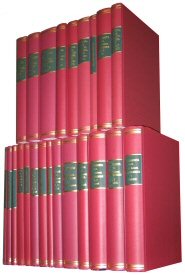
$369.95 for the Göttingen Septuagint in Logos Bible Software. It’s on sale for International Septuagint Day, all day Friday (midnight to midnight). If you click here, it adds to your cart, and you can purchase from there–whether you already have the academic discount or not. Marked down from $700.
I reviewed the Göttingen Septuagint in Logos here. Its product page is here.
Göttingen. Not just a city in Germany, but a word that instills awe and fear in the hearts of every student of the Septuagint who must eventually consult the set of Old Greek editions by that name.
Okay, that’s maybe a bit dramatic. I do suspect, however, that if one finds it challenging to learn how to read the leading critical edition of the Hebrew Bible–the Biblia Hebraica Stuttgartensia or BHS–the Göttingen Septuagint will prove even more difficult to decipher.
Not impossible, though.
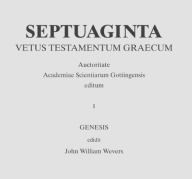
In celebration of International Septuagint Day Friday, here I review the Göttingen Septuagint in Logos Bible Software. The full name is Septuaginta: Vetus Testamentum Graecum Auctoritate Academiae Scientiarum Gottingensis editum. It’s published by Vandenhoeck & Ruprecht in Göttingen, Germany. The Göttingen Septuagint has published over 20 volumes covering some 40 biblical books (counting the minor prophets as 12). Publication of additional volumes, while slow-going, is in progress.
The typical contents of a volume include:
The introduction (“Einleitung”)
The reconstructed Greek critical text (“Der kritische Text”)
The Source List (“Kopfleiste”) (not every Göttingen volume has this)
The First Critical Apparatus (“Apparat I”)
The Second Critical Apparatus (“Apparat II”)
In two previous posts I wrote a primer on how to read and understand the Göttingen Septuagint. In part 1 I wrote about the reconstructed Greek critical text and the source list (full post is here). In part 2 I explained how to understand the first critical apparatus, here. Each of those posts contains additional explication of Göttingen, so the one who is new to it may want to pause here to read more there. Having written at length about numbers 2-4 above, a future post will cover 1 (the introduction) and 5 (the second critical apparatus).
Logos is the only Bible software that has available all of the published volumes of the Göttingen Septuagint. Though Logos offers the set in 67 volumes, that corresponds to the 24 existing print volumes. This includes the 2004 Supplementum, which offers a “list of Greek manuscripts of the Old Testament,” sorted by date, region, writing material, and more, and which also cross-references various editors’ classifications of manuscripts against each other, so that differing systems can easily be compared.
There is, of course, the question of which Bible software to use in general. I’ve written about issues like layout, functionality, cost, and so on here, which includes both praises and critiques of Logos, Accordance, and BibleWorks. So what about Göttingen in Logos?
From what I’ve seen, the text of Göttingen in Logos is the most accurate digital text available. I am aware of others who have found typos in Göttingen for Logos, but based on a verse-by-verse read of Isaiah 1-11, I found just one error in Logos compared to the print text. The Accordance text of Göttingen for Isaiah, by contrast, had 14 spelling mistakes, misplaced words, or wrong inflections in that same span. This was a surprise to me, since Accordance aims to produce “research-grade” texts, a goal which sometimes means their texts take longer to complete than other software companies. (Accordance currently has some, but not all, of the Göttingen volumes that exist in print.) As of right now, as far as the actual critical text of Göttingen, Logos seems to be the best bet for consistent correspondence to the print text.
It’s easy to set up the critical text and both apparatuses in three separate areas in Logos, syncing them to scroll together. One can also easily add a tab with an English translation, Hebrew Masoretic text, and more, so as to use Göttingen in conjunction with other resources. Here’s how I use Göttingen in Logos (click for larger):
Assuming you have other versions of the Septuagint available in Logos (Rahlfs, Swete, etc.) you can use the Text Comparison feature (top right in the shot above) to see where the critical text of Göttingen differs from another Septuagint text. I’ve found this to be a useful and time-saving feature. (One can do the same with the Compare tool in Accordance, though there’s an unresolved issue with that tool that impacts use of Göttingen. [UPDATE: It’s now resolved.] Accordance’s comparison tool is, however, a bit more versatile with its “List Text Differences” feature.)
You can use the critical text as any other text in Logos–double-click on a word to look it up in a lexicon (I have LEH open at bottom center above), right-click to do a variety of other searches, word study, etc. It doesn’t take long to see how many times the Göttingen text uses a given word.
As to the critical apparatuses, you can mouse over blue hyperlinked abbreviations to find out what they stand for. Or you can have an Information window open, as here (click to enlarge):
The apparatus abbreviates Latin and German, which is what the Information tab shows. (The Göttingen introductions are in German.) Miles Van Pelt’s short chart (in English) is helpful with the Latin (pdf here). And there is an English translation of the Pentateuch introductions available here (with Exodus being the most complete one). But there is no mechanism in Logos to translate the German or to decipher the apparatus. Accordance is the same here, and neither Logos nor Accordance offer a German-English dictionary, so one couldn’t even link to that. The general academic assumption, of course, is that by the time someone is using Göttingen in their study of the Septuagint, they are already learning (or have learned) German. (Ah, but academic assumptions….) I’m not sure it’s fair to fault Logos (or Accordance) for this lack, but a German-English dictionary as a future module would help a lot of users.
Speaking of the introduction, the introductions to each volume are nicely laid out with plenty of hyperlinks for easy reference:
You’ll have to know German to get very far in the introduction, but note the link above to English translations for some of the introductions. Also, though one ought not to rely too much on it, Google Translate takes the user surprisingly far if she or he simply copies from Logos and pastes here.
One thing lacking in the Logos Göttingen is the Kopfleiste (Source List). Not every print volume has it, but the five Pentateuch volumes, Ruth, Esther, and others do. Accordance, by contrast, includes this feature for the Göttingen volumes that have it. The Kopfleiste makes the most sense in a print edition (since it is a list of manuscripts cited on a given page), but someone doing serious textual research using Göttingen in Logos would still feel its lack. No word yet from Logos on if/when that will come available.
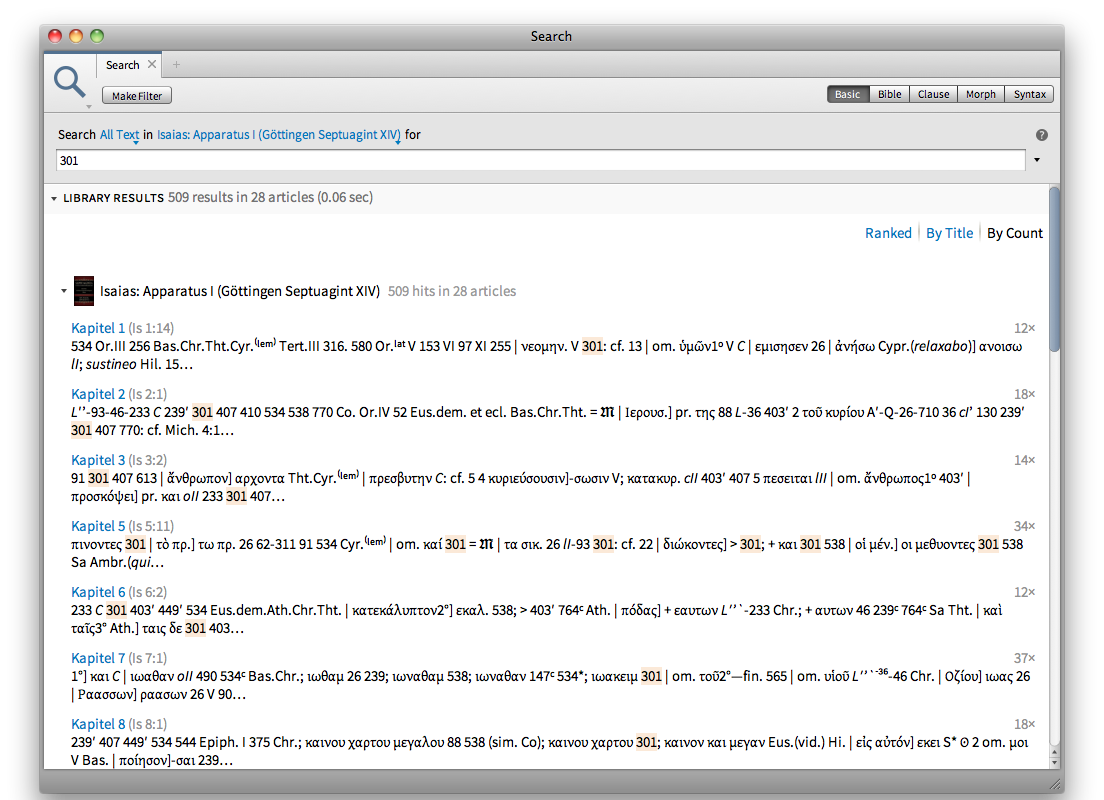
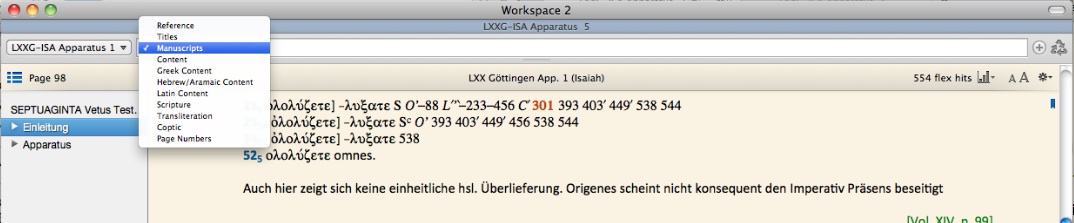
What about searching the apparatuses? Less than ideal here, though not unmanageable. If I want to see every time the First Critical Apparatus in Isaiah cites the Minuscule manuscript 301, I right click to “Search this resource,” but the results are grouped as follows (click to enlarge):
To my knowledge it is not possible to expand these results in this screen (pane) to see every use of MS 301, which is what I really want to be able to do. (If I am mistaken and find a way, I’ll post here again.) The shortcut command+F (in Mac) or control+F (in Windows) is an alternate way to search a text in Logos. The apparatuses are searchable using this keyboard shortcut; in this case all the instances of MS 301 are highlighted as you scroll through the apparatus, so you can still see all its occurrences.
Accordance, by contrast, offers multiple ways of searching an apparatus: by references, titles, manuscripts (most helpful), Hebrew, Greek, or Latin content, and more. This makes Accordance’s apparatuses really usable and easy to navigate in multiple ways.
The price for the Logos Göttingen is a bargain. I mean, $700 is not cheap, but considering that the same sum would get you just a few volumes of the print edition, it’s a great deal. The academic program gives you a significant discount in this case, too.
By the way, a tip for using Göttingen efficiently in Logos: Brian Davidson of LXXI has a neat way to set up a Logos layout to include multiple Göttingen books. (They list in the Logos library all as separate volumes, not as one Septuagint.) His suggestion (here) is a good way to go.
All in all, the Logos Göttingen is a worthwhile investment, especially if you primarily want Göttingen for the critical text itself, and for the chance to compare it with other Septuagint editions. The lack of a Kopfleiste is not an immense loss, but the inability to search apparatuses by multiple search fields (and with expandable results) is a drawback. So the potential purchaser will just have to consider what his or her needs are. Accordance nails it in apparatus searching, but their critical text in Isaiah had more mistakes than one who needs an accurate text would like.
Logos has a fully digitized Göttingen Septuagint, so if you need access to everything that exists in print, know that this is the only Bible software where you can get it. Accordance continues production on their volumes and, as far as I know, will see the project through to completion. (Though see here and here, a project of Computer Assisted Tools for Septuagint Studies.)
In Logos it’s convenient to be able to scroll through all of the Göttingen Septuagint with additional resources open and a click away. The electronic availability (and affordability) of Göttingen is a significant step forward in text criticism and Septuagint studies.
Many thanks to Logos Bible Software for the review copy of the Göttingen Septuagint, given to me for the purposes of review, but with no expectation as to the content of my review. Accordance provided me with their Göttingen Isaiah for purposes of comparison.
First things first: Friday is International Septuagint Day. I’ll post again more then. This week in Greek Isaiah in a Year covers Isaiah 10:30 through the end of Isaiah 12 (a six-verse chapter). Friday we celebrate International Septuagint Day by reading a whole chapter of the Old Greek of Isaiah.
Here is the schedule and text for Monday through Friday, using again the text from R.R. Ottley’s Book of Isaiah According to the Septuagint. (As always, Ottley is here on Amazon, here in Logos, and here as a free, downloadable pdf in the public domain.) The full reading plan for our group is here (pdf).
Here is the schedule and text for Monday through Friday, using again the text from R.R. Ottley’s Book of Isaiah According to the Septuagint. (As always, Ottley is here on Amazon, here in Logos, and here as a free, downloadable pdf in the public domain.) The full reading plan for our group is here (pdf).
Jesus makes a pun in Luke 4. I’m not the first one to notice this, but it stood out to me as I read my way through Luke 4:14-21 this past week. I’m preaching on the passage at my church tomorrow.
Jesus enters the synagogue at his hometown of Nazareth in Galilee and opens the Isaiah scroll to Isaiah 61. In the NIV, the Luke passage reads as follows:
The scroll of the prophet Isaiah was handed to him. Unrolling it, he found the place where it is written:
The Spirit of the Lord is on me,
because he has anointed me
to preach good news to the poor.
He has sent me to proclaim freedom for the prisoners
and recovery of sight for the blind,
to release the oppressed, to proclaim the year of the Lord’s favor.
But a few verses later (v. 24) Jesus tells the people, “No prophet is accepted in his hometown.” (They tried then to throw him off a cliff.)
The play on words Jesus uses is not readily evident in most translations, but Jesus uses the same word for favor (“year of the Lord’s favor“) as he does for accepted (“no prophet is accepted“). It’s a rare enough Greek word Luke uses, that I can only conclude it’s deliberate–this is the only passage in all the Gospels to use this word. (For Hellenophiles who read this blog, the word is δεκτός.)
The translations aren’t necessarily wrong to obscure the fact that it’s the same word in each verse. After all, context determines meaning, so even this same word carries different nuances the two times it’s used.
But the irony is that in this year of the Lord’s favor, which Jesus notes later in the passage begins “today,” even his hometown will not accept him. There is no acceptance (δεκτός) of this favor (δεκτός).
And before we rush to point backwards at the hard-heartedness of 1st century Nazareth, perhaps we easily enough realize those ways in which we fail to accept the favor that God would lavish on us. May Jesus give us sight where we do not see all that he comes to offer us.
In this last week (week 7) we covered chapter 8. Note that 8:23 in the reading plan is actually 9:1 in the Göttingen and Ottley editions, but marked as 8:23 in the Hebrew Masoretic text, as well as Rahlfs. Note Ken Penner’s versification comparison chart here.
Here is the schedule and text for Monday through Friday, using again the text from R.R. Ottley’s Book of Isaiah According to the Septuagint. (As always, Ottley is here on Amazon, here in Logos, and here as a free, downloadable pdf in the public domain.) The full reading plan for our group is here (pdf).
Monday, January 21: Isa 9:1 MT=9:2 LXX – Isa 9:6 MT=9:7 LXX
This week our reading includes Isaiah 8:14, which Paul and Peter cite together with Isaiah 28:16. About this passage Jobes and Silva write:
Both Paul and Peter–perhaps reflecting an early Christian tradition–link two passages in Isaiah, namely, 8:14 with 28:16, presumably because the word λίθος occurs in those two passages (see Romans 9:33 and 1 Peter 2:6-7). But there is more. LXX Isaiah 8:14 begins with the clause καὶ ἐὰν ἐπʼ αὐτῷ πεποιθὼς ᾖς (“and if you put your confidence in him”), for which no corresponding text is found in the Hebrew. The translator evidently took his cue from the last clause of verse 17 (καὶ πεποιθὼς ἔσομαι ἐπʼ αὐτῷ=וקויתי־לו) and used it to give a surprising interpretation of verse 14. In addition, he provided a closer link between 8:14 and 28:16 by adding the words ἐπʼ αὐτῷ to the latter passage. It is clear that the Greek translator’s own reflection on the message of Isaiah had a signficant impact on early Christian theology.
Last week, week 6, we read chapter 7 start to finish. In this week 7 we do the same with chapter 8. Friday is an anomaly in the reading plan–just one verse that day. Note, too, that 8:23 is actually 9:1 in the Göttingen and Ottley editions, but marked as 8:23 in the Hebrew Masoretic text, as well as Rahlfs.
Here is the schedule and text for Monday through Friday, using again the text from R.R. Ottley’s Book of Isaiah According to the Septuagint. (As always, Ottley is here on Amazon, here in Logos, and here as a free, downloadable pdf in the public domain.) The full reading plan for our group is here (pdf).
The one who is serious about getting at the earliest attainable text of the Hebrew Bible will eventually find herself or himself face-to-face with a page like this:
Genesis 1 in the Göttingen Septuagint
The Göttingen Septuagint is the largest scholarly edition of the Greek translation of the Hebrew Bible. Its full title is Septuaginta: Vetus Testamentum Graecum Auctoritate Academiae Scientiarum Gottingensis editum. Vandenhoeck & Ruprecht in Göttingen,
Germany publishes the series, which includes more than 20 volumes covering some 40 biblical books (counting the minor prophets as 12). Various editors are working toward the publication of additional volumes.
But if good coffee, fine wine, or well-aged cheese requires work on the part of the one taking it in, the Göttingen LXX makes its own demands of the reader who would use it. The critical apparatuses on each page have Greek, abbreviated Greek, abbreviated Latin, and other potentially unfamiliar sigla. The introductions in each volume are in German.
How to read and understand the Göttingen Septuagint, then? To begin, here is the sample page from above:
Genesis 1:4-9, reprinted with publisher’s permission
There are four main parts to the page, marked in the image above by the numbers 1 through 4.
The reconstructed Greek critical text (“Der kritische Text”)
The Source List (“Kopfleiste”) (note: not every Göttingen volume has this)
The First Critical Apparatus (“Apparat I”)
The Second Critical Apparatus (“Apparat II”)
In part 1 of my primer, I covered numbers 1 and 2 above. To summarize a bit:
1. With verse references in both the margin and in the body of the text, the top portion of each page of the Göttingen Septuagint is the editorially reconstructed text of each biblical book.
2. The Kopfleiste comes just below the text and above the apparatuses. Wevers notes it as a list of all manuscripts and versions used, listed in the order that they appear in the apparatus on that page. A fragmentary textual witness is enclosed in parenthesis.
Next are the two critical apparatuses. In his introduction to Genesis (conveniently translated into English here, from which I quote), editor John William Wevers speaks of the critically reconstructed text as an “approximation of the original” and “hopefully the best which could be reconstructed.” I previously noted:
[Göttingen] editors have viewed and listed the readings of many manuscripts and versions. The critical apparatuses are where they list those readings, so the user of Göttingen can see other readings as they compare with the critically reconstructed text. (Because the Göttingen editions are critical/eclectic texts, no single manuscript will match the text of the Göttingen Septuagint.)
The International Organization for Septuagint and Cognate Studies (IOSCS) notes (from here):
The Göttingen Septuagint features two apparatuses (as does the Larger Cambridge Septuagint), the first for LXX/OG textual evidence proper and the second for so-called hexaplaric evidence, i.e. “rival” translations/revisions of the translated LXX/OG (such as circulated under the labels “Theodotion,” “Aquila,” and “Symmachus”), preserved largely through the influence of Origen’s Hexapla. For LXX/OG research the importance of both apparatuses is second only to the critical text itself.
The challenge, of course, is that to make sense of the apparatuses and their abbreviations.
3. The First Critical Apparatus (“Apparat I”)
The “textual evidence proper” consists of any readings that the editor deems as variant to the reconstructed text. The editors follow a consistent order in the witnesses they cite. (There is minor variation, volume to volume.) In Genesis Wevers writes:
The witnesses for a variant are always arranged in a set order: a) the uncial texts in alphabetic order; b) the papyri in numerical order; c) the witnesses of the O‘ mss [AKJ: the “hexaplaric group”]; d) the witnesses of the C‘’ mss [AKJ: the “Catena group”]; e) the remaining text families (comp Section B I above) in alphabetical order; f) the rest of the Greek evidence in the following order: N.T. witnesses, Ios [AKJ: Josephus], Phil [AKJ: Philo], followed by the rest of the Greek writers in alphabetic order; g) La (or the sub-groups, for ex. LaI Las, etc.) [AKJ: Old Latin versions], followed by the other versions in alphabetic order; h) citations of the Latin Fathers, introduced by the sign Lat (these witnesses always stand in opposition to La or a sub-group of La); i) other witnesses or commentaries.
To look at an example of the first critical apparatus, Deuteronomy 6:5 in the Göttingen edition reads:
(And you shall love the Lord your God with all your mind and with all your soul and with all your strength.)
The apparatus for that verse, in part, has:
om καί 1° Arab Sa17 | αγαπησης 30; αγαπη σε 527 | κύριον τόν] bisscr 120* | om σου 1° Tht Dtap | ἐξ 1°—διανοίας] εν ολη τη καρδια Matth 22:37 |
With each unit broken up by line here, the apparatus gives this information about its manuscripts:
Arab and Sa17 omit (om) the first (1°) use of καί
30 has αγαπησης; 527 has αγαπη σε
120* has κύριον τόν written (scr) twice (bis)
Tht Dtap omits (om) the first (1°) use of σου
From the first use (1°) of ἐξ through (—) the word διανοίας, Matthew 22:37 has rather (]) εν ολη τη καρδια
One has to go to the introduction for information about the manuscripts “Arab” (Arabic version), ” Sa17” (from the Sahidic version), “30” and “527” (minuscule manuscripts), “120*” (also a minuscule manuscript, where the asterisk * refers to “the original reading of a ms,” as opposed to a “correction”), and “Tht Dtap” (Tht=Theodoretus (“Cyrensis=Cyrrhensis”); Dt=his Quaestiones in Deuteronomium;ap refers, Wevers notes, “to readings (variants) in the apparatus of editions”).
Miles Van Pelt has produced a concise two-page summary of sigla and abbreviations. I offer appreciation and gratitude to Miles that I can link to that pdf here. That offers further instruction as to deciphering the apparatuses (both the first and second) in the Göttingen volumes. The introductions to given volumes contain the signs/symbols and abbreviations (“Zeichen und Abkürzungen”), as well.
Boromir had it right:
So I’ll write about the Second Critical Apparatus (“Apparat II”) in a future post. Until then….
Thanks to Brian Davidson of LXXI for his helpful suggestions on an earlier draft of this post and the part 1 that preceded it. He is not to be blamed for the inclusion of Boromir in this post.
This week in Greek Isaiah in a Year we get to the famous and sometimes contested Isaiah 7:14. Here it is in Ottley’s Greek text, including his English translation:
Therefore the Lord himself shall give you a sign; Behold, the virgin shall be with child, and shall bring forth a son, and thou shalt call his name Immanuel.
Last week I hosted the Biblical Studies Carnival for December 2012. Here’s an excerpt of posts I linked to from December about Isaiah 7:14. There were even more than what I highlighted:
December saw a plethora of posts about παρθένος/עלמה in Isaiah 7:14, and Matthew’s use of that verse. Here is T.M. Law, saying that Greek Isaiah’s use of παρθένος for עלמה is not without precedent in the LXX (“The Greek translator of Isaiah used a perfectly acceptable rendering for עלמה.”). Here’s the Jesus Creed on the virgin birth. Krista Dalton notes, “[T]he author of Matthew is not saying that Isaiah was envisioning the birth of Jesus.” Kevin Brown of Diglotting posts here about it. And, looking at hermeneutics more generally, Brian LePort suggested three paradigms to use in studying the virgin birth.
So for this Week 6 of Greek Isaiah in a Year, we cover one chapter in its entirety, chapter 7. I’m looking forward to what I’m sure will be lively discussion on Wednesday at our Facebook group. Below is the schedule and text for Monday through Friday, using again the text from R.R. Ottley’s Book of Isaiah According to the Septuagint. (As always, Ottley is here on Amazon, here in Logos, and here as a free, downloadable pdf in the public domain.) The full reading plan for our group is here (pdf).

 Here is the schedule and text for Monday through Friday, using again the text from R.R. Ottley’s Book of Isaiah According to the Septuagint (pictured at left; click on image to go to Amazon product page). Ottley is also here in Logos (I reviewed that edition here) and here as a free, downloadable pdf in the public domain. The full reading plan for our group is here (pdf).











 Words on the Word