What Jonah, Honest Toddler, McNulty, and Choose Your Own Adventure Novels Have in Common

Honest ToddlerI have Honest Toddler to thank for helping me keep my wits about me as the father of three young kids. Here’s a recent Facebook status of this all-too familiar personality:

Good Morning! Wow it’s like it has been forever. …. Anyway for breakfast I’ll have 6 plain pancakes … on the red plate. Not the red one with the green trim or the brick colored one, RED. Yes, the one that shattered yesterday. I’m sure you’ll figure something out. God help you if I see a crack. Also, I would like my pancake intact but in bite-sized pieces. Don’t break my pancakes but please cut them. I want them undamaged but in small pieces so I can eat. Do you see what I’m saying? Perfect but altered. It’s not hard. Follow your heart but keep in mind that if you get it wrong I’ll make today hard. Ok I’ll be in the family room sitting in your lap while you also cook in the kitchen. Love you. (so hungry)

Toddlers can somehow seamlessly embody two (or more) mutually exclusive desires at the same time.

I want to wear that shirt, but I don’t want it covering my top half.

I want milk on my cereal, but I don’t want my Cheerios to be wet!


 Nuanced Characters


I have a hard time knowing what to do when someone I’m responsible for wants me to do their top button, but at the same time leave it unbuttoned.

McNultyBut when it comes to literature, film, music, and narrative TV, I love highly nuanced and complex characters.

I appreciate people like Elsa, Jimmy McNulty, Robert Duvall in The Apostle, any character by Flannery O’Connor.

Good literature, good film, and good TV all blur the line between “good guys” and “bad guys,” because those categories aren’t so clear in real life.

Jonah’s a fascinating character in that regard. We’re not really sure what to make of him. Is he a good prophet, a bad prophet, or some of both, depending on the day? His portrayal is not an even one, or an easy one to detect. He’s a bundle of contradictions and love and judgmentalism and frustration and eagerness and obedience…. He runs away from Nineveh, but then goes flying towards it, preaching repentance as he walks into the city. And then with his message successful, he flees the city again, to watch it from afar.


Jonah: Loves God’s Compassion (for him),
Hates It (for others)
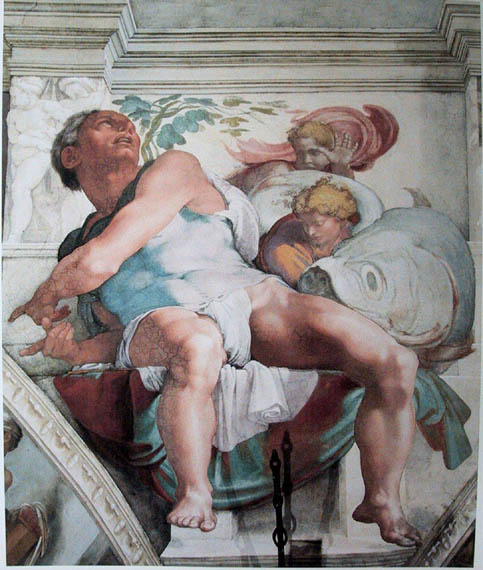
 

Jonah / Michelangelo / Sistine Chapel

God’s compassion is what Jonah loves most about God… when it comes to Jonah. It was God’s predisposition toward second chances, after all, that has kept Jonah alive throughout this book.

Jonah shows in Jonah 4 that he knew one of Israel’s creeds quite well: “I knew that you are a gracious and compassionate God, slow to anger and abounding in love, a God who relents from sending calamity.” And he rightly takes the shade-giving vine as God’s provision for him.

But if God’s provision and compassion toward Jonah is what keeps Jonah coming back to God, the Lord’s mercy toward despised others is what keeps Jonah running away from God.

Three times in this chapter Jonah tells God he’d rather die than watch his repentant enemies receive God’s clemency.

It almost makes you think about Peter’s three-fold denial of knowing Jesus. Jonah tries to deny God the opportunity to forgive whomever he wants to forgive.


Even the Animals


Jonah is angry enough to die. But God is concerned enough to save a clueless city…. even the animals!

Like in Jonah 4:11. Another translation follows the word order of the Hebrew a little more closely than the NIV, and punctuates the book’s ending with a mention of the animals!

“Should I not be even more concerned about Nineveh, this enormous city? There are more than one hundred twenty thousand people in it who do not know right from wrong, as well as many animals!”

A Heathen Animal of Nineveh, Pre-Repentance

Animals—there they are again! Putting on their sackcloth and mooing their repentance to the Lord.

Jonah loved the whale that saved him, but the worm that ate his shade—this animal he hated.

A vine that came up overnight, that Jonah had nothing to do with—he latched onto and cried when it withered. But a city full of hopeless people… well, he wanted them to wither like that vine… to go down into the depths and be consumed by worms.

But God loves all that he has made—evildoing humans, whales, worms, withered vines, and cursing sailors. Not one being is outside the scope of God’s loving care.


Good Theology, Bad Heart


Jonah gets a lot of things right. He’s right, I think, to be so angry at the perpetrators of injustice and oppression. He’s like every other God-inspired prophet who railed against those who tipped the scales to keep others down.

And he’s right about who God is, in verse 2 of the final chapter of the book: “a gracious and compassionate God, slow to anger and abounding in love, a God who relents from sending calamity.”

But not everything in Jonah’s head has made its way down into his heart. His theology at the beginning of this chapter sounds right, but he wants to apply the attributes of God just to himself.

It’s as if Jonah turns God’s words against him. He recites a well known formula, an articulation of who God is, but in a mocking tone of voice. In conflict resolution terminology, that’s called invalidating.

He’s like the prodigal son, who can’t stand watching lavish grace poured out on people who should have long ago forfeited the opportunity by their behavior. He’s the good guy, they’re the bad guys–why would God show them favor?

Which leads to an important question: Whom is God for? For whom exactly does God intend his salvation?


Whom is Christmas For?


And we might seasonally appropriate that question: Whom is Advent for? Whom is Christmas for?

Whose Light?
Whose Light?

It would be easy in a season of preparation, to tend so much to our own hearts and lives, that we think only of how we receive Jesus for ourselves. We can spend so much time tending the vine, that we forget about the city we live in.

And we may be tempted to keep God’s compassion to ourselves and begrudge him when he shows mercy to those who have wronged us (and then turned to God). Well, we just wanted to see them get what was coming to them!

A Jewish commenter on this passage says, “It is not unusual for people to be so intent on the punishment of others that they lose their own way and are disappointed when people change their ways for the better.”

Jesus came into the world, offering light and life to anyone who would turn away from the darkness and turn toward him. And there are some really scummy people included in this invitation. How do we feel about that? What do we think of God’s way too liberal compassion? (I mean, he should pace himself more, right?)

Will we hide it under a bushel? Is God’s grace a proprietary character trait, only meant for the people of God? Jonah tried to hide under a vine, a divinely created shelter that he wanted only for himself.

But God sent a little worm to eat that thing up, in an effort to shake Jonah out of his self-focused slumber.


Choose Your Own Adventure


I like these stories with nuanced characters, ones whose interior lives are complex. I think this sort of storytelling is truer to the human condition.

And I resonate with Jonah. He gets it some of the time; other times, not so much. He really has a hard time just letting God be God.

One other thing that good storytellers do, besides writing full and complex characters, is to write compelling endings.

You can probably recall endings to novels that left you with goosebumps, because the last few lines of the story actually described a new beginning:


So we beat on, boats against the current, borne back ceaselessly into the past.


After all, tomorrow is another day.


Where the Wild Things AreMax stepped into his private boat and waved goodbye and sailed back over a year and in and out of weeks and through a day and into the night of his very own room where he found his supper waiting for him—and it was still hot.

These stories show characters with the hope of boats going on, even if into the past… they show the hope of a new day, the hope of a still-hot dinner, waiting in his room.

The narrator of Jonah is writing a new beginning into the end of the story.

But Nineveh has more than a hundred and twenty thousand people who cannot tell their right hand from their left, and many cattle as well. Should I not be concerned about that great city?

This is no tidy conclusion. It’s a question. It’s a rhetorical question, and we know the answer, just like Jonah knew the “right answer” in verse 2. But even as a rhetorical question, it invites—even demands—our response.

We have no idea how Jonah ends for Jonah. We don’t know if he’ll continue in his anger, or if he’s changed for the better.

Choose Your Own AdventureBut it really doesn’t matter… because it’s not just Jonah’s new day that the author concerned about… it’s ours. This is not The Great Gatsby or Gone with the Wind or Where the Wild Things Are. Jonah reads much more like a Choose Your Own Adventure book, where you, the reader, decide how the story ends for you.

The conclusion to Jonah requires our participation.

God has compassion on evil agents of empire when they come clean. The compassion that was always ours is now theirs—we have decide if we’re okay with sharing.

We are left with having to answer God’s question ourselves. The main character of the book of Jonah has always been God, with Jonah the most prominent supporting actor. But now we become the supporting cast, as we hear God ask:


“Should I not be concerned about that great city?”


Should I not be concerned about people who are killing each other, enslaving the innocent, beating the helpless, oppressing the poor, and destroying the environment?


Did I not come to earth to set despised evildoers free, too, should they accept my love?


Do you have any right to be angry at my gratuitous acts of incarnation, crucifixion, and resurrection for the life of the world?


Is this not the way, God asks, of my breaking in on earth, that I should have mercy on whom I will have mercy, and compassion on whomever I please?


This doesn’t mean there won’t still be justice, but do you have any right to be angry, God asks, when I decide to save the ones who should be smitten down?


The book of Jonah all boils down to that burning question: What will your response be, O reader, to the ways and work of God? Can you only accept it on your own terms, and keep God’s grace close to home? Or can you see Jesus as coming to earth for everyone, a gift of love for anyone who would believe?

Jonah ends here—but for us, the revelation of God’s concern for oppressors is not a period, but an ellipsis….


When Jesus comes, will we receive him largely for ourselves? Or can we receive him on his own terms, and open our hearts to his compassion so that we overflow with love toward even the most corrupt parts of God’s creation?


The skilled storyteller invites us now to take up the pen…

…to write—and to live—our response.


Two New IVP “Black Dictionaries” from Accordance

Last week Accordance released two new IVP “black dictionaries.” Both cover the Old Testament. There is Wisdom, Poetry & Writings and Prophets.

Here’s a screen grab from the Accordance page–they’re on sale through midnight EST tonight, and still reasonably priced after that.


Prophets (click image below for product page):

IVP Prophets


Wisdom, Poetry & Writings (click image below for product page):

IVP_Wisdom, Poetry, Writings


These IVP dictionaries are really good. I usually use whatever volume I own when preparing sermons.

And Accordance 11 (just released this fall) is a nice way to use these dictionaries. You can try especially sophisticated searches with them in Accordance, like this one.

If you’ve used either of these dictionaries, I’d love to hear your thoughts in the comments. So far, I’ve really appreciated everything else from this series.

All of Joy of Cooking’s Recipes, On Your Phone

http://a2.mzstatic.com/us/r30/Purple5/v4/0c/24/75/0c24758d-bcc6-2a84-1e00-9e308d7b5740/icon175x175.jpegDid you know that you can get the entirety of Joy of Cooking in your iPhone or iPad?

The iconic and ever-useful cookbook would be hard to improve upon in its print edition (though some duct would help ours), but the iOS app does just that.

It’s currently on sale through New Year’s Day, $4.99 at the App Store. EDIT: They’ve changed the price twice since I posted. As of 12/22, it’s $6.99.

If I procure the app unto myself, I shall report back, but for now here’s a bit of what it claims to be able to do:

• Universal app supports both iPhone and iPad.

• Thousands of recipes and reference materials cover everything from enchiladas to lemon meringue pie.

• All materials are included in the app. No internet access is required.

• Pre-set digital timers enable you to get each recipe just right.

• Let the app speak each step aloud so you can concentrate on cooking, rather than reading.

• Navigate each recipe with simple voice commands. No need to touch the screen with sticky fingers!

• Thousands of photos and illustrations leave nothing to interpretation.

• Built-in menu-maker allows you to create a menu and use it to
navigate among recipes while you cook; you can even print it out or
email it to your guests.

• Joy of Cooking classic red bookmarks help you keep track of several recipes at once.

• The Favorites list lets you store recipes that you want to cook again and again.

• Shopping lists can be created easily from one or more recipes.

• The Sleep-Block feature prevents your iPad from sleeping when you just want to cook.

• A switch to enable metric units can adapt recipes to your preference.

• A built-in conversion calculator makes it easy to substitute just
about anything. Want to know how many teaspoons are in a half-cup? That
answer, and many others, is just a few taps away.

…and more.

Here are a couple screenshots from the App Store:


Read more about this impresive-looking app here.

My New External Brain: Evernote

Evernote Icon


I’ve finally seen what all the Evernote fuss is about: It’s more impressive than almost any other productivity app I’ve used, and a basic account is free.

The company claims a lot for its app:

Evernote makes modern life more manageable by letting you easily collect and find everything that matters. From work notes and to-do lists to recipe collections and travel plans, add everything to Evernote to help you get organized without the effort.

But it’s so easy to access from any other app on any device, and so well-organized that it really can help you remember (or, rather, access) everything.

For example, do you want to file away the information in an email in a safe place, but not lose it among hundreds of email folders? Email it to your custom-created Evernote address, and it automatically files in your default notebook.

Do you want to make a simple shopping list with check marks and tap them as you go? Evernote can do that.

Do you have a bill you need to pay, and want to remind yourself of that unfortunate reality, but also have the relevant info at hand? Just take a picture of your bill with Evernote, add in a few comments, and it all saves in one place. You can even set a time-basd reminder to a note.

EvernoteAre you trying to make sense out of that stack of recipe notecards, and want to have it all in one easily accessible location for next time you cook? You can take photos of everything and file it in a “Recipes” notebook in Evernote. You can even tag your recipes with primary ingredients or nutritional details, so that pulling up your “Protein” tags gives you some good ideas for dinner.

There are at least a dozen more ways I’m using Evernote now every day to organize myself. I highly recommend it.

If you want to try it, you can register for free here. Going to that link also gives you and me both a free month of Premium, which adds some nice features like (get ready): keyword searching the three pages of text you just photographed from your favorite textbook. Yes, Evernote can do that.

But you don’t really need Premium to get a lot of utility out of it. It’s free, no strings attached.

It’s not perfect, of course. But I have yet to run into a limitation for the many ways I’ve already put it to use. Check it out and see what you think.

App Santa–Sweet iOS Apps on Sale

App Santa


I’m not sure how the actual St. Nick would feel about iTechnology, but App Santa offers a surprisingly large selection of excellent iOS (and Mac) apps for sale, starting today.

A few highlights of apps I use (and like):

  • PDF Expert 5 ($6.99, from $9.99)
  • Scanner Pro ($2.99, from $6.99), which I use regularly for e-filing
  • Calendars 5 ($2.99, from $6.99), even better than Apple’s native Calendars app
  • TextExpander Touch ($2.99, from $4.99)

And a few apps that I haven’t reviewed (but will soon) that look sweet:

  • Drafts 4 ($4.99, from $9.99), “where text starts on iOS”
  • Launch Center Pro ($0.99, from $4.99), the tag line of which is, “Launch actions, not just apps”
  • Screens ($13.99, from $19.99). This morning after having it installed for less than a minute, I was using a tiny little phone to control a big desktop computer. Amazing!
  • MindNode ($4.99, from $9.99): a smooth mind mapping app, which I’ll post about more in coming months

Find them all (and others) here.

Nisus Writer Pro: One Day Festivus Sale

Strong, Fast
Excellent Word Processing for Mac


I don’t really know much about Festivus, but in honor of it, for less than 24 hours, Nisus Writer Pro is on sale. I was pleasantly surprised by this really versatile and smooth (and high-powered) word processor when I started using it a few months ago.

Find Nisus Writer Pro here. You can also get Nisus Writer Express and a sweet Mac Mail searching program (InfoClick) on sale. I don’t think it gets priced this low, usually.

Here’s the pricing info, from the Nisus newsletter:

Nisus Writer Pro is $55 for the full version (regular price $79) and $35 for the upgrade (regular price $49). Nisus Writer Express is priced at $20, the upgrade price is just $15. InfoClick is only $10! Family Packs for both Express and Pro are also discounted. You can purchase from our store and from the Mac App Store (full versions only).

All you need to do is go to our store and buy, no coupons required. You will be happy you did as you will receive a fantastic deal on great Nisus products.

I have switched almost all of my work away from Word and Pages to Nisus Writer Pro. I highly recommend it. There are also demo/trial versions at the links above.

15% Off All Logos 6 Base Packages

Logos 6 is Here


Now you can get 15% off any base package in Logos 6 through Words on the Word. If you order a base package through this Logos landing page, Logos feeds a percentage back to me, which I’d use for resources supporting the work of Words on the Word. (Current project I’m excited about: Greek Psalms in a Year.)

Check it out here, or just use the promo code ABRAMKJ6 when you checkout with a base package in your Logos cart. My review of Logos 6 is here.

A Full Review of Accordance 11

Acc 11_Simply Brilliant_logo


Accordance 11 is now available. Here I offer a full review.


Don’t Forget: Version 10 Was Already Sweet


To fully understand all I appreciate in Accordance, I offer you this collection of links to my Accordance 10 review posts. While potential upgraders will want to know what is new in 11, those new to Accordance altogether will find a wealth of practical and impressive features. For example, a few initial standouts when I reviewed version 10 were: Analytics (#1 here), Flex Search (first feature noted here), the use of the Command key on Mac to make the Instant Details pane do even more, and Construct searches (see #2 here).


What to Love About Accordance: Improvements in Version 11


None of the features that so impressed me in Accordance 10 has disappeared. The overall layout and appearance of 11 is similar to 10. (Accordance 10 offered a significant update in appearance over version 9.)

An overview of the features in Accordance 11 is here. I’ve found 7 improvements in particular to be laud-worthy:


1. The New Info Pane


A new option is available when you have a Bible text open and click the “Add Parallel” button: Info Pane. Here’s what it looks like:

Info Pane

Though you can save a Workspace with dozens of commentaries tied to a Bible text, Info Pane automatically pulls up all the commentaries (and Study Bibles!) you own that treat a given verse. Clicking on the cover image takes you (in a new pane) to that commentary. What’s especially thoughtful about how this feature was programmed is that just hovering the cursor over a cover image shows the text from that commentary in the Instant Details pane.

You can also choose from a variety of Cross-Reference modules to display hyperlinked related verses in the Info Pane. The Topics section quickly links you to other verses that address the same themes your passage does.

The Apparatus portion is an especially nice feature for doing textual criticism–you can see the information multiple apparatuses contain very quickly.

Accordance 11.0.1 already added something neat: you can command-click on your Cross-References in the Info Pane to see them all at once.

So command-clicking on the Cross-References at right here:


X Ref 1


yields this:


X Ref 2


The Info Pane is useful in the Gospels, too, where it pulls up “Parallel Passages.”

Whereas in Accordance 10 I had to create and save new Workspaces with relevant commentaries for a given book of the Bible, now in 11 the Info Pane means I can get up and running with research on any book, right away.

And the speed with which everything operates from the Info Pane is quite incredible. Long-time Accordance users probably won’t be surprised, but it is good to see that even a more advanced and robust feature like the Info Pane operates with the same expected speed that makes Accordance what it is.


2. Custom Upgrades


New to the online store in Accordance 11 is the chance to “Custom Upgrade,” which provides users with a discounted collection rate if they already own modules contained in that collection. The Custom Upgrade option is recently also available for various Add-on Bundles. This new feature will especially be welcomed by long-time users who will essentially be rewarded now for past purchases, should they decide to upgrade in various instances.


3. Quick Entry


When I first heard about this feature, I didn’t think it would be that big of a deal–predictive text entry is already available in Google and a host of other free programs. But Quick Entry really does speed up my work with Accordance. One especially neat thing about this feature is how it works with Bible texts.

One can toggle between searching a Bible by Words or Verses. But here I get both options suggested at once, just by typing in the letter “G.” I can then select an option from the drop-down menu, which narrows if I type additional letters. This is a good refinement to the program.


Acc11_Quick Entry


4. Better Library Organization for Tools


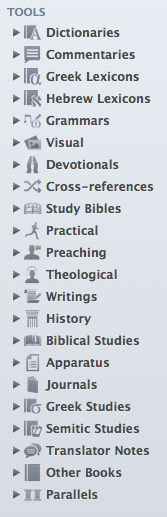
You can have Accordance 11 automatically organize your tools into the following folders:


Acc11 Library Tools Organized


Of course, further customization is possible, but this makes for a great starting point, having everything so well-sorted, which it wasn’t in Accordance 10. David Lang from Accordance has explained the re-organization in detail here. (If you’re already an Accordance user considering an upgrade to 11, you’ll appreciate what David has to say.)

This easier organization also greatly enables what has recently become my most used new feature in Accordance 11….


5. Research, or, The Feature Formerly Known as Search All


Search All (Accordance 10) was fine, but Research (Accordance 11) is even better.

We’re in the season of Advent now. What does my Accordance library have to say about this important time of preparation? Think of Research as harnessing the power of a Google search, but utilizing the content of all the books Google only allows limited preview to. In a matter of seconds, or less, Accordance goes through all my Dictionaries (selected in the drop-down menu at top left in the image below) for “Advent.” The resources that have search hits are neatly listed in the left sidebar, and the main pane of the window below allows me to quickly scroll through all the places “Advent” appears. There is an option to see “More…” of a hit result, while still staying in the same Research tab. Or you can just click on “Open” to go directly to the resource:

Research in Acc11At first I thought the new Research was just pretty cool, but it’s much more advanced than Search All, well-executed, and easy to navigate. I find myself using it much more than I used Search All in version 10.

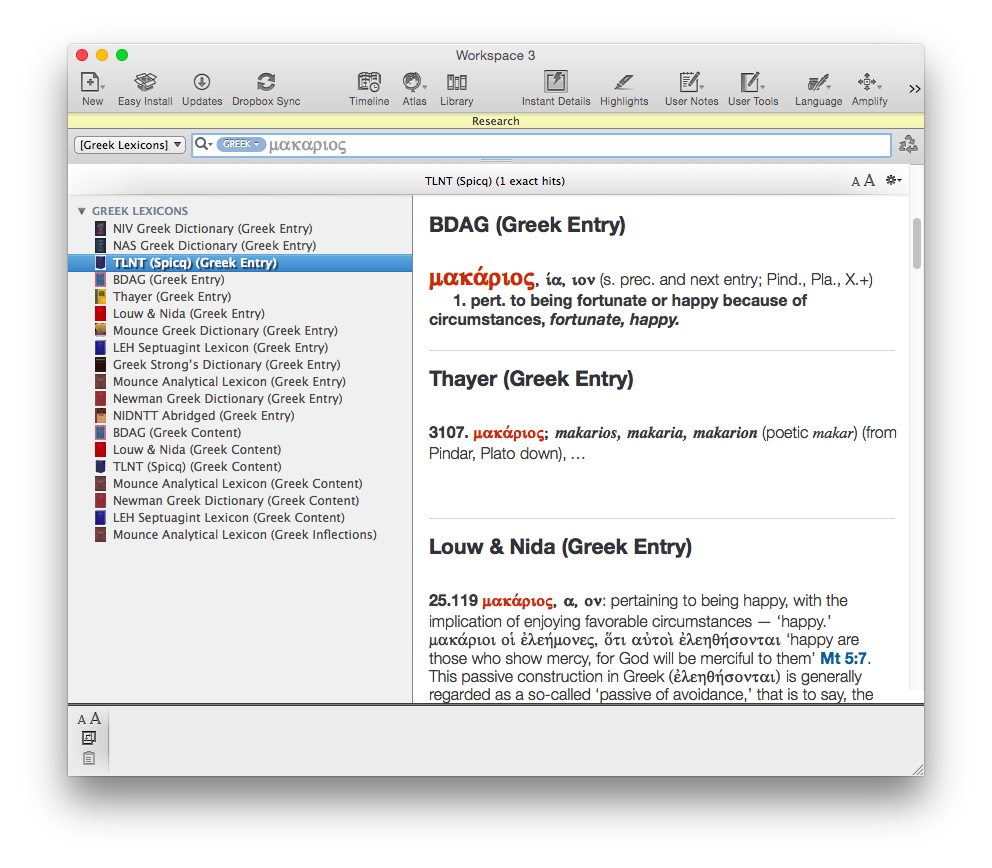
How does it tie in to the newly organized Library? From that drop-down menu that gave me “Dictionaries,” I can hone my search in on any category of tools in the library–Grammars, Commentaries, Greek Lexicons, etc.

Here–it’s worth showing two more search results, just so you can see how cool a thing Research is:

Acc11 Research_Greek Lexicons

Acc11 Research_Jonah

6. User Notes Extended to Commentaries and Books


Accordance 11 offers some improvements to User Notes, not the least of which is that users can at last take notes on commentaries, books, and other non-biblical resources they own. You can do this in Kindle, iBooks, Logos, etc., so I’m glad Accordance is caught up here. This has been a long-requested user request, so will be a much-appreciated addition.

You can make a single note file that is notes on one book, or you can make a note file that includes notes on multiple books you own.

There is also now full Unicode support for Notes.


7. Speed


Okay, this is definitely not a new feature, but it’s so much a part of what makes Accordance Accordance that I am compelled to mention it. Even running Research queries returns results before you can even think to navigate away to Firefox and check your email. Once again Accordance has added new features without sacrificing their trademark speed.


Desiderata


There’s still room for improvement, though. Here are some desired features:


1. More Seamless Syncing for User-Created Tools and Notes


The iOS version of Accordance allows the syncing and editing of User Notes, but does not allow the preservation of formatting styles therein. The iOS app also does not permit editing of User Tools at all. Accordance has noted that both are forthcoming in future updates, which I’ll be happy to see. The lack of ability to edit User Tools on iOS however, has led me to begin to use Evernote in place of Accordance on iPad, since Evernote edits and syncs automatically across multiple devices.

This is not a criticism of Accordance 11 per se (i.e., the desktop app), but it does affect the overall Accordance user experience. The installation screens in Accordance 11 hint that a 2.0 iOS app is not too far off.


2. More Robust Editing Capabilities in User Notes


I’ve often wished (whether in User Notes tied to a biblical verse or for my “Books of the Bible” User Tool) to be able to drop and drag images, or even just make a bulleted list easily. There are workarounds, but not easy ones. Editing options are fairly limited:


User Notes 1


User Notes 2


The “Auto Link” button was an addition in a later version of Accordance 10. That’s one thing Evernote can’t do; any verse references in notes you write are automatically hyperlinked to the version of your choice.

Accordance has hinted more is on the horizon. In the meantime, I’ve become reliant on with Evernote for sermon preparation and note-taking.


3. Future Additions to Info Pane


Given that Logos has had both a Passage Guide and Exegetical Guide since at least Logos 4, Accordance’s Info Pane feels a bit overdue. Similarly, BibleWorks’s Resource Summary Window (bottom left pane here) quickly links to grammars, lexicons, and other verse-by-verse references.

At the time of this review, the Info Pane does not have a Grammars section or Lexicons section or (what would be really fun) a Diagrams section. The improvements in Library organization and the Research feature make it really easy to get to words in multiple lexicons at once, so this is not a huge critique, but a more robust Info Pane would be great. Knowing Accordance’s responsiveness to user requests, I expect the Info Pane will grow and expand over time.


Conclusion: Get It


I have a contact form at Words on the Word. (Feel free to drop me a line.) Easily the most common inquiry I receive is folks asking things like, “Which is better: Accordance or Logos or BibleWorks?” or, “How can I do x in Accordance?” This post is not a comparative review (this one is). So I won’t answer that question in those terms here.

But I will say that the speed of Accordance and its search capabilities are hard to beat. Bibleworks is just as fast and can also run complex queries, but Accordance has more biblical studies resources, and just as many (or more) original language resources, not to mention the most customizable workspace setup of any software program (Bible or otherwise) I can think of. You gathered from the above that I like Evernote–though I also find myself wishing I could set up my workflow in it as flexibly as I can in Accordance.

Thinking about diving in? Check out all the Accordance collections here.

If you’re already using Accordance and wondering about the upgrade to 11, it’s a no-brainer. Go for it. It’s quite affordable for all the features you’ll get. The upgrade costs $59.90 ($49.90 if you have Accordance 10). And don’t forget about potential discounts you may qualify for.

Accordance has quite a few sources of support, too. Check out their blog for more features and tips and tricks in Accordance 11. All their sources of support (a video podcast, user forums, online seminars, and more) are here.

Accordance 11 is one of the apps I use almost every day. Accordance 10 was already good enough to be my first stop in Bible software. Version 11 has taken several significant steps forward that make it even more enjoyable and efficient to use.


Thanks to Accordance for the review license to Accordance 11. See my other Accordance posts (there are many) gathered here.

Reading Jonah, Receiving Jesus in Advent

Jonah into Sea
Jonah Thrown into the Sea, by Peter Paul Rubens (1577–1640)

Advent is a season of preparation, of expectation, of taking stock before the Christ comes.

In his mercy Jesus came into the world to save a wayward people. In his mercy Jesus comes to us each day and dwells with everyone—woman, man, and child—who calls on his name.

Jonah—that recalcitrant prophet who finally cried out to God from inside a giant fish—knew God’s mercy. It was probably a deep appreciation of God’s grace and a desire to share it with others that led Jonah to the prophetic vocation in the first place.

Yet the book of Jonah shows a follower running in the opposite direction of his Lord.

“I knew that you are a gracious and compassionate God, slow to anger and abounding in love, a God who relents from sending calamity,” Jonah will say in the fourth and final chapter of the book bearing his name. “That is why,” Jonah said, “I was so quick to flee to Tarshish.”

Reading the first few verses of Jonah, we think he is fleeing from God because he has to call a powerful, godless empire to repentance—and that would involve some serious risk to the prophet’s life! But at the end of the book, Jonah reveals it wasn’t fear for his safety that led him away from Nineveh; it was fear that this heinous people would actually accept and receive God’s mercy.

The same God of mercy who had drawn near to Jonah and won his heart now wanted to draw near to the unworthy city of Nineveh.


A King and Savior drew near—to one of Israel’s most despised enemies in the 8th century B.C., the Assyrian Empire. And—hope against hope—Nineveh’s king repented and called the rest of the city to “give up their evil ways and their violence.”

Our King and Savior now draws near—through our remembrance of the Incarnation, a scandalous act of God’s lavish mercy to the undeserving. The Incarnation would culminate in the crucifixion, an act by which Jesus would draw all people to himself—from sacred Jerusalem to Gentile Nineveh, from Main Street to Wall Street.

Our King and Savior now draws near—through the promise of Christ’s second coming, to be at an hour which no one knows, at a time when we least expect it.

Our King and Savior now draws near—in daily interactions with neighbors, in world events, among the least and the last, and to our own hearts.

The book of Jonah teaches us who have accepted God’s mercy that we are to extend God’s lavish love to everyone. We should not begrudge God’s grace given to those we most despise.

That’s easier said than done.

Reading through Jonah, we do well to pay special attention to what it reveals of its main character (Jonah’s God), to Jonah’s internal struggles (and how it resonates with our own), and to the repentance of unlikely characters (the sailors, the Ninevites).

And may we each consider, as we meditate on the unfolding of God’s mercy, from Jonah to Jesus:

Our King and Savior now draws near—how do I receive him?


The above is adapted from an introduction I wrote for my congregation as part of an Advent Reading Guide to Jonah. (A number of us are reading a chapter of Jonah each week of Advent.) More on Advent and Jonah to follow.

“Jonah” (A Poem by Bonhoeffer)

Source: German Federal Archive


They screamed in the face of death, their frightened bodies clawing
at sodden rigging, tattered by the storm,
and horror-stricken gazes saw with dread
the sea now raging with abruptly unleashed powers.

“Ye gods, immortal, gracious, now severely angered,
help us, or give a sign, to mark for us
the one whose secret sin has roused your wrath,
the murderer, the perjurer, or vile blasphemer,

who’s bringing doom on us by hiding his misdeed
to save some paltry morsel of his pride!”
This was their plea. And Jonah spoke: “’Tis I!”
In God’s eyes I have sinned. Forfeited is my life.

“Away with me! The guilt is mine. God’s wrath’s for me.
The pious shall not perish with the sinner!”
They trembled much. But then, with their strong hands,
they cast the guilty one away. The sea stood still.


–“Jonah,” Dietrich Bonhoeffer, written from prison the year before his death