Greek Isaiah in a Year, Week 14=Isaiah 16:11-18:7

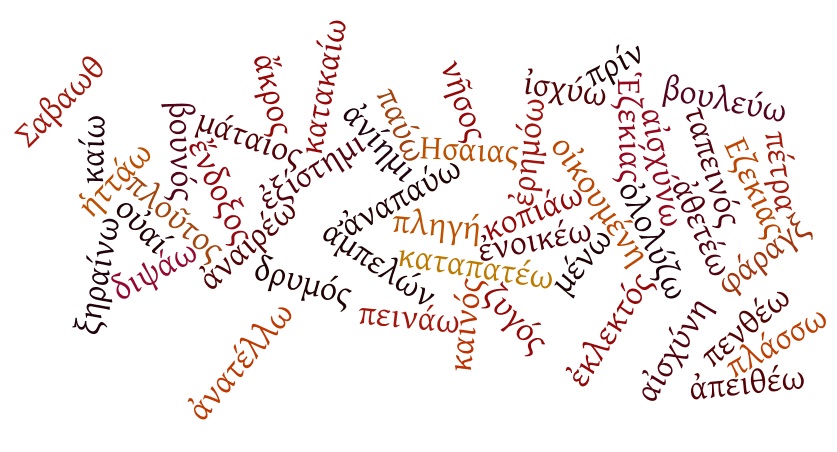
Isaiah Greek wordle

This week in Greek Isaiah in a Year covers Isaiah 16:11-18:7.

Here is the schedule and text for Monday through Friday, using again the text from R.R. Ottley’s Book of Isaiah According to the Septuagint. Ottley is also here in Logos (reviewed here) and here as a free, downloadable pdf in the public domain. The full reading plan for our group is here (pdf).

Monday, March 4Isa 16:11-14

11 διὰ τοῦτο ἡ κοιλία μου ἐπὶ Μωὰβ ὡς κιθάρα· ἠχήσει, καὶ τὰ ἐντός μου ὡσεὶ τεῖχος ὃ ἐνεκαίνισας. 12 καὶ ἔσται ὡς τὸ ἐντραπῆναί σε, ἐκοπίασεν Μωὰβ ἐπὶ τοῖς βωμοῖς, καὶ εἰσελεύσεται εἰς τὰ χειροποίητα αὐτῆς ὥστε προσεύξασθαι, καὶ οὐ μὴ δύνηται ἐξελέσθαι αὐτόν. 13 τοῦτο τὸ ῥῆμα ὃ ἐλάλησεν Κύριος ἐπὶ Μωάβ, ὁπότε καὶ ἐλάλησεν. 14 καὶ νῦν λέγω Ἐν τρισὶν ἔτεσιν ἐτῶν μισθωτοῦ ἀτιμασθήσεται ἡ δόξα Μωὰβ ἐν παντὶ τῷ πλούτῳ τῷ πολλῷ, καὶ καταλειφθήσεται ὀλιγοστὸς καὶ οὐκ ἔντιμος.

Tuesday, March 5: Isa 17:1-5

Τὸ ῥῆμα τὸ κατὰ Δαμασκοῦ.

17 1 Ἰδοὺ Δαμασκὸς ἀρθήσεται ἀπὸ πόλεων, καὶ ἔσται εἰς πτῶσιν, 2 καταλελιμμένη εἰς τὸν αἰῶνα, εἰς κοίτην ποιμνίων καὶ ἀνάπαυσιν βουκολίων, καὶ οὐκ ἔσται ὁ διώκων· 3 καὶ οὐκέτι ἔσται ὀχυρὰ τοῦ καταφυγεῖν Ἐφράιμ· καὶ οὐκέτι ἔσται βασιλεία ἐν Δαμασκῷ, καὶ τὸ λοιπὸν τῶν Σύρων ἀπολεῖται· οὐ γὰρ σὺ βελτίων εἶ τῶν υἱῶν Ἰσραὴλ καὶ τῆς δόξης αὐτῶν. 4 Τάδε λέγει Κύριος σαβαώθ Ἔσται ἐν τῇ ἡμέρᾳ ἐκείνῃ ἔκλειψις τῆς δόξης Ἰακώβ, καὶ τὰ πίονα τῆς δόξης αὐτοῦ σεισθήσεται. 5 καὶ ἔσται ὃν τρόπον ἐάν τις συναγάγῃ ἀμητὸν ἑστηκότα καὶ σπέρμα σταχύων ἐν τῷ βραχίονι αὐτοῦ ἀμήσῃ, καὶ ἔσται ὃν τρόπον ἐάν τις συναγάγῃ στάχυν ἐν φάραγγι στερεᾷ,

Wednesday, March 6: Isa 17:6-9

6 καὶ καταλειφθῇ ἐν αὐτῇ καλάμη, ἢ ὡς ῥῶγες ἐλαίας δύο ἢ τρεῖς ἐπʼ ἄκρου μετεώρου, ἢ τέσσαρες ἢ πέντε ἐπὶ τῶν κλάδων αὐτοῦ καταλειφθῇ. τάδε λέγει Κύριος ὁ θεὸς Ἰσραήλ. 7 τῇ ἡμέρᾳ ἐκείνῃ πεποιθὼς ἔσται ἄνθρωπος ἐπὶ τῷ ποιήσαντι αὐτόν, οἱ δὲ ὀφθαλμοὶ αὐτοῦ εἰς τὸν ἅγιον τοῦ Ἰσραὴλ ἐμβλέψονται, 8 καὶ οὐ μὴ πεποιθότες ὦσιν ἐπὶ τοῖς βωμοῖς οὐδὲ ἐπὶ τοῖς ἔργοις τῶν χειρῶν αὐτῶν ἃ ἐποίησαν οἱ δάκτυλοι αὐτῶν, καὶ οὐκ ὄψονται τὰ ἄλση αὐτῶν οὐδὲ τὰ βδελύγματα αὐτῶν. 9 τῇ ἡμέρᾳ ἐκείνῃ ἔσονται αἱ πόλεις σου ἐγκαταλελιμμέναι ὃν τρόπον ἐγκατέλιπον οἱ Ἀμορραῖοι καὶ οἱ Εὑαῖοι ἀπὸ προσώπου τῶν υἱῶν Ἰσραήλ· καὶ ἔσονται ἔρημοι·

Thursday, March 7: Isa 17:10-14

10 διότι ἐγκατέλιπες τὸν θεὸν τὸν σωτῆρά σου, καὶ Κυρίου τοῦ βοηθοῦ σου οὐκ ἐμνήσθης. διὰ τοῦτο φυτεύσεις φύτευμα ἄπιστον καὶ σπέρμα ἄπιστον· 11 τῇ δὲ ἡμέρᾳ ᾗ ἂν φυτεύσῃς, πλανηθήσῃ· τὸ δὲ πρωὶ ἐὰν <σπείρῃς>, ἀνθήσει εἰς ἀμητὸν ᾗ ἂν ἡμέρᾳ κληρώσῃ, καὶ ὥσπερ πατὴρ ἀνθρώπου κληρώσῃ τοῖς υἱοῖς.

12 Οὐαὶ πλῆθος ἐθνῶν πολλῶν· ὡς θάλασσα κυμαίνουσα, οὕτως ταραχθήσεσθε, καὶ νῶτος ἐθνῶν πολλῶν ὡς ὕδωρ ἠχήσει· 13 ὡς ὕδωρ πολὺ ἔθνη πολλά, ὡς ὕδατος πολλοῦ βίᾳ καταφερομένου. καὶ ἀποσκορακιεῖ αὐτόν, καὶ πόρρω αὐτὸν διώξεται ὡς χνοῦν ἀχύρου λικμώντων ἀπέναντι ἀνέμου, καὶ ὡς κονιορτὸν τροχοῦ καταιγὶς φέρουσα. 14 πρὸς ἑσπέραν ἔσται πένθος· πρὶν ἢ πρωί, καὶ οὐκ ἔσται. αὕτη ἡ μερὶς τῶν ὑμᾶς προνομευσάντων, καὶ κληρονομία τῶν ὑμᾶς κληρονομησάντων.

Friday, March 8: Isa 18

18 1 Οὐαὶ γῆς πλοίων πτέρυγες ἐπέκεινα ποταμῶν Αἰθιοπίας, 2 ὁ ἀποστέλλων ἐν θαλάσσῃ ὅμηρα καὶ ἐπιστολὰς βυβλίνας ἐπάνω τοῦ ὕδατος. πορεύσονται γὰρ ἄγγελοι κοῦφοι πρὸς ἔθνος μετέωρον, καὶ ξένον λαὸν καὶ χαλεπόν· τί αὐτοῦ ἐπέκεινα; ἔθνος ἀνέλπιστον καὶ καταπεπατημένον. νῦν οἱ ποταμοὶ τῆς γῆς 3 πάντες ὡς χώρα κατοικουμένη κατοικηθήσεται· ἡ χώρα αὐτῶν ὡσεὶ σημεῖον ἀπὸ ὄρους ἀρθῇ, ὡς σάλπιγγος φωνὴ ἀκουστὸν ἔσται. 4 ὅτι οὕτως εἶπέν μοι Κύριος Ἀσφάλεια ἔσται ἐν τῇ ἐμῇ πόλει ὡς φῶς καύματος μεσημβρίας, καὶ ὡς νεφέλη δρόσου ἡμέρας ἀμήτου ἔσται. 5 πρὸ τοῦ θερισμοῦ, ὅταν συντελεσθῇ ἄνθος, καὶ ὄμφαξ ἀνθήσῃ ἄνθος ὀμφακίζουσα· καὶ ἀφελεῖ τὰ βοτρύδια τὰ μικρὰ τοῖς δρεπάνοις, καὶ τὰς κληματίδας ἀφελεῖ καὶ κατακόψει, 6 καὶ καταλείψει ἅμα τοῖς πετεινοῖς τοῦ οὐρανοῦ καὶ τοῖς θηρίοις τῆς γῆς· καὶ συναχθήσεται ἐπʼ αὐτοὺς τὰ πετεινὰ τοῦ οὐρανοῦ, καὶ παντὰ τὰ θηρία τῆς γῆς ἐπʼ αὐτὸν ἥξει. 7 ἐν τῷ καιρῷ ἐκείνῳ ἀνενεχθήσεται δῶρα Κυρίῳ σαβαὼθ ἐκ λαοῦ τεθλιμμένου καὶ τετιλμένου, καὶ ἀπὸ λαοῦ μεγάλου ἀπὸ τοῦ νῦν καὶ εἰς τὸν αἰῶνα χρόνον· ἔθνος ἐλπίζον καὶ καταπεπατημένον, ὅ ἐστιν ἐν μέρει τοῦ ποταμοῦ τῆς χώρας αὐτοῦ, εἰς τὸν τόπον οὗ τὸ ὄνομα Κυρίου σαβαώθ, ὄρος Σιών.

See here for more resources and links to texts for Greek Isaiah.

And here are the Week 14 readings above, but in pdf form.

What I Just Cooked in the Kitchen (Bakin’ Bacon… and Eggs)

We just had this for lunch:

Eggs, Bacon

It was a simple recipe (from this excellent cookbook):

  • Partially cook some bacon
  • Pour a bit of bacon grease into muffin tin
  • Wrap bacon in muffin tin
  • Drop egg in
  • Bake at 350° for 18 or so minutes

Septuagint lovers (all seven of you), don’t worry–this will not turn into a cooking blog. But my more frequent presence in the kitchen has been requested, so I’ll consider this a small start.

Review of Morris Proctor’s “What’s New?” Manual for Logos 5

L5 What's NewLogos 5 does not operate in ways that are drastically different from Logos 4, but there are enough new features and modifications that a “What’s New?” guide for Logos 5 is useful.

Morris Proctor is president of MP Seminars, “the authorized trainer” for Logos Bible Software. With the release of Logos 5 in November, MP Seminars produced a “What’s New?” manual for Logos 5. It is not intended to be a stand-alone guide to Logos 5; those are here, and I’ll review them in a future post. Proctor assumes a general working knowledge of Logos 4 for this guide, though even as someone new to Logos in the last six months or so, I found it easy to follow his explanations.

The chief virtue in this manual is its attention to detail–down to offering various “keystroke” shortcuts for tasks in Logos 5. “What’s New?” covers Logos 5 for both Mac and Windows. There are screenshots throughout with clear labels and instructions. For example:

MP example

The instructions are clear and easy to follow. The consistent use of illustrations like the above make “What’s New?” a reference guide to keep near the computer. (The plastic spiral-bound construction of the book means it easily lays flat.) The screenshots are printed in black and white, but that does not detract from their clarity.

Even having spent significant time with Logos 5, I found details through this manual that I never would have thought to look for. For example, MP notes a new item in the “Information” panel called “Translated,” which displays various Bible translations of a given word in one place. The sections on the Bible Sense Lexicon (ch. 14) and Clause Searching (ch. 5) are especially good at explaining new features from the ground up, in a way that someone using Logos 5 for the first time could easily understand. MP has probably the best short explanation of the new Bible Sense Lexicon that I’ve seen–he calls it an “orchard with trees bearing branches,” a phrase he then unpacks in helpful detail.

I did find myself wanting a bit more from the section on the new “Sermon Starter Guide.” MP describes the basic headings found in that guide, but there is not a lot of information about how to work within the guide’s results. For example, it is clear from the manual how to generate the report and understand the headings it provides, but there is not mention of the fact that from a passage-based report, you can click on a theme to open an new theme-based report, or that you can click on “x” next to a heading to close that section altogether. Perhaps MP goes into this level of detail in the full Logos 5 manuals.

There is often mention of what Logos “can do for you,” or the assertion that “Logos is here to help,” and so on. This made me feel a few times like I was being sold to, which is unnecessary since anyone using this manual will already have Logos 5. This is a small distraction, through.

Here’s the Table of Contents, detailing what the 68-page manual covers:

1. Appearance and Tabs
2. Home Page
3. Library
4. Searching
5. Clause Searching
6. Documents Menu
7. Bibliography
8. Word List
9. Guides
10. Sermon Starter Guide
11. Topic Guide
12. Tools Menu
13. Bible Facts
14. Bible Sense Lexicon
15. Timeline
16. Visual Filters
17. Root Words

Even with Logos 5 under my belt for a few months, the “What’s New?” manual from MP Seminars has really deepened my understanding of the new features in that program. It’s a good guide for the transition from Logos 4 to 5.

Thanks to MP Seminars for the copy of the Logos 5 – What’s New? manual to review. You can find it available for purchase here.

Lenten Worship

Calvin Institute of Christian Worship has a “Lent Resource Guide” that will be helpful for worship planners during this season.

Lent invites us to make our hearts ready for remembering Jesus’ passion and celebrating Jesus’ resurrection. … As a period of preparation, Lent has historically included the instruction of persons for baptism and profession of faith on Easter Sunday; the calling back of those who have become estranged from the church; and efforts by all Christians to deepen their piety, devotion, and readiness to mark the death and resurrection of their Savior. As such, the primary focus of the season is to explore and deepen a “baptismal spirituality” that centers on our union with Christ rather than to function only as an extended meditation on Christ’s suffering and death. (from the Worship Sourcebook, p.551-552)

The guide is here.

Who is the author of Honest Toddler? Identity revealed…

HT book cover

Her name is Bunmi Laditan. As recently as a week ago, the author of the forthcoming Honest Toddler: A Child’s Guide to Parenting was “anonymous.” But now the book cover (above, from Amazon) shows that HT is “written under the supervision of Bunmi Laditan.” Awesome. I’ve been curious about this since reading HT, as have hundreds of thousands of others. Here is her bio from the HT Google Books page:

BUNMI LADITAN started her first media company at age eighteen. Soon after, she launched and sold a social networking site geared toward moms and began a social media agency, working with Fortune 500 companies. She is a regular contributor to The Huffington Post, Mothering and iVillage.com, where her satirical pieces on parenting and politics have often gone viral. In May 2012, she created The Honest Toddler, a character based on her youngest child. She lives with her family near Montreal.

Love it. It looks like she’s just started her own blog, too, which I plan to read regularly. See, too, if you notice another difference in the cover above compared to what was on Amazon when I posted here.

I’ll be reviewing the book as soon as it comes out. Read much more about it (including the table of contents) here at HT’s blog.

Bunmi, thank you. Thank you for HT and for the laughter that little toddler has brought. You live far away, but if you ever want to bring HT over for a play-date, our 2-year-old will be happy to lead an expedition to the beach… or to the fridge.

UPDATE 5/6/13: Go here for a chance to win a free copy of Honest Toddler.

UPDATE 2: I review Honest Toddler here.

Greek Isaiah in a Year, Week 13=Isaiah 14:28-16:10

This week in Greek Isaiah in a Year covers Isaiah 14:28-16:10. I’ve been behind off and on the last few weeks, but am caught up now. It’s amazing how even five verses a day can be a challenge to keep up with.

Ottley Isaiah coverHere is the schedule and text for Monday through Friday, using again the text from R.R. Ottley’s Book of Isaiah According to the Septuagint (pictured at left; click on image to go to Amazon product page). Ottley is also here in Logos (I reviewed that edition here) and here as a free, downloadable pdf in the public domain. The full reading plan for our group is here (pdf).

Monday, February 25Isa 14:28-32

28 Τοῦ ἔτους οὗ ἀπέθανεν Ἀχὰζ ὁ βασιλεὺς ἐγενήθη τὸ ῥῆμα τοῦτο.

29 Μὴ εὐφρανθείητε, πάντες οἱ ἀλλόφυλοι, συνετρίβη γὰρ ὁ ζυγὸς τοῦ παίοντος ὑμᾶς· ἐκ γὰρ σπέρματος ὄφεων ἐξελεύσεται ἔγγονα ἀσπίδων, καὶ τὰ ἔκγονα αὐτῶν ἐξελεύσονται ὄφεις πετόμενοι. 30 καὶ βοσκηθήσονται πτωχοὶ διʼ αὐτοῦ· πτωχοὶ δὲ ἄνδρες ἐπʼ εἰρήνης ἀναπαύσονται· ἀνελεῖ δὲ λιμῷ τὸ σπέρμα σου, καὶ τὸ κατάλιμμά σου ἀνελεῖ. 31 ὀλολύζετε, πύλαι πόλεων, κεκραγέτωσαν πόλεις τεταραγμέναι, οἱ ἀλλόφυλοι πάντες, ὅτι καπνὸς ἀπὸ βαρρᾶ ἔρχεται, καὶ οὐκ ἔστιν τοῦ εἶναι. 32 καὶ τί ἀποκριθήσονται βασιλεῖς τῶν ἐθνῶν; ὅτι Κύριος ἐθεμελίωσεν Σιών, καὶ διʼ αὐτοῦ σωθήσονται οἱ ταπεινοὶ τοῦ λαοῦ.

Tuesday, February 26: Isa 15:1-4

15 1 Νυκτὸς ἀπολεῖται ἡ Μωαβῖτις, νυκτὸς γὰρ ἀπολεῖται τὸ τεῖχος τῆς Μωαβίτιδος. 2 λυπεῖσθε ἐφʼ ἑαυτοῖς, ἀπολεῖται γὰρ Δαιβηδών, οὗ ὁ βεμὸς ὑμῶν· ἐκεῖ ἀναβήσεσθε κλαίειν, ἐπὶ Ναβαῦ τῆς Μωαβίτιδος. ὀλολύζετε, ἐπὶ πάσης κεφαλῆς φαλάκρωμα, πάντες βραχίονες κατατετμημένοι, 3 ἐν ταῖς πλατείαις αὐτῆς περιζώσασθε σάκκους, καὶ κόπτεσθε ἐπὶ τῶν δωμάτων αὐτῆς, καὶ ἐν ταῖς πλατείαις αὐτῆς καὶ ἐν ταῖς ῥύμαις αὐτῆς, πάντες ὀλολύζετε μετὰ κλαυθμοῦ. 4 ὅτι κέκραγεν Ἑσεβὼν καὶ <Ἐλεαλή>, ἕως ἠκούσθη ἡ φωνὴ αὐτῆς· διὰ τοῦτο ἡ ὀσφὺς τῆς Μωαβίτιδος βοᾷ, ἡ ψυχὴ αὐτῆς γνώσεται.

Wednesday, February 27: Isa 15:5-9

5 ἡ καρδία τῆς Μωαβίτιδος βοᾷ ἐν ἑαυτῇ ἕως Σήγωρ· δάμαλις γὰρ ἐστὶν τριετής· ἐπὶ δὲ τῆς ἀναβάσεως τῆς πρὸς σὲ κλαίοντες ἀναβήσονται τῇ ὁδῷ Ἀδωνίειμ· βοᾷ σύντριμμα καὶ σεισμός, 6 τὸ ὕδωρ τῆς Νεμρεὶμ ἔρημον ἔσται, καὶ ὁ χόρτος αὐτῆς ἐκλείψει· χόρτος γὰρ χλωρὸς οὐκ ἔσται. 7 μὴ καὶ οὕτως μέλλει σωθῆναι; ἐπάξω γὰρ ἐπὶ τὴν φάραγγα Ἄραβας, καὶ λήμψονται αὐτήν. 8 συνῆψεν γὰρ ἡ βοὴ τὸ ὄρος τῆς Μωαβίτιδος τῆς Ἀγαλλείμ, καὶ ὀλολυγμὸς αὐτῆς ἕως τοῦ φρέατος τοῦ Αἰλείμ. 9 τὸ δὲ ὕδωρ τὸ Ῥεμμὼν πλησθήσεται αἵματος· ἐπάξω γὰρ ἐπὶ Ῥεμμὼν Ἄραβας, καὶ ἀρῶ τὸ σπέρμα Μωὰβ καὶ Ἀριὴλ καὶ τὸ κατάλοιπον Ἀδαμά.

Thursday, February 28: Isa 16:1-5

16 1 Ἀποστελῶ ὡς ἑρπετὰ ἐπὶ τὴν γῆν· μὴ πέτρα ἔρημός ἐστιν τὸ ὄρος Σιών; 2 ἔσῃ γὰρ ὡς πετεινοῦ ἀνιπταμένου νεοσσὸς ἀφῃρημένος, θυγάτηρ Μωάβ· ἐπὶ τάδε, Ἀρνών, πλείονα 3 βουλεύου, ποίει τε σκέπην πένθους αὐτῇ διὰ παντός· ἐν μεσημβρινῇ σκοτιᾷ φεύγουσιν, ἐξέστησαν· μὴ <ἀχθῇς>. 4 παροικήσουσιν οἱ φυγάδες Μωάβ· ἔσονται γὰρ σκέπη ὑμῖν ἀπὸ προσώπου διώκοντος, ὅτι ἤρθη ἡ συμμαχία σου, συνετελέσθη ταλαιπωρία, καὶ ὁ ἄρχων ἀπώλετο ὁ καταπατῶν ἐπὶ τῆς γῆς. 5 καὶ διορθωθήσεται μετὰ ἐλέους θρόνος, καὶ καθιεῖται ἐπʼ αὐτοῦ μετὰ ἀληθείας ἐν σκηνῇ Δαυείδ, κρίνων καὶ ἐκζητῶν κρίμα καὶ σπεύδων δικαιοσύνην.

Friday, March 1: Isa 16:6-10

6 Ἠκούσαμεν τὴν ὕβριν Μωάβ, ὑβριστὴς σφόδρα, τὴν ὑπερηφανίαν ἐξῆρας. οὐχ οὕτως ἡ μαντεία σου, οὐχ οὕτως. 7 ὀλολύξει Μωάβ, ἐν γὰρ τῇ Μωαβίτιδι πάντες ὀλολύξουσιν· τοῖς κατοικοῦσιν Δέσεθ μελετήσεις, καὶ οὐκ ἐντραπήσῃ. 8 τὰ πεδία Ἐσεβὼν πενθήσει, ἄμπελος Σεβαμά· καταπίνοντες τὰ ἔθνη, καταπατήσατε τὰς ἀμπέλους αὐτῆς ἕως Ἰαζήρ· οὐ μὴ συνάψητε, πλανήθητε τὴν ἔρημον· οἱ ἀπεσταλμένοι ἐγκατελείφθησαν, διέβησαν γὰρ τὴν ἔρημον. 9 διὰ τοῦτο κλαύσομαι ὡς τὸν κλαυθμὸν Ἰαζὴρ ἄμπελον Σεβαμά· τὰ δένδρα σου κατέβαλεν Ἐσεβὼν καὶ <Ἐλεαλή>, ἐπὶ τῷ θερισμῷ καὶ ἐπὶ τῷ τρυγητῷ σου καταπατήσω, καὶ πάντα πεσοῦνται. 10 καὶ ἀρθήσεται εὐφροσύνη καὶ ἀγαλλίαμα ἐκ τῶν ἀμπελώνων σου, καὶ ἐν τοῖς ἀμπελῶσίν σου οὐ μὴ εὐφρανθήσονται, καὶ οὐ μὴ πατήσουσιν οἶνον εἰς τὰ ὑπολήνια, πέπαυται γάρ.

See here for more resources and links to texts for Greek Isaiah.

And here are the Week 13 readings above, but in pdf form.

Review of Basics of Biblical Hebrew: Video Lectures

Miles Van Pelt keeps turning out the hits. Through Zondervan he has published resources that fill a gap in original language learning in biblical studies. I’ve reviewed (with approval) his Biblical Hebrew: A Compact Guide, his Basics of Biblical Aramaic, and have been grateful in my Göttingen Septuagint primer to link to a short two-page abbreviations sheet he produced for that critical edition of the Septuagint.

This fall Zondervan released Basics of Biblical Hebrew: Video Lectures.

The DVDs work “chapter by chapter, section by section” through Pratico and Van Pelt’s Basics of Biblical Hebrew grammar textbook. The videos are “the basic content in lecture form for the grammar.” Here’s how Van Pelt recommends using the DVDs:

  1. Read the chapter of Basics for Biblical Hebrew “for simple content overview.”
  2. Watch the lectures.
  3. Go back to the printed chapter and memorize the relevant information (vocabulary, paradigms, charts, grammar).
  4. Complete the workbook exercises.
  5. Check your answers.

Each DVD chapter corresponds to a chapter in the textbook. The DVDs come with a pdf file that includes summary charts. Throughout the lectures Van Pelt refers to these charts and the screen moves to them as he is speaking.

There is nothing particularly novel or revolutionary in the videos that is not already covered to some degree in the textbook. But especially for a student who is making her or his way through the book alone, the video lectures serve to reinforce the material in a new medium. Even a student taking a course with a live lecturer could benefit from watching these alongside the class.

Van Pelt is a solid lecturer. If not overly exciting, he communicates concepts clearly. For just about anyone making their way through the grammar, it will be easy to follow these lectures.

He offers good study tips in the introduction, and continues to encourage learners throughout the 36 lectures. My favorite tip: “Begin reading your Hebrew Bible as soon as possible,” and, “Take that Bible with you everywhere.” I remember that often in my first year of Hebrew (I used the Van Pelt and Pratico text), I wanted to just be able to read the Hebrew Bible. There are examples throughout the grammar from the Bible, but learning charts and paradigms first can be tedious. This is perhaps a necessary tedium.

Or is it? Some people disagree that paradigm memorization outside the context of a text or conversation is ideal pedagogy for language learning. (Look at how babies acquire language, after all, the argument goes–by hearing, talking, etc., not by memorizing grammatical rules.) Even dead or ancient languages should be taught as “living languages,” proponents say. So some Hebrew textbooks encourage instead a text-based inductive approach.

Van Pelt at one point in the lectures says, “Languages are meant to be accessed and decoded in your mind,” though “decoding” is something a language learner ought to try to move away from as quickly as possible, as she or he seeks fluency. And an early strong verb paradigm has Van Pelt saying, “You must memorize this paradigm, like a ROBOT!”

Hebrew and other languages have been taught this way for a long time, and some language learners may not mind it. I, for example, find paradigm memorization tedious, but not overly difficult. If I have an end goal firmly in mind–reading the Hebrew Bible–I have motivation to repeatedly go over verb conjugations.

But I don’t think this approach will work for everyone, and the potential viewer of these videos should understand that Van Pelt takes a paradigm-memorizing approach to learning Hebrew, with not much inductive learning or interaction with the biblical text. (I think of my high school Spanish teacher, who would not answer classroom questions asked in English, but would simply say, “¡En Español, por favor!”)

Van Pelt and Pratico’s materials use verbal diagnostics. Paradigm charts show in red what the unique prefixes and suffixes and vowels are for each verbal stem, so that it is not just rote memorization of multiple verbs. The diagnostics are a time-saving feature in this sense. As here:

Diagnostics

For those interested in verbal theory, Van Pelt uses perfect (“completed action”) and imperfect (“incomplete action”) nomenclature to describe verbs.

The lectures are well-produced and alternate between views of charts like the one above, real-time writing (like a dry-erase board), and Van Pelt speaking. The clarity of the lectures is a strong point, as they reinforce the material in the textbook well.

If a student is already assigned the Pratico and Van Pelt text, he or she should seriously consider using the lectures as an additional study aid, if one is needed. If a student or professor has a choice as to which text to use for learning Hebrew, though, it is worth considering (either in addition or instead) other “living language”/inductive approaches. Randall Buth’s Living Biblical Hebrew or John H. Dobson’s Learn Biblical Hebrew are two possible texts.

Chapter 1 of the lectures is here, if you want to get a flavor of the lectures (it’s just over an hour):

Thanks to Zondervan for the review copy. You can find the Basics of Biblical Hebrew Video Lectures here at Amazon. The Zondervan product page is here.

New Layout, New Address for Words on the Word

Words on the Word now sports a new layout and address.

We’re at abramkj.com now, though all your old links to previous posts will still work. Going to abramkj.wordpress.com still directs you here.

I’m open to thoughts? Feedback? You can check out the home page here (which shows the most recent post and some “featured posts” beneath that), or see what it looks like when you click on an individual post.