2018: Greek Gospels in a Year


I plan to read through the four canonical Gospels in Greek in 2018: Matthew, Mark, Luke, and John.

I’ve created a reading plan, which divides the Gospels into three months each, Monday through Friday (with weekends to catch up, review, or take a break).

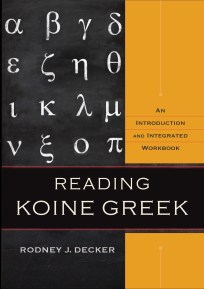
fullsizeoutput_39f2-e1514662411967.jpegThere is also a weekly reading suggestion for an accompanying Greek textbook to help with vocabulary and grammar: Rod Decker’s Reading Koine Greek.

The plan also includes suggested passages for ​lectio divina each week, for those who want to engage with the Greek text reflectively and prayerfully. Finally, the plan concludes with 16 tips for Scripture memory, for those who want to add that component, as well.

Phew! I am looking forward to reading through the Gospels in this way.

Here is the plan as a PDF, with navigable/hyperlinked Table of Contents: PDF.

And here is the plan as an interactive Accordance User Tool: User Tool.

Would you like to join me? Let me know in the comments or by emailing me through this form. I’m off all social media in 2018 (woo hoo!), but will respond to comments here, as well as at Accordance Bible Software’s “Greek in a Year” forum (here).

Coming Soon(ish): Historical and Theological Lexicon of the Septuagint


From publisher Mohr Siebeck:

Edited by Eberhard Bons and Jan Joosten (Université de Strasbourg)

This large-scale collective and interdisciplinary project aims to produce a new research tool: a multi-volume dictionary providing an article of between two and ten pages (around 600 articles in all) for each important word or word group of the Septuagint. Filling an important gap in the fields of ancient philology and religious studies, the dictionary will be based on original research of the highest scientific level.

This project has benefitted from funding from the Agence Nationale de la Recherche (French Research National Agency), the Maison Interuniversitaire des Sciences de l’Homme – Alsace (Strasbourg), the Melanchthon-Stiftung (Tübingen), and the Armin Schmitt Stiftung (Regensburg).

The first volume is projected to be published in 2018.

You can check out a lengthy PDF sample here, with a “Wordlist of the First Volume,” as well as some sample articles.

Zondervan Exegetical Commentary (OT, NT): Big Accordance Sale

Image via Accordance


One of the most promising new commentary projects continues to add new volumes: the Zondervan Exegetical Commentary series, covering both Old and New Testament books.

Accordance Bible Software has a huge sale on the OT and NT volumes, both as collections and individual volumes. Check out the details here.

Want to read more about individual volumes in the series?

I reviewed Daniel I. Block’s Obadiah volume here. And Kevin J. Youngblood’s Jonah volume might just be the best commentary I’ve worked through on Jonah. (A remarkable feat, as there is no dearth of Jonah commentaries!) I have not yet reviewed Block’s Ruth volume, but noted it here.

And I’ve reviewed these NT volumes: Matthew, Colossians and Philemon, James, and Luke… with a book note on Mark here. (Fun fact: the Luke ZECNT volume was the very first commentary reviewed at Words on the Word.)

If you haven’t gotten lost in the above hyperlinks, here is the link again to the sale at Accordance. Overall this is a series I’ve been impressed with, and have made good use of in preaching.

Lee Irons’s Greek NT Syntax Guide, Reviewed

One of my favorite seminary classes was a Greek exegesis course in the book of Hebrews. The Greek of that book is difficult! Hebrews can even be a challenging read in English translation.

Part of our required assignment was to keep a translation and exegesis notebook, translating much of the book verse-by-verse, with our own comments on the vocabulary, grammar, and theology.

In those days Charles Lee Irons had a boatload of free PDFs on his Website, syntax guides for each book of the Greek New Testament. I printed out his Hebrews guide and kept it close at hand.

Now, some years later, Irons has turned his helpful work into a full book: A Syntax Guide for Readers of the Greek New Testament (Kregel, 2016).

This new resource is beautifully produced:


Irons’s goal is to help the reader toward fluid reading of the Greek New Testament: “to assist readers of the Greek New Testament by providing brief explanations of intermediate and advanced syntactical features of the Greek text.” The focus is on grammar and how words work together, rather than vocabulary helps for individual words per se.

In addition, should a sentence in the GNT lose the reader due to length, word order, or idiom, Irons’s guide provides the needed translation. Here’s an example:


Irons has created the book to be used in tandem with a reader’s GNT (see here or here), or with Kregel’s excellent New Reader’s Lexicon of the GNT.

The book’s size and production is such that it fits right with other GNTs:


Here it is next to a larger Reader’s GNT:


The binding appears to be sewn. This is as hoped for with a book that a reader might want to use for many years.


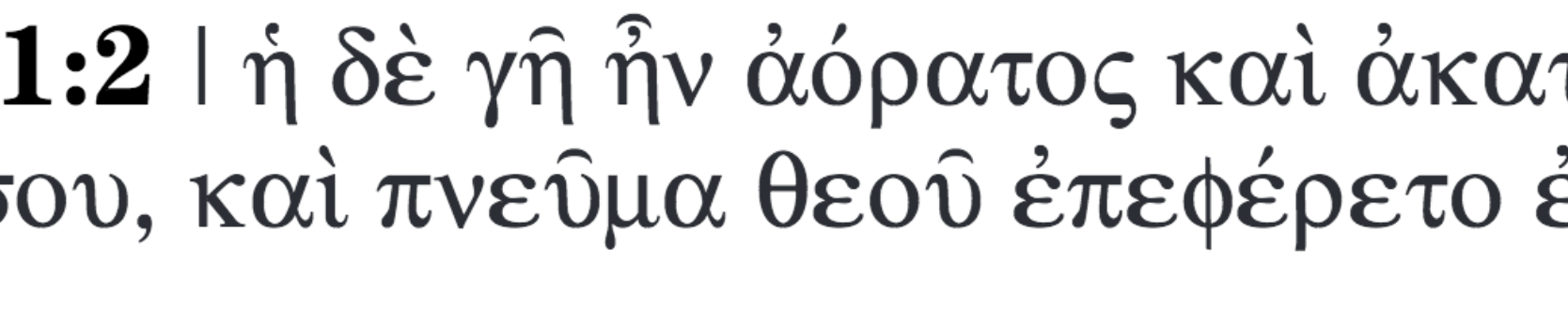
One pleasant surprise is how often Irons details Hebraisms and keeps an eye on the Septuagint and its influence on the GNT. He does that right from the beginning, in fact, as with this entry for Matthew 1:2

1:2 | Ἀβραὰμ ἐγέννησεν τὸν Ἰσαάκ = LXX 1 Chron 1:34 – note the unexpected definite article τόν before the name of the person begotten, and so throughout vv. 2–16. Formula used in the LXX genealogies: x ἐγέννησεν τὸν y (see LXX Gen 5:6 ; 10:8 ; 1 Chron 2:10ff)

Here is a full sample page:


It is difficult to imagine an intermediate Greek reader working through the New Testament with just a Greek text and this book… as the author notes, the Syntax Guide is best used with a Reader’s GNT where infrequently occurring vocabulary is already glossed. And of course a book of this brevity will (inevitably) include grammatical matters that Irons does not comment on—it covers fewer words and phrases, for example, than “Max and Mary” (A Grammatical Analysis of the Greek New Testament).

But in the dozens of Greek chapters I read with just a Reader’s GNT and Irons’s book at hand, there were very few times when I had a grammatical question Irons didn’t treat.

You can check out a longer excerpt of the book here. And you can purchase it at Amazon here or through Kregel here.


Thanks to Kregel for the review copy, given for the purposes of this write-up, but with no expectation as to the content of my review.

Zondervan Reader’s Greek New Testament: An Illustrated Review


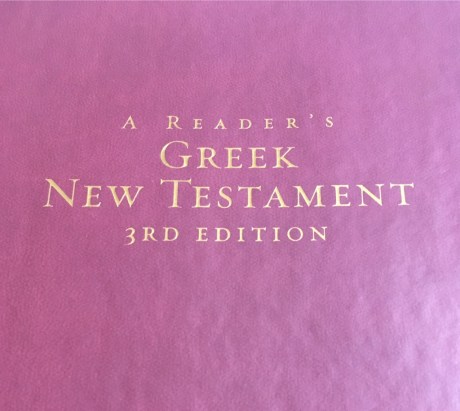
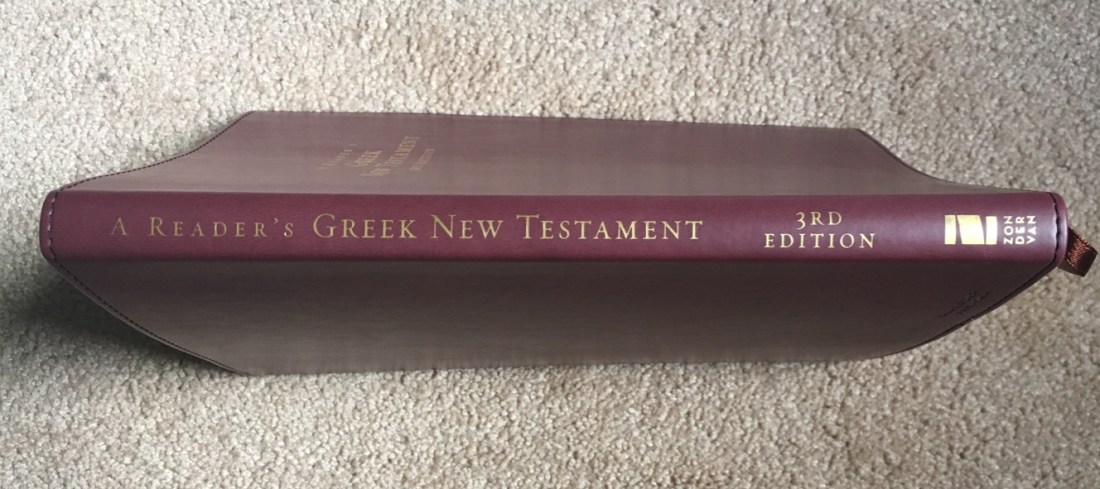
The Zondervan Reader’s Greek New Testament has undergone vast improvements in its Greek font since its first eye-hurting edition. Now in its 3rd edition, the lightweight, handsome, and well-constructed Reader’s Bible is perfect for sticking in a satchel to be able to read the Greek New Testament in transit.

Most notable is its size—it’s significantly thinner and lighter than its UBS5 Reader’s counterpart. Here it is with a 3.5” x 5.5” Field Notes notebook on top:


The included ribbon marker and gilded edges and lettering add a touch of class:


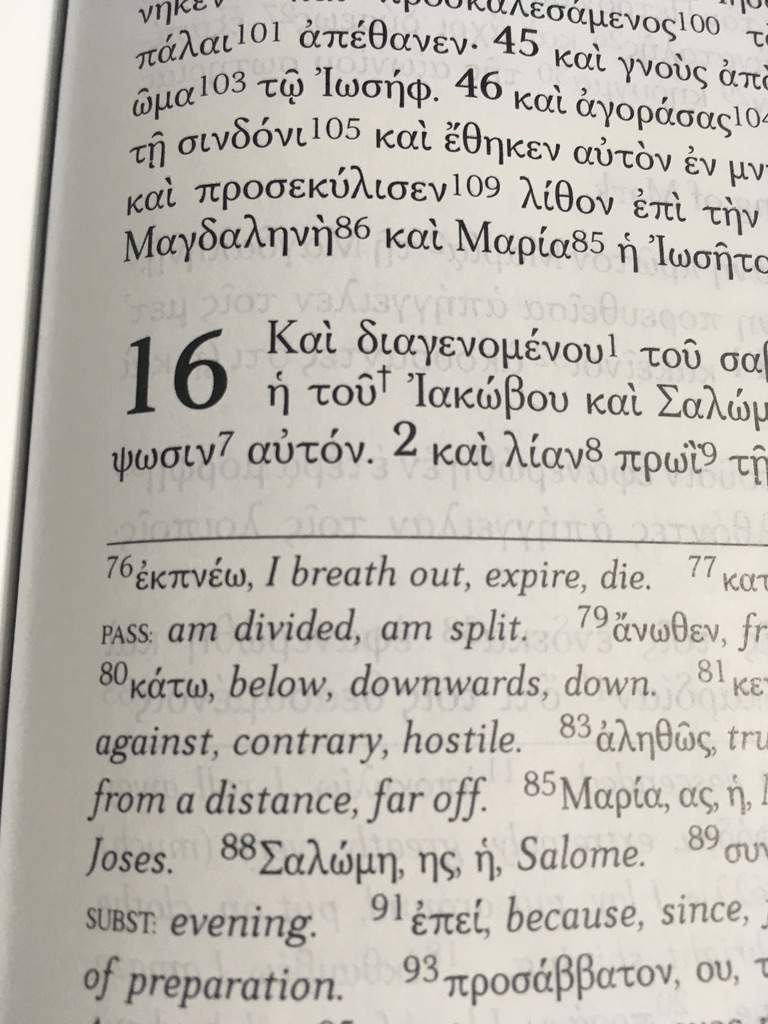
It’s worth repeating: the Greek font looks much better that previous editions. I think the UBS5 font still is the best-looking and most readable, but this one is good, too:


The text here is the Greek that underlies the New International Version—so not an exact match with the Nestle-Aland 28th edition. However, there are notes that point out where this Greek text and the NA28/UBS5 differ. For the purposes of reading through the Greek New Testament (the aim of this edition), I found the (minor) differences wholly inconsequential.

The footnoted vocabulary covers words that occur 30 times or fewer in the Greek NT. At the back is a “mini-lexicon” for everything else:


Whereas the UBS Reader’s edition has two nicely formatted columns, it can be difficult to quickly scan the single-column footnote jumble in Zondervan’s edition to find the appropriate word:


IMG_0923


And there are no verb parsings—just a list of possible glosses for each word (without a decision made based on context).

Overall I think the UBS5 Reader’s GNT is the best on the market, but the improved font, feel, and portability of the Zondervan Reader make it worth exploring. And if you’re going to own two Reader’s Greek New Testaments (because why not??), it’s nice to be able to switch between the UBS5 and this one, which is more affordable.

You can find the book here (Zondervan) and here (Amazon). See also my recent review of the UBS5 Reader’s Edition here.


Thanks to Zondervan for the review copy, given for the purposes of this write-up, but with no expectation as to the content of my review.

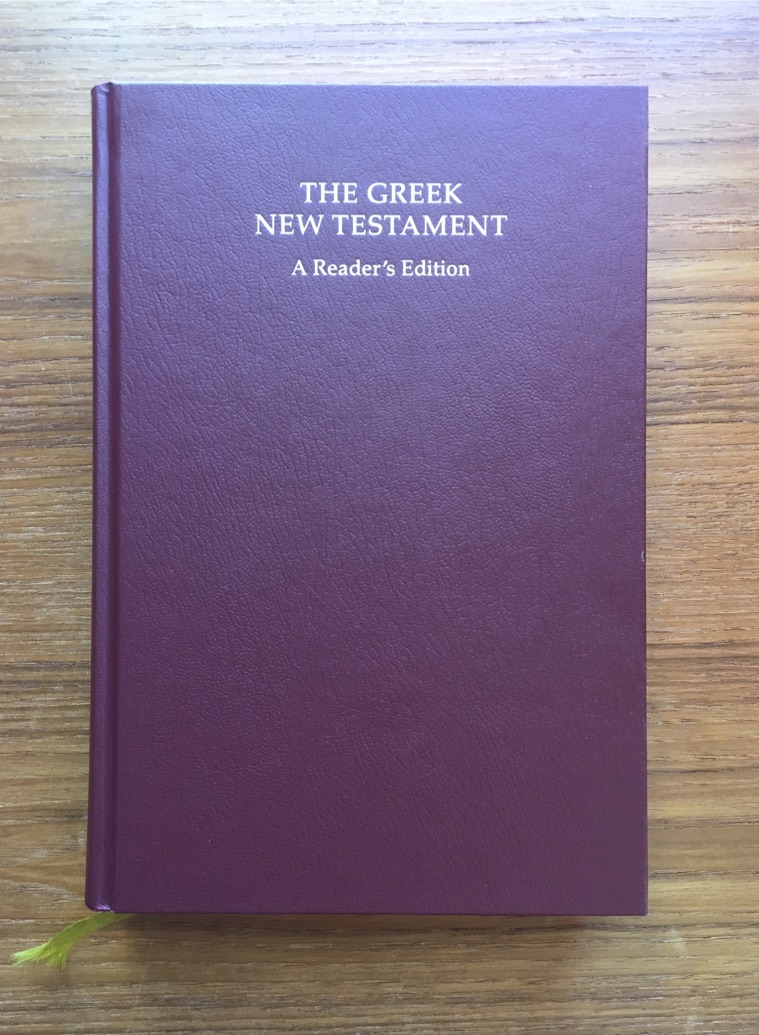
Reader’s Edition of the UBS5 Greek New Testament: An Illustrated Review

Typesetting is somewhat subjective, but the German Bible Society’s UBS5 has some of the best-looking Greek text you’ll find in any New Testament.

The UBS5 itself is about three years old. (Hendrickson, which distributes GBS items in the U.S., put together this excellent infographic.) Known for its full-bodied text-critical apparatus, translators and students alike benefit from its footnoted listing of variant manuscript readings. (So do NA28-loving scholars; don’t let them fool you!)

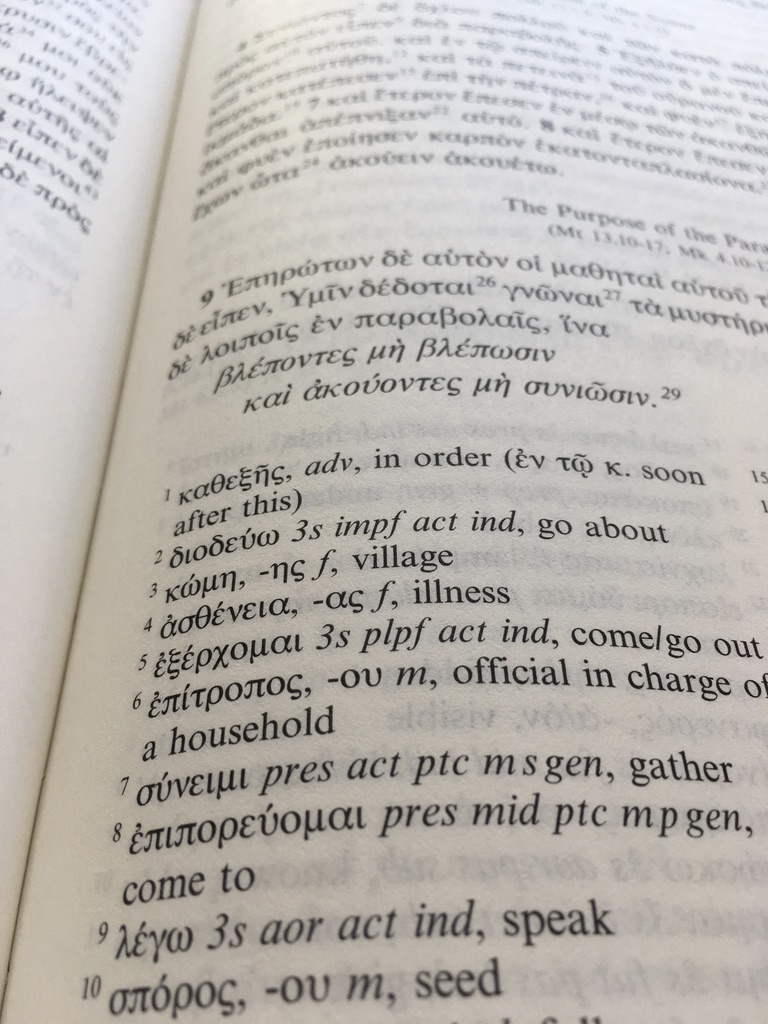
The UBS5 Reader’s Edition significantly pares down the textual apparatus and in its place provides a running list of infrequently occurring Greek vocabulary. As the name implies, the Reader’s Edition is a one-stop shop that facilitates fluid reading of the Greek text, even for those who have had just a year or so of Greek studies.

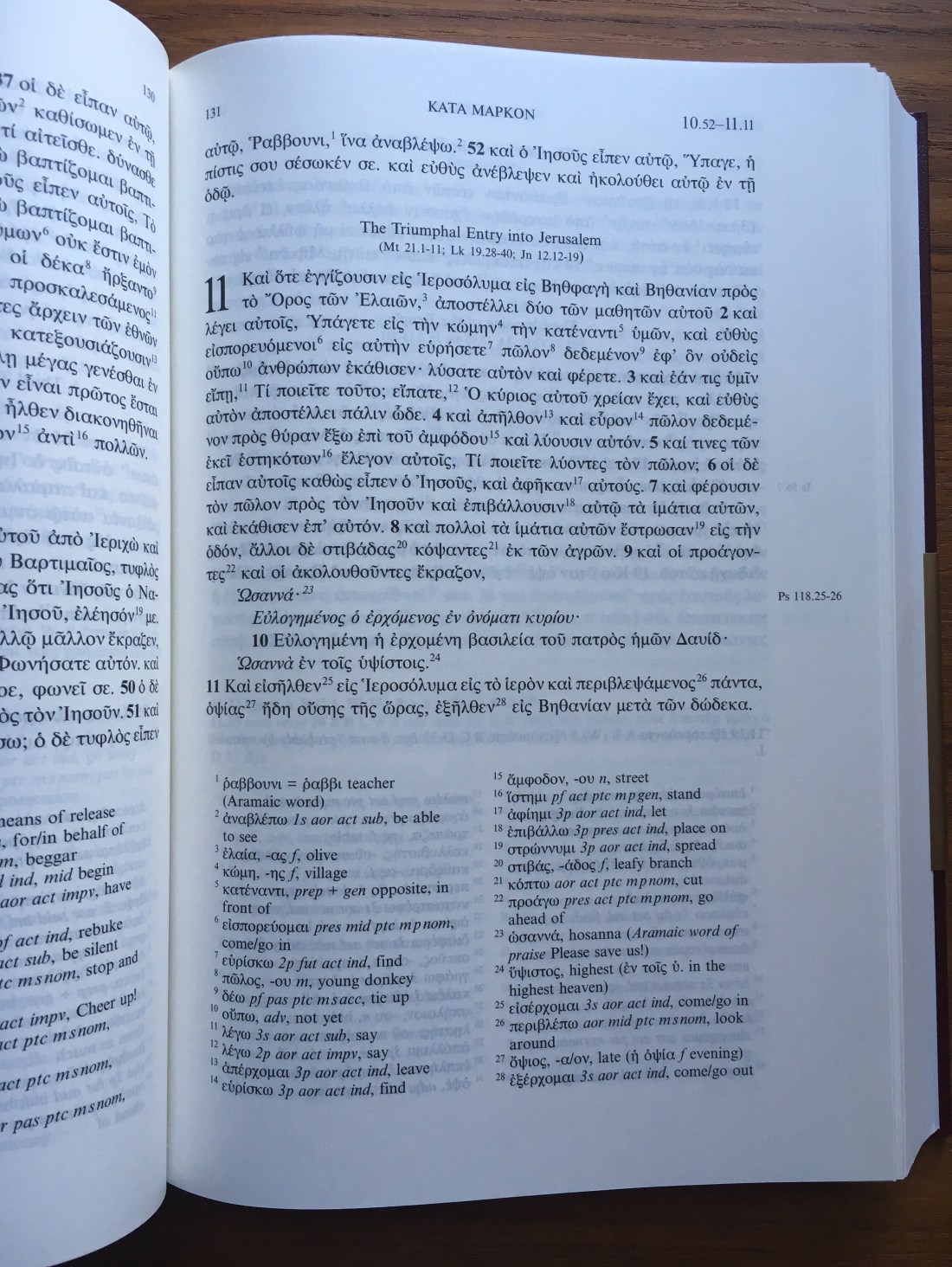
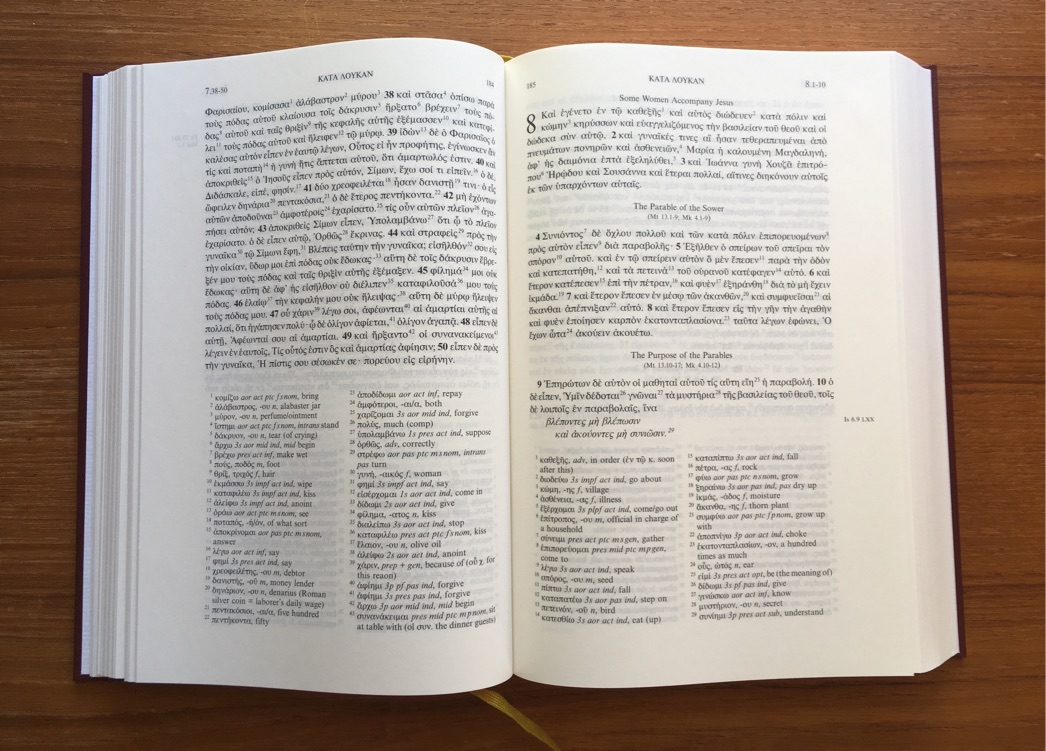
Here’s what it looks like:


The “textual notes” here just “highlight the most important differences between major Greek manuscripts and identify Old Testament references in the margins,” the latter of which I have found really useful.

As for the footnoted vocabulary, any word that occurs 30 times or less in the Greek New Testament has a “contextual” gloss (short translation equivalent) next to it. What I really like about this volume in contrast to the Zondervan Reader’s Edition is that there are verb parsings and noun genders listed with the vocabulary. This helps me not just to know what a word means in its context, but provides occasion to review verbal forms—something that can slip surprisingly quickly without review! Everything on the bottom of the page is easy to scan, too, as it is in two columns, not all jumbled together as some other reader’s editions have it.


img_6961-e1497842648504.jpeg


Between the aesthetically pleasing font and the vocabulary and parsings, this is the best reader’s edition on the market.

I’ve found parsing errors in the previous UBS Reader’s Edition. No doubt there have been corrections in this one. I cannot recall coming across any errors so far, and I’ve been using it off and on for at least a year of reading.

If a vocabulary word is not glossed at the bottom (i.e., you don’t know your vocabulary down to 30 occurrences), there is a concise Greek-English dictionary in the back of the Bible. Yes! Just about everything you need for Greek reading is here.

The only potential annoyance I can think of is that sometimes if a word is glossed already on page (n), when it occurs again on page (n+1) it is not always listed on that page—you have to flip back a page. Sometimes it’s not even footnoted when repeated, but then you recall that you just saw it (hopefully).

The inclusion of a high-quality ribbon marker is icing on the cake.

Finally, I have to say I was a little saddened that a beautiful typo (found in the UBS5 stand-alone and UBS5-NIV11 diglot and even previous UBS Reader’s Edition) is corrected in this edition! For the better, I suppose.

You can find the UBS5 Reader’s Edition here at Whole Foo—I mean, Amazon, here at Hendrickson, here at GBS, and here at CBD. There is both a hardcover edition (what is pictured in this post) and a slightly more expensive imitation leather edition.


Thanks to Hendrickson for the review copy, given for the purposes of this write-up, but with no expectation as to the content of my review.

February 8: Happy International Septuagint Day!

International Septuagint Day


Today is February 8, which can only mean one thing: International Septuagint Day. Happy LXX Day! Take some time to read part of the Septuagint today, in Greek or English.

Here are few more links to explore:

A Review of Discovering the Septuagint: A Guided Reader (Jobes)

Discovering the LXX


At long last Karen Jobes’s Discovering the Septuagint: A Guided Reader, has been published by Kregel Academic. The TL;DR version of my review is: while the resource has a few noticeable flaws (easily fixable for a second edition), its addition to the world of Greek reading and Septuagint studies is long overdue.

Below is a longer review of the book, in what I hope will be easy-to-scan Q & A format.


What books of the LXX are covered?

There are ten, intended to “give readers a taste of different genres, an experience of distinctive Septuagintal elements, and a sampling of texts later used by writers of the New Testament” (9). Discovering the Septuagint treats nearly 700 verses from:

  1. Genesis (80 verses)
  2. Exodus (79 verses)
  3. Exodus 20:1–21 // Deuteronomy 5:6–21 (10 Commandments)
  4. Ruth (85 verses)
  5. Additions to Greek Esther (73 verses)
  6. Psalms (67 verses)
  7. Hosea (56 verses)
  8. Jonah (48 verses)
  9. Malachi (55 verses)
  10. Isaiah (81 verses)


For whom is this book?

Jobes says it “contains everything needed for any reader with three semesters of koine Greek to succeed in expanding their horizons to the Septuagint” (8). I think this assessment is right, as I found the book easy to understand (though I’ve had more than three semesters of Greek).


How is the book structured?

Each LXX book has a short introduction. Then there is the passage, verse by verse, with the Greek text re-printed in full. Under each verse are word-by-word and phrase-by-phrase comments on the vocabulary, usage, syntax, translation from Hebrew (the book is strong here), and so on. Following each passage is the NETS (English translation). The end of the book has a three-page, 33-term glossary and a two-page “Index of New Testament LXX Citations” for the books included in the reader.


What does a sample entry look like?

Here’s Jonah 4:6:

jobes-on-jonah-lxx


What’s commendable about Discovering the Septuagint?

It shouldn’t go without saying that the very existence of this resource is a boon to Greek readers. There is Conybeare and Stock, as well as some passages in Decker’s Koine Greek Reader, but readers of the Septuagint have far fewer resources than readers of the Greek New Testament.

The margins are plenty wide for students to jot down their own parsings, translations, and notes.

Notes on the verses are often answers to questions I’ve had as I’ve read the Greek text. In this sense the reader is a great guide. For example, here is a comment from Genesis 1:4:

ἀνὰ μέσον . . . ἀνὰ μέσον | Idiomatic prep phrase, “between.” This is a Hebraism, so there is no need to translate the second of the pair as NETS does.

And another helpful nugget from Genesis 1:11:

κατὰ γένος | Prep + neut sg acc (3rd dec) noun, γένος, kind. Remember the nom and acc forms are identical in this paradigm. Agrees with and modifies σπέρμα.

Whether or not a fourth semester Greek student should remember that nominative and accusative forms are identical in the third declension is another issue. That the reader reminds me as much is welcomed.


What is lacking?

The glued binding doesn’t do justice to a book like this, but that seems to be the way many publishers have gone recently, even with reference works in biblical studies.

Parts of the book feel under-edited or rushed to print:

  • a few typos (missing periods, etc.)
  • referring to the Rahlfs-Hanhart text as a “critical edition of the Septuagint” (9), which is technically true, but potentially misleading, as “semi-critical” is better (text criticism is not a real concern of the book)
  • a peppering of vague statements like this one on “the image of God” in Genesis 1:26: “See a commentary or study Bible” (31)
  • the typesetting on the epsilon just seems off to me. I’ve tried to convince myself it’s just me, but I haven’t since been able to unsee what just looks like a flattened ε or a backwards three, rather than an actual Greek letter:


    screenshot-2016-10-31-22-06-57


    By contrast, look at the letter in this screenshot, taken from Accordance Bible Software:


    screenshot-2016-10-31-22-08-42


    The layout and Greek font are nice otherwise! (Though a couple times in the typesetting of the book, a letter from another language intrudes mid-word.)

  • Introductory issues are quite sparse–whether in the introduction to the Greek of the Septuagint itself (just two pages) or in the introductions to books. I would have liked it if the contributing writers had offered more for each book–even three or four pages would have gone further than the one or two that are here.

This last point deserves just a couple more lines. A number of the introductions adapt or “abstract” their text from the NETS book introductions, which readers could easily enough have found on their own. In some ways the book introductions read just like exam study guides you might have made yourself for a grad-level class on the Septuagint. That may be, in fact, how they started! (Jobes is chief overseer of the book, with many contributors.) This does not make the introductions not valuable, but it will probably leave readers wishing for more detail.

All in all, Discovering the Septuagint is worth owning. The number of times I’ve gotten grammatical or morphological help from the comments far outweighs any of the volume’s weaknesses. And there is a lot of Greek help to be had here. I’ll be making repeated use of this book by Jobes and company, and am glad it’s finally on the market.

Discovering the Septuagint is available from Amazon, as well as from Kregel.


Thanks to Kregel for sending the review copy, provided to me so I could write about the book, but with no expectation as to the content of my review.

How I’m Keeping Greek and Hebrew Fresh

I’ve been practicing reading Greek fairly regularly all year. Hebrew had fallen a bit by the wayside until recently. As of the last two weeks, however, I think I’ve got a good rhythm now for keeping both fresh.

I know I’m not the only pastor who finds it a challenge to not lose the heard-earned results of semesters and years of Greek and Hebrew in the classroom.

Here’s what I’ve been doing:


1. Reading through the Greek New Testament, roughly a chapter a day.


To become more fluent in reading, there’s no substitute for… you know… reading. I just got through 2 Corinthians, which I think might be the most difficult book in the New Testament—in both Greek and English!


2. Working through the Baylor Handbooks.


Baylor’s got two solid series in progress: Baylor Handbook on the Greek New Testament (BHGNT) and Baylor Handbook on the Hebrew Bible (BHHB).


These are books to read cover to cover, especially when you want to move from “rapid reading” to more detailed analysis of the text. I just finished Jonah and have started in on †Rod Decker’s Mark. You can see more about the series in my reviews of Luke and Malachi (here and here).


3. Reading my preaching passage in the original language, maybe even making my own translation.


Mark 1 in GreekI just preached through Ephesians. I translated much of it as I studied the text—either typing it out or doing it in my head. Especially with Paul’s longer sentences and more involved lines of thought in the first three chapters, this was challenging, but also essential in my grasping the text.

Now with the Old Testament lectionary readings in view (hello, prophets!), I’ll have a chance to reactivate my Hebrew reading.

If you (a) preach somewhat regularly and (b) want to make use of your Greek and Hebrew, why not combine the two endeavors? Both your preaching and your languages will be the better for it.

(NB: I teach a Webinar on this very topic, with more dates TBA. Here’s the handout.)

There’s also an invaluable chapter in Baker Academic’s Preaching the Old Testament called “Keeping Your Hebrew Healthy.”


4. Reading Greek with another person.


I’m really fortunate to have a reading partner for #1 above, reading through the GNT. This is an immense help and likely deserves its own post. Just remember that skill-building often happens best in community.


5. Learning to enjoy reading Greek and Hebrew.


Lack of proficiency for me is a great way to not enjoy a task; conversely, the more I read, the more comfortable I am with the text (Galatians was almost easy after 2 Corinthians!). Reading the Bible in its first languages also forces me to slow down and carefully consider what I’m reading. Greek and Hebrew reading fit well into devotional practices. (Great book on this, by the way, here: Using and Enjoying Biblical Greek: Reading the New Testament with Fluency and Devotion).


How about you? If you’ve been keeping your Greek and Hebrew active, what’s been helpful? What pitfalls are you facing? What other resources should I and others like me be using?

Review and Reflection: Greek for Preachers

Greek for Preachers (Chalice Press, 2002) divides into three primary parts. Part 1 is “The Preliminaries,” where authors Joseph M. Webb and Robert Kysar suggest initial tools for preachers who want to use Greek. Part 2 offers “Ten Principles for Uncovering Greek Meaning,” which makes up the majority of the book. Part 3 focuses on “Using the Greek Text in Sermon Preparation,” and is a hands-on application of the principles the authors have taught in the second part. The book’s aim is simple: “to bring the Greek text of the New Testament within reach of anyone who wishes to explore its riches” (x). The authors want preachers who have lost their Greek (or not had any) to find the language “both usable and exciting” for use in sermon preparation (7).


Part 1: “The Preliminaries”


I worried a bit when I saw “uncovering Greek meaning” as the title for Part 2. Somewhere along the way I learned that Greek is not just a language to decode, as if there could be one-to-one equivalents for everything, with “hidden gems” available to ones with secret inside knowledge. But the authors are balanced here. In the Preface they say, “We do not believe there is anything intrinsically magic or even necessarily sacred about the original language of the New Testament, even though we both assert the importance of biblical languages for the Christian tradition” (ix). This approach resonates with me, especially as they go on to affirm, “But, judiciously and frugally handled, the joys of the Greek language of our New Testament are as bright as newly cut diamonds sitting in a store window waiting for someone to pick them up and share them with others” (7).

The first part focuses primarily on introducing the preacher to two tools: a Greek-English interlinear and an analytical lexicon. From there the authors go over the Greek alphabet, syllabification, pronunciation, and helpful immersion in a few practice texts. (The Greek font in this book looks good and is readable.) It is also in this first part that the authors introduce their approach to words and meaning, one that I am fully on board with: “[W]e should never assume that a word is used in the exact same way in different passages. The context in which a word is used is more important than how another writer in a different document might use the same word…” (5). This, in fact, has preaching implications for me, because I can make points like this in my sermons without even bringing “the underlying Greek” into the picture.


Part 2: “Ten Principles for Uncovering Greek Meaning”


Part 2 is the heart of the book. The authors give ten principles around specific grammatical features. Concepts they explore include: articles (and how their presence or absence adjusts meaning), verbs, participles, infinitives, cases, and more. There are lots of examples from the Greek New Testament, including possible sermon angles to derive from interpreting the Greek grammar. There’s a wealth of interaction with the Greek text for the reader to work through. There are charts, glosses, and plenty of material that any Greek reader will benefit from reviewing.

A highlight of the second part for me was the authors’ good distinction between grammatical gender and what they call human gender (also called social gender). They would support, for example, not using the generic “man” in English translations where the Greek has ἄνθρωπος. I am similarly deliberate in reading from the pulpit gender-accurate translations whenever I can.

While most of the instruction in this section is consistent with what I’ve learned from various grammars and exegesis courses at Gordon-Conwell (and reading Greek regularly since), there are a couple of surprising hermeneutical moves that I didn’t think were on firm footing.

For example, here is John 1:1:

Ἐν ἀρχῇ ἦν ὁ λόγος, καὶ ὁ λόγος ἦν πρὸς τὸν θεόν, καὶ θεὸς ἦν ὁ λόγος.

The authors say, “Look for the articles, especially the ones associated with God” (39). With the last part of the verse (θεὸς ἦν ὁ λόγος), the authors rightly point out that ὁ λόγος becomes the subject because of the article. So, “the Word was God.” However, they go on to explore “the nature of the articular nouns as they differ from the anarthrous nouns “(39), considering that the anarthrous θεὸς could simply mean something less specific like “God-like.” They approach the translation with humility, but unfortunately conclude, “Theologically, it raises the issue of whether or not the text means that God and the ‘word’ are identical” (39). Though it’s tempting to criticize this interpretation on account of what sounds like heterodoxy, Greek grammar alone (at least I thought!) settles the issue, that, “the Word was God” (and not just God-like). I can recall at least two Greek professors at GCTS making a similar point that the anarthrous θεὸς should not be interpreted in the way the authors explore.
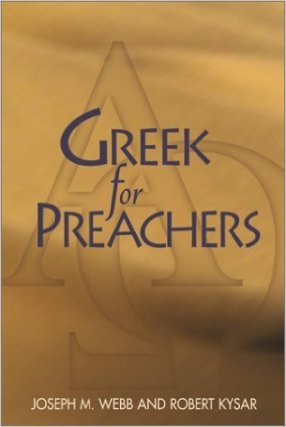
greek-for-preachersAlso a curious was the interpretation of participles in the Great Commission of Matthew 28:19-20. The authors point out the three participles in those two verses, the first of which is aorist. “But the aorist participle,” they say, “that begins the sentence gives the idea of ‘going’ before it mentions the command to ‘make learners.’ Those who are addressed in this passage are already going” (65). As Roy Ciampa (from a 2008 Every Thought Captive blog post called, “As You Go, Make Disciples?“) and others have argued, that aorist participle is actually a participle of attendance circumstance, and it simply has the force of an imperative: nothing more, nothing less.

How does this interaction impact my own preaching, beyond my desire to critically engage with anything I read for my ministry development?

The authors model humility in how they approach the Greek, even when I disagree with them. I want to follow suit here.

On the other hand, some of their Greek-based hermeneutical moves seem like classic anecdotes of “what not to do” when moving from Greek New Testament to interpretation to pulpit. One wants to be careful not to make too much of subtle grammatical points that may reflect merely on what wording the author felt like using at the time of writing. As with the John 21 example where John and Peter dance between two different Greek words for love, a given author could simply be using a rhetorical flourish, and not intending us to derive any meaning more than that the author writes with creative style. (John 21 seems less clear-cut to me, though, than the examples above.)


Part 3: “Using the Greek Text in Sermon Preparation”


In the third part, “Using the Greek Text in Sermon Preparation,” the authors move the process into the pulpit. They list seven steps, each of which is easy enough to implement. And they have a stance on commentaries that I really appreciate, even as I’m aware of the discipline required: “We suggest that you use commentaries to learn what others have said about the passage but not necessarily to learn what you should say” (172). Great advice. I also resonated with their explanation of a topical sermon, where “the text gives you entry into an extensive issue that reaches beyond the text itself” (163).

The book closes with two full sample sermons using Greek, the first of which was a really interesting (and helpful) take on “submission” (as mutual) in Ephesians 5.


Concluding Assessment


Greek beginners will want to turn to Part 1 right away, although I’ve had it drilled into me that interlinears are bad. I think they have their place, but a preacher who really wants to learn Greek might better avoid them and use a footnoted Reader’s Greek New Testament instead. The authors suggest that pastors actively using Greek can profitably skim Part 2 as a refresher–it can be consulted later as a reference–and cut right to Part 3 for the meat of using Greek in preaching.

I appreciate the desire of this book. On the one hand, the authors are right on when they say,

“A little learning is a dangerous thing.” Novices in the Greek New Testament are in danger of slipping into the same mold. Greek is not a cure-all for biblical interpretation nor the key that unlocks truth. It is only one more tool to help us (176).

On the other hand, I really like the idea of teaching pastors the basics of Greek so that they can begin to get their feet wet with word studies.

Again, the drawback to using this book is that readers need enough Greek already to be able to discern what the authors are doing with John 1:1 and Matthew 28:19-20. The humility they model is admirable, though, and the majority of the other examples don’t make the same kind of questionable (in my opinion) conclusions those ones do.

For me, I try to use Greek as much as possible in my study. I’m reading through the Greek New Testament this year with a friend, and we’re taking (and sharing) notes as we go. I often find that insights from our conversations about the Greek text make their way into my sermons. So I wholeheartedly affirm with the authors that the integration of Greek reading and sermon preparation is a beautiful thing. Reading Greek for Preachers compels me to re-double my efforts in turning over the Greek (or Hebrew) text as an essential part of sermon preparation.

Greek for Preachers is at Amazon here, and at Chalice Press here.


Thanks to Chalice Press for sending me a review copy, which—I trust will be evident—did not influence my attempts at objectivity in assessing the book.