In this post I summarize and briefly interact with three more articles: “Warfare,” “Book of Genesis,” and “Haran.” Then I offer my concluding thoughts.
Warfare
A.C. Emery’s article explores “the conduct of warfare found in the Pentateuch, as well as instructions provided for the waging of warfare in Israel” (877). He notes, “Conflict is a common event recorded within the OT” (877), even if the student of ancient warfare tactics may not find much in the Pentateuch. To wit: “With rare exception the battle is described more for the divine intervention than for its technical conduct, which is the particular interest of this article” (878-9). God himself is described “as a warrior” (877) in the Pentateuch.
Emery looks at common Hebrew words that the Pentateuch uses to describe warfare and battles, with qārab (“draw near”) being the most common. He explores Pentateuchal “battle accounts” (879), from Abraham in Genesis 14 to Amalek in Exodus 17 and the “Canaanite king of Arad” and Og, king of Bashan, in Numbers 21-25 (879-80). There are “various instructions with regard to activities related to warfare” (880), including “the need to be… emotionally and religiously prepared for the dangers of combat” and the mechanics of negotiations and siege warfare (880). Emery’s final section examines the ethical difficulty that warfare poses.
Surprisingly, Emery does not in his ethics section mention the difficult Deuteronomy 7:2 with its “show them no mercy” command. He also has an article in the dictionary (“ḤĒREM”) that covers that passage, but his treatment of warfare ethics in “Warfare” was briefer than I would have liked. But, as with the rest of the dictionary, the few-page article still offers a decent jumping-off point for further research, even if it’s not a one-stop shop.
Book of Genesis
The entry on the book of Genesis examines the book with special reference to structure, plot, and theology (350). L.A. Turner’s key assumption is: “Genesis is a narrative book, and its theology is conveyed through features such as its structure, plot and characterization, rather than through set pieces of divine promulgation, as in legal or prophetic texts” (356).
Regarding structure, though there are varying theories, most agree that “Genesis is composed of two distinct blocks of unequal size” (350). The first runs roughly through Genesis 11 or the first few verses of Genesis 12 and is about humanity generally. Genesis 12 onward picks up the story of Abraham. The “main sections” in Genesis, according to Turner, are “the Abraham story (Gen 11:27–25:18), the Jacob story (Gen 25:19–37:1) and the story of Jacob’s family (Gen 37:2–50:26)” (350). The Hebrew word tôlĕdôt (genealogy) is a structural marker throughout Genesis.
The plot of Genesis has “progressive complexity” (352), moving from early human history to complex characters and families by the end of the book. “Divine promises and blessings” constitute “the book’s central core” (353) for Turner, and set the stage for the rest of the Bible (358). Regarding theology, he notes the tension “between divine sovereignty (as exemplified in the genealogies) and human free will (as demonstrated in the narratives)” (357).
I wanted to be sure to review a longer article in the dictionary. I was unexpectedly riveted as Turner walked through Genesis (10 pages in print). I found his contention that the book’s structure has theological import to be particularly compelling.
Haran
“Haran” in English could refer either to a place or to a person, though the spelling is different between each word in Hebrew (379). Both the place and the person are in Genesis 11:27-32, so M.W. Chavalas treats them together (379).
Haran the place is where Abraham lived after leaving Ur and before departing for Canaan (379). He also sought a wife for Isaac there, and Jacob found Rachel and Leah there, too. Similar to Ur, Haran centered on lunar worship. Haran is located in what today is southeastern Turkey. There is “only a small amount of archaeological evidence…for the city, and even less for patriarchal times” (379). It seems to have been inhabited already well before Abraham’s time, perhaps by some 20,000 people (379). Chavalas notes its likely founding “as a merchant outpost by the Sumerian city of Ur in the late third millennium B.C.” (379).
Haran the person has “very little biblical or extrabiblical information” recorded about him. He was Terah’s son, Lot’s father, and Abram’s brother. It was Haran’s death at Ur that led Lot to go to Haran with Abram. Haran also had two daughters, Iscah and Milcah.
The more I research Abraham and the Pentateuch, the more I realize how important Lot was to him. His desire to bear a family perhaps through Lot seems to be what led to his rescue of Lot in Genesis 14. Several dictionary articles point this out nicely. Chavalas covers Haran fairly thoroughly in a short amount of space (just two or three print pages).
**********
I hope Logos will update the dictionary so that the sidebar Table of Contents can expand to include all the article sub-points. Another thing that would make the product better is an easier way to find out about contributors from within an article. Having their names hyperlinked with their biographical information would be nice. As it is, one has to move between the article and the separate “Contributors” section to find out more about each author. [EDIT: Author names have hyperlinks in the Accordance production of this module.]
The Logos edition of the IVP Dictionary of the Old Testament: Pentateuch is overall a good module. Being able to have it open to both Hebrew and English biblical texts saves considerable time compared to using the print edition. The Dictionary is a solid first place to go on issues, themes, and people in the Pentateuch.
The Dictionary is on Amazon here (in print) and at Logos here. My thanks to Logos for the review copy. Read part 1 of my review here and part 2 here.
Here is the schedule and text for Monday through Friday, using again the text from R.R. Ottley’s Book of Isaiah According to the Septuagint. Ottley is also here in Logos (reviewed here) and here as a free, downloadable pdf in the public domain. The full reading plan for our group is here (pdf).
Here’s what the IVP page says about the dictionary in its book description:
The Dictionary of the Old Testament: Pentateuch is the first in a four-volume series covering the text of the Old Testament. Following in the tradition of the four award-winning IVP dictionaries focused on the New Testament and its background, this encyclopedic work is characterized by close attention to the text of the Old Testament and the ongoing conversation of contemporary scholarship. In exploring the major themes and issues of the Pentateuch, editors T. Desmond Alexander and David W.Baker, with an international and expert group of scholars, inform and challenge through authoritative overviews, detailed examinations and new insights from the world of the ancient Near East.
My first review contains an initial evaluation of the dictionary specifically in Logos Bible Software; you can read that here. In this post I summarize and briefly interact with three more articles: “Terah,” “Lot,” and “Ur.”
Terah
Terah was Abram’s father and Lot’s grandfather. He also fathered Nahor and Haran. M.W. Chavalas notes that Terah was “the family head,” since “all of the material in Genesis 11:27-25:11 is prefaced by the statement, ‘This is the family history of Terah’” (829). Chavalas considers Terah in three parts: the etymology of his name, his time in the city of Ur, and “Terah and Later Traditions.”
Chavalas considers several options for the meaning and linguistic source of “Terah,” but concludes, “An understanding of the etymology of the name Terah has proved to be difficult” (829). It does seem to have “associations with a place name in northern Mesopotamia” (830) and perhaps some associations with lunar worship (though perhaps not). Similarly, Ur, from which Terah comes, has been difficult to pinpoint. Chavalas places it in southern Mesopotamia. Chavalas finally considers the challenge that Acts 7:4 and Philo pose regarding chronology and location.
Chavalas manages to cover most of the essential territory on Terah in a short space. There is not much biblical material on Terah, but this article contains an overview of it all. There is little content in the “Terah and Later Traditions” section, and the article’s bibliography does not point to more resources to explore Abram’s father, for example, in rabbinical tradition. Detailed research on Terah would have to be supplemented with other resources.
Lot
Lot was Terah’s grandson and Abram’s nephew. J.I. Lawlor notes that Lot traveled with his grandfather Terah from Ur to Haran because his own father has died (556).
Lawlor primarily takes a literary and narrative approach to understanding Lot’s place in the Abram/Abraham material. He notes “two ‘paired sets’” of Lot material that “have been integrated, one set in each half of the Abraham story” (556). The author/compiler of Genesis does this, Lawlor notes, to “suggest and hold open the possibility of Lot as Abraham’s heir” (556), later dismissing the possibility as Isaac becomes heir (557).
Genesis 14:17-24 marks Abram’s encounter with Melchizedek, occasioned because Abram had gone to battle due to the Mesopotamian kings’ kidnapping of Lot. Abram rescued Lot in Gen. 14, then rescued him again, in a way, by interceding on behalf of Sodom and Gomorrah in Gen. 18-19 (557-8).
Due to an incestuous drunken encounter with his daughters, Lot gave rise to two groups of people, the Moabites and Ammonites, which Lawlor briefly discusses.
Lawlor’s most helpful contribution is in his situating of Lot in the larger flow of Genesis 12-19, where Lot serves as a possible answer to the question, Who will be an heir to Abram and Sarai? His reading of the “two paired sets” of Lot material is illuminating.
Ur
Like Chavalas in the “Terah” article, Osborne locates Ur in southern Mesopotamia as one of its “oldest and most famous” cities (875). Today the two-millenia old city of Ur is “modern Tell al-Muqayyar, located on the Euphrates in southern Mesopotamia” (875). Osborne looks at the archaeology of Ur as well as its place in patriarchal times.
Based on an early 20th century exploration of the tell (hill/remains) where Ur once was, archaeologists think that Ur was “not…one of the most extensive cities of its time” (875), with a population of just under 25,000. Ur was a center of lunar worship in Mesopotamia, as was Haran, where Terah would go from Ur (875). Tomb excavations have shown a wealthy city, which “was most probably derived from its lucrative involvement in trade along the Gulf” (876). Osborne also explores the debate over the birthplace of Abraham, whether it was northern or southern Mesopotamia (he favors the latter). He notes that the Genesis text does not say why Terah and his family left Ur.
Archaeology is not my primary interest within biblical studies, but Osborne introduces the basic archaeological finds to the reader in a short space, and does a good job of it. The bibliography at the end of the article offers titles for further reading.
**********
My impression of the dictionary continues to be positive. At the same time it is becoming clear to me that it is not comprehensive in the subjects it treats. So researchers, exegetes, writers, and teachers will want to consider using it alongside other resources. However, its ability to summarize much detail in a succinct way is a strong point of the dictionary.
I’ll do at least one other installment in my review of Dictionary of the Old Testament: Pentateuch, and include some concluding thoughts there. See the first part of my review here.
The Dictionary is on Amazon here (in print) and at Logos here. My thanks to Logos for the review copy.
Here is the schedule and text for Monday through Friday, using again the text from R.R. Ottley’s Book of Isaiah According to the Septuagint. Ottley is also here in Logos (reviewed here) and here as a free, downloadable pdf in the public domain. The full reading plan for our group is here (pdf).
Over the next few weeks I’ll be reviewing IVP’s Dictionary of the Old Testament: Pentateuch in Logos Bible Software. I’ll look at a few dictionary articles in each post, commenting on the content of each, as well as on the dictionary’s presentation in Logos.
I’ve reviewed Logos 4 and 5, looking at several packages and additional resources. Find those reviews collected here.
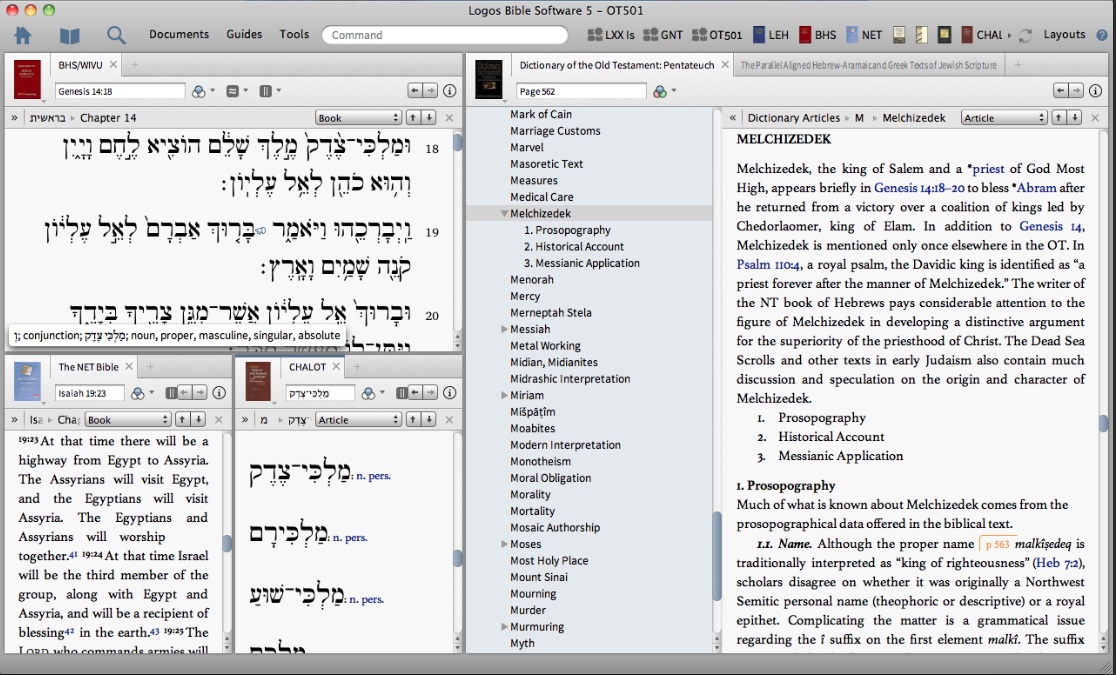
The dictionary is easy to lay out in Logos with other accompanying resources. Here I have it next to the Hebrew text with English translation and a Hebrew lexicon (click to enlarge):
As with all of Logos’s resources, you can hover over hyperlinked words (see “Heb 7:2” above) to see the Scripture without leaving that tab.
One solid feature so far (true of Logos resources in general): being able to use the shortcut command (Mac) or control (PC) + F to quickly find words in the entries.
One thing to critique so far: the items in the Table of Contents don’t expand to all the subpoints. In the shot above, for example, you can see that “1. Prosopography” under Melchizedek has “1.1. Name” in the entry, but not in the left sidebar Table of Contents. This makes navigating through multiple layers of detail a bit more cumbersome. (By contrast, the Accordance version of this module looks like it has the triangle that continues to expand, here.)
What about content of the dictionary itself? In this installment, I summarize and review three articles: “Sarah,” “Melchizedek,” and “Language of the Pentateuch.”
Sarah
R.G. Branch notes that Sarah and other “matriarchs of God’s people” are “equally significant” compared to the “widely recognized Israelite patriarchs” (733). Chief among these is Sarah. Even if there is not the amount of biblical material about Sarah that there is about Abraham, she remains a “pivotal character” in Genesis (733).
Branch divides the “Sarah” entry into two parts: “Sarah in the Ancestral Narratives” and “Sarah in the Later Tradition.”
In the first part Branch notes that Sarah, about 10 years younger than Abraham, is “the first matriarch of the biblical text” (733). Her childlessness in Genesis 11:30 is a key characteristic. Her first mention in that passage describes her barrenness, which “sets the tone for the stories about them that follow” (733). Sarai and Sarah (her name after God changed it in Genesis 17) both mean “princess” or “chieftainess.” Genesis records several threats to the possibility of Abraham and Sarah bearing offspring, not the least of which is two stories (in Genesis 12 and 20, which Branch understands as two separate incidents) of “marital deception,” where Abraham claims Sarah as his sister (734).
“In both cases,” Branch notes, “Abram feared for his life because of his wife’s great beauty” (734). It is this beauty that is the focus of the second part of the article, “Sarah in Later Tradition.” Branch cites various Jewish sources that extol Sarah for her immense beauty. She is also said to have been “surrounded” by miracles (735).
Branch gives a good, basic summary of biblical and Jewish rabbinic material about Sarah (as well as her importance for understanding Elizabeth in the New Testament), with citations that the reader can follow up for more.
Key statement from this article is: “Many of the issues in the stories about the couple can be understood as their struggle to come to terms with God’s promises of land, offspring, greatness and blessings” (734).
Melchizedek
Scripture contains very few references to the mysterious figure of Melchizedek. S.J. Andrews recounts Abram’s encounter with Melchizedek in Genesis 14:18-20, which Psalm 110 (noted as a “royal Psalm”) cites. Andrews also does well in noting the book of Hebrews’ understanding and interpretation of Melchizedek.
In “Prosopography” Andrews notes the complications that arise in trying to understand the name malkîṣedeq. Hebrews reads it as “king of righteousness,” but Andrews notes scholarly disagreement on “whether it was originally a Northwest Semitic personal name (theophoric or descriptive) or a royal epithet” (563). Therefore, “The name could mean either ‘(my) Malk/Melek is just’ or ‘Ṣedeq is my king’” (563). Either way, Genesis calls him “king of Salem,” which could be Jerusalem, or just mean, “king of peace,” as in Hebrews 7:2.
The “Historical Account” section of the article delves more into the story of Abram’s victory of kings and subsequent exchange with Melchizedek, where the latter gives the former bread and wine and a blessing, and the former appears to tithe to the latter.
In the final section, “Messianic Application,” Andrews explores various possibilities for the appearance of Melchizedek, what it meant, possible connection to a Messiah, and so on.
Andrews says, “The Qumran text 11QMelch portrays Melchizedek as an archangelic figure like Michael” (564), but he could have perhaps gone into more depth about the Qumran understanding of Melchizedek. However, his basic overview serves as a solid starting point for understanding the Melchizedek figure in biblical tradition.
Language of the Pentateuch
R.S. Hess’s “Language of the Pentateuch” article consist of three sections: “A discussion of the history of languages in and around Palestine during the third and second millennia b.c., a consideration of the grammar and style of the Pentateuch’s language in comparison with Classical Hebrew, and a study of those linguistic elements within the Pentateuch that might relate it to the period in which the narratives and events recorded in Genesis through Deuteronomy claim to have taken place” (491).
He offers a survey of Pentateuchal chronology, marking the date of the exodus as “sometime between the fifteenth century b.c and the end of the thirteenth century b.c.” (492), part of the Late Bronze Age. The Hebrew language is part of a family of West or Northwest Semitic dialects. There are not immense differences between the language of the Pentateuch and the language of (presumably) later Old Testament texts, but Hess does point out research around some “distinctive elements found in the Pentateuch that might set it apart from the grammar of the remainder of biblical Hebrew” (493), though these are few. Hess holds to an “early date” for at least the initial writing of the Pentateuch.
This particular article was a bit dry at times, but the level of detail is still to be appreciated.
So far my overall impression of the dictionary is positive. I will write more about it later. UPDATE: Part 2 is here.
The Dictionary is on Amazon here (in print) and at Logos here. My thanks to Logos for the review copy.
Here is the schedule and text for Monday through Friday, using again the text from R.R. Ottley’s Book of Isaiah According to the Septuagint. Ottley is also here in Logos (reviewed here) and here as a free, downloadable pdf in the public domain. The full reading plan for our group is here (pdf).
This week in Greek Isaiah in a Year covers Isaiah 20 and 21–two full chapters! And this time, I’m including an English translation–one that is in the public domain by R.R. Ottley.
Here is the schedule and text for Monday through Friday, using again the text from Ottley’s Book of Isaiah According to the Septuagint. Ottley is also here in Logos (reviewed here) and here as a free, downloadable pdf in the public domain. The full reading plan for our group is here (pdf).
20 1 In the year when Tartan came to Azotus, when he was sent by Sargon king of the Assyrians, and warred against Azotus and took it,
2 Then spake the Lord to Isaiah, saying, Go, and take off the sackcloth from thy loins, and loose thy shoes from thy feet, and so do, walking naked and barefoot.
3 And the Lord said, Like as my servant Isaiah hath walked naked and barefoot, three years there shall be signs and wonders to the Egyptians and Ethiopians.
4 For thus shall the king of the Assyrians lead away the captivity of Egypt and of the Ethiopians, young men and old men, naked and barefoot, uncovered, the shame of Egypt.
5 And the Egyptians shall be ashamed and discomfited concerning the Ethiopians, upon whom the Egyptians had trusted, for they were their glory.
6 And they that dwell in this isle shall say, Behold, we had trusted to flee unto them for help, who could not be saved from the king of the Assyrians; and how shall we be saved?
21 1 As a tempest passeth through the desert, coming from a desert, from the land. Fearful
2 is the vision, and hard, that was proclaimed to me. He that setteth at nought doth set at nought, and he that transgresseth doth transgress.
The Elamites are upon me, and the envoys of the Persians are coming against me. Now will I mourn, and will comfort myself.
3 Therefore are my loins filled with faintness, and pangs have taken hold of me, as her that travaileth; I did wrong, so as not to hear, I laboured earnestly so as not to see.
4 My heart wandereth, and my transgression overwhelmeth me; my soul turneth to fear.
5 Prepare the table, drink, eat; stand up, ye rulers, and prepare shields.
6 For thus saith the Lord to me, Go, set thee a watchman, and whatsoever thou seest, tell it.
7 And I saw two mounted horsemen, one mounted an an ass, and one mounted on a camel. Hear with diligent hearing,
8 And call Uriah to the watch tower of the Lord. And he said, I have stood continually by day, and over the camp I stood the whole night,
9 And behold, he himself cometh, mounted on a two-horse chariot. And he answered and said, Babylon is fallen: and all her mages and the works of her hands are crushed into the earth.
10 Hear, ye that are left, and are in anguish, hear what I have heard from the Lord of Hosts: the God of Israel hath proclaimed it to us.
The vision of Idumæa.
11 To me ye call from Seir, Watch ye (the) battlements.
12 I watch at morning, and through the night; if thou inquire, inquire, and dwell beside me.
13 In the forest shalt thou lie down at evening, in the way of Dedan.
14 Bring water to the thirsty to meet him, ye that dwell in the and of Teman; meet ye with loaves them that flee,
15 Because of the multitude of them that flee, and because of the multitude of them that wander, and because of the multitude of the sword, and because of the multitude of the bows that are bent, and because of the multitude of them that are fallen in the war.
16 For thus said the Lord to me, Yet a year, as the year of an hireling, the glory of the sons of Kedar shall fail,
17 And the remnant of the bows of the strong sons of Kedar shall be few; for the Lord, the God of Israel, hath spoken.
See here for more resources and links to texts for Greek Isaiah.
And here are the Week 16 readings above, but in pdf form.
Here is the schedule and text for Monday through Friday, using again the text from R.R. Ottley’s Book of Isaiah According to the Septuagint. Ottley is also here in Logos (reviewed here) and here as a free, downloadable pdf in the public domain. The full reading plan for our group is here (pdf).
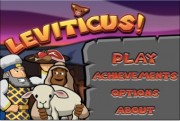
Sharpen your knife and your priestly reflexes: are you ready for the Ultimate Rule Book? Leviticus!
Play the role of a busy priest working to keep God happy by sacrificing choice offerings of sheep, goats, and bulls with frantic speed and slicing precision. Combo your actions and the rewards get BIBLICAL!
Three sacrificial services a day, seven days a week. Can YOU make it to Shabbat? Download Leviticus! and start swiping to find out!
That’s the real description of this real iPhone and iPad app: Leviticus! It sounds like Fruit Ninja meets the Hebrew Bible.
I don’t think Leviticus can be wholly reduced to a rule book (it is also all about covenant), and I don’t think sacrifices are best described as just an attempt to “keep God happy,” but there is a lot of detail in Leviticus that most of us struggle through when (if) we read it.
Here’s a screen shot. Not for the weak of stomach, though neither is Leviticus the book:
Titled Leviticus!, the game, as its title suggests, is both irreverent and deeply faithful to the source text—all that business about doves and cows and purity is right there in the book. But whereas Leviticus is too thick with rules to make for a very compelling read, it’s perfect when played.
As irreverent as this game first seemed to me, it may actually help one better understand the book. At least, that’s one of its purposes, according to the creator:
And education is at the heart of [Sarah] Lefton’s efforts. The game, she hopes, will do more than just amuse. “We brought something to very visual life that’s normally left on the page,” she said, “and that a lot of people just never study.” Believing that Jewish literacy and digital literacy make for excellent bedfellows—learning how to code and create applications that, in turn, are designed to enhance Jewish education and engagement—she now has future plans that involve not only the production of more games like Leviticus!, but also workshops teaching students and educators how to create their own Jewish-themed software.
The app is free, and found here. I don’t have an iPhone or iPad, so if anyone reading this downloads and tries it, I’d love to hear more about what you think. And it’s not April 1, so, as far as I know, the app is real.
Here is the schedule and text for Monday through Friday, using again the text from R.R. Ottley’s Book of Isaiah According to the Septuagint. Ottley is also here in Logos (reviewed here) and here as a free, downloadable pdf in the public domain. The full reading plan for our group is here (pdf).







 Words on the Word
