I8 months ago I learned about the T & T Clark Companion to the Septuagint. It has now been released as an ebook in pdf form, available here, with the hard copy to be published very soon. You can pre-order through Bloomsbury here or through Amazon here.
The Companion is unique in Septuagint studies in that it offers a “handy summary of features for each of the Septuagint books” of the Bible. Here’s part of the publisher’s description of the book:
This Companion provides a cutting-edge survey of scholarly opinion on the Septuagint text of each biblical book. It covers the characteristics of each Septuagint book, its translation features, origins, text-critical problems and history. As such it provides a comprehensive companion to the Septuagint, featuring contributions from experts in the field.
One thing that continually impresses me about Greek is its preponderance of multisyllabic words.
Much of this has to do with how its verbs are conjugated. The four-syllable verb μεγαλυνω, for example, when inflected in Psalm 19:8 (Psalm 20:7 in English Bibles), becomes a majestic seven-syllable ending to an already beautiful verse:
ουτοι εν αρμασιν και ουτοι εν ιπποις,
ημεις δε εν ονοματι κυριου θεου ημων μεγαλυνθησομεθα.
Here is an English translation:
These ones take pride in chariots, and these ones in horses,
But as for us, we will find glory in the name of the Lord!
Though I’m a week behind on the reading plan, little gems like this make reading the Greek Psalms in a Year well worth the effort.
One good monograph to read on the Septuagint is First Bible of the Church. And if you want to get in-depth with the critical edition of the LXX, I have offered reviews of the Göttingen Septuagint in Logos and Accordance softwares. And, perhaps as important, I suggest how one might actually make sense of that critical edition, noted here and here, with an ever-elusive third part of the primer still to come.
I have very recently reviewed the Genesis volume of the Göttingen Septuagint, found here.
Happy LXX Day!
(The above is a slightly modified re-post of my 2014 Happy LXX Day post.)
Greek Psalms in a Year is almost through its first month. Here are some verses that have really stuck with me, both in the Greek and with the NETS (New English Translation of the Septuagint) translation. All references below are according to the Septuagint versification:
Psalm 3:4
συ δε, κυριε, αντιλημπτωρ μου ει,
δοξα μου και υψων την κεφαλην μου.
But you, O Lord, you are my supporter,
my glory, and one who lifts up my head.
Psalm 9:10-12
και εγενετο κυριος καταφυγη τω πενητι,
βοηθος εν ευκαιριαις εν θλιψει·
και ελπισατωσαν επι σε οι γινωσκοντες το ονομα σου,
οτι ουκ εγκατελιπες τους εκζητουντας σε, κυριε.
ψαλατε τω κυριω τω κατοικουντι εν Σιων,
αναγγειλατε εν τοις εθνεσιν τα επιτηδευματα αυτου,
And the Lord became a refuge for the needy,
a helper at opportune times in affliction.
And let those who know your name hope in you,
because you did not forsake those who seek you, O Lord.
Make music to the Lord, who resides in Sion.
Declare his practices among the nations,
Psalm 9:19
οτι ουκ εις τελος επιλησθησεται ο πτωχος,
η υπομονη των πενητων ουκ απολειται εις τον αιωνα.
Because the poor shall not be completely forgotten,
the endurance of the needy shall not perish forever.
There are others, too, but Psalm 9 especially—with its focus on God’s compassion for the poor—struck me as important… and convicting.
Having recently re-watched the fourth season of the best television show in history, I need now to amend my assessment two years ago that the Göttingen Septuagint is the Cadillac of Septuagint editions. It’s the Lexus of the LXX.
The Göttingen Septuagint
Vandenhoeck & Ruprecht in Göttingen, Germany publishes the Göttingen Septuagint, more formally known as Septuaginta: Vetus Testamentum Graecum Auctoritate Academiae Scientiarum Gottingensis editum.
The series of critical texts with apparatus spans more than 20 volumes and covers some 40 biblical books (counting the minor prophets as 12), with more continuing to appear.
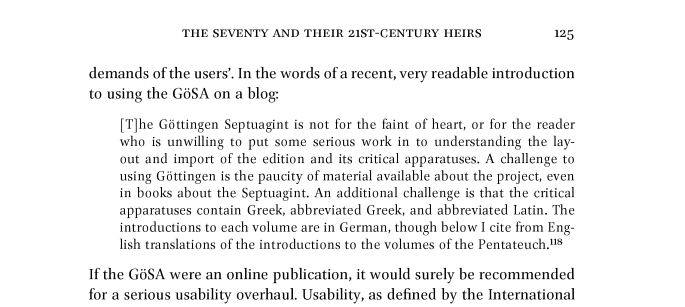
But, as I remarked two years ago when I confused Cadillacs and Lexuses, the Göttingen Septuagint is not for the faint of heart, or for the reader who is unwilling to put some serious work in to understanding the layout of the edition and its critical apparatuses.
The Contributions of John William Wevers
Enter John William Wevers. If Göttingen is the Lexus of LXX editions, Wevers is its chief mechanic. His Notes on the Greek texts of the Pentateuch–though provisional in nature, Wevers intimated–remain some of the best resources for carefully studying the Septuagint. And his Text Histories on those same books (now free online, thanks to the Göttingen Septuaginta-Unternehmen) guide the reader through the transmission of the Greek text in its various manuscripts.
Better yet, before his passing Wevers translated much of his own Göttingen-Pentateuch introductions from German into English. That enduring gift can be found here.
Göttingen-Genesis
Published in 1974, Wevers’s Genesis includes a 70+-page introduction, Wevers’s reconstructed Greek text of Genesis, and two critical apparatuses at the bottom of each page that highlight readings from various manuscripts.
The introduction includes these sections:
The Textual Witnesses (Greek and other versions)
The Text History (“Here only information necessary for the use of this edition is given”)
Re: This Edition
Signs and Abbreviations
A challenge to using the Genesis volume is the scarcity of material available about the Göttingen project in general. Further, the introduction is in German and the critical apparatuses contain Greek, abbreviated Greek, and abbreviated Latin. A few things come in handy:
As for deciphering the apparatus and abbreviations, Wevers offers such a key in the introduction, and the print edition comes with a handy insert (in German and Latin, but not unusable to those without command of those languages)
Miles Van Pelt has made available his own two-page summary of sigla and abbreviations (here as PDF).
Seeing the need, I wrote a two-part primer (here and here, two of my most-visited posts on this blog) to reading and understanding the Göttingen Septuagint–the focus was largely on Genesis, and I draw on those posts for what follows
So equipped, the reader (whether she or he knows German or not) is ready to work through the Greek text itself.
Tour of a Page
Instead of using a text based on an actual manuscript (as BHS, based on the Leningrad Codex, does), the Göttingen Septuagint utilizes a reconstructed text based on a thorough examination of evidence from manuscripts and translations.
Because it is an editio maior and not an editio minor like Rahlfs, any page can have just a few lines of actual biblical text, with the rest being taken up by the apparatuses. Here’s a sample page from Genesis 1 (image used by permission).
Note the #s 1-4 that I’ve added to highlight the different parts of a page.
Page reproduction by permission of publisher (annotations are mine)
1. The reconstructed Greek critical text (“Der kritische Text”)
With verse references in both the margin and in the body of the text, the top portion of each page of the Göttingen Septuagint is the editorially reconstructed text of each biblical book. In the page from Genesis 1 above, you’ll notice that the text includes punctuation, accents, and breathing marks.
Regarding the critical text itself, Wevers writes in the Genesis introduction:
Since it must be presupposed that this text will be standard for a long time, the stance taken by the editor over against the critical text was intentionally conservative. In general conjectures were avoided, even though it might be expected that future recognition would possibly confirm such conjectures.
2. The Source List (“Kopfleiste”)
The Kopfleiste comes just below the text and above the apparatuses in Genesis. Wevers notes it as a list of all manuscripts and versions used, listed in the order that they appear in the apparatus on that page. A fragmentary textual witness is enclosed in parenthesis.
3. and 4. Critical Apparatuses (“Apparat I” and “Apparat II”)
The critical apparatuses are where the user of Göttingen can see other readings as they compare with the critically reconstructed text. Because the Göttingen editions are critical/eclectic texts, no single manuscript will match the text of the Göttingen Septuagint.
The first critical apparatus will be familiar in its aims to readers of BHS. Regarding the second apparatus, Wevers writes:
In view of the fact that the materials presented in the second apparatus [are] not at least in theory a collection of variants within the LXX tradition, but rather one such of readings from other traditions, especially from the “three”, which have influenced the LXX tradition, these readings are given in full.
“The three,” sometimes referred to in Greek as οι γ’, are the texts of Aquila, Symmachus and Theodotion.
In other words–there is virtually no stone unturned here in the quest to reconstruct a Greek text of Genesis.
Concluding Evaluation
Serious work in Septuagint studies uses the Göttingen text, where available, as a base. Wevers’s scholarship and care for the text is clear as one makes her or his way through the Genesis volume. It’s the starting place for studying the Greek text of Genesis.
Vandenhoeck & Ruprecht’s production of the book is stellar, too. It’s got a sewn binding and is beautifully constructed–built to last and look good on the shelf, or in your hands:
You can find the volume here at V & R’s site, and here at Amazon. ISD distributes the book, as well, and carries it here.
Many thanks to V & R for the review copy of this fine work, given to me with no expectation as to the content of my review. Find more V & R blog posts here.
Want to read the Old Testament in Greek on all your devices? This is the cheapest way I’ve seen to get started: until midnight PST tomorrow (1/6/15) night, you can get this Septuagint bundle for less than $50. It includes
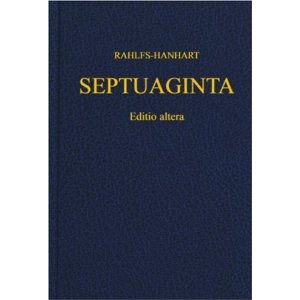
The Rahlfs-Hanhart Septuagint text
Its critical apparatus
The Kraft-Wheeler-Taylor parsings of each word in the text
The LEH Greek-English Lexicon of the Septuagint (Lust, Eynikel, and Hauspie)
This is really an incredible deal, given that the Rahlfs-Hanhart text in print is about $50 (and doesn’t include running parsings). The LEH Lexicon in print runs anywhere from $40 to $80.
What can Olive Tree do, you ask? See my gathered posts here, including my recent review of a five-volume dictionary set that is still on sale.
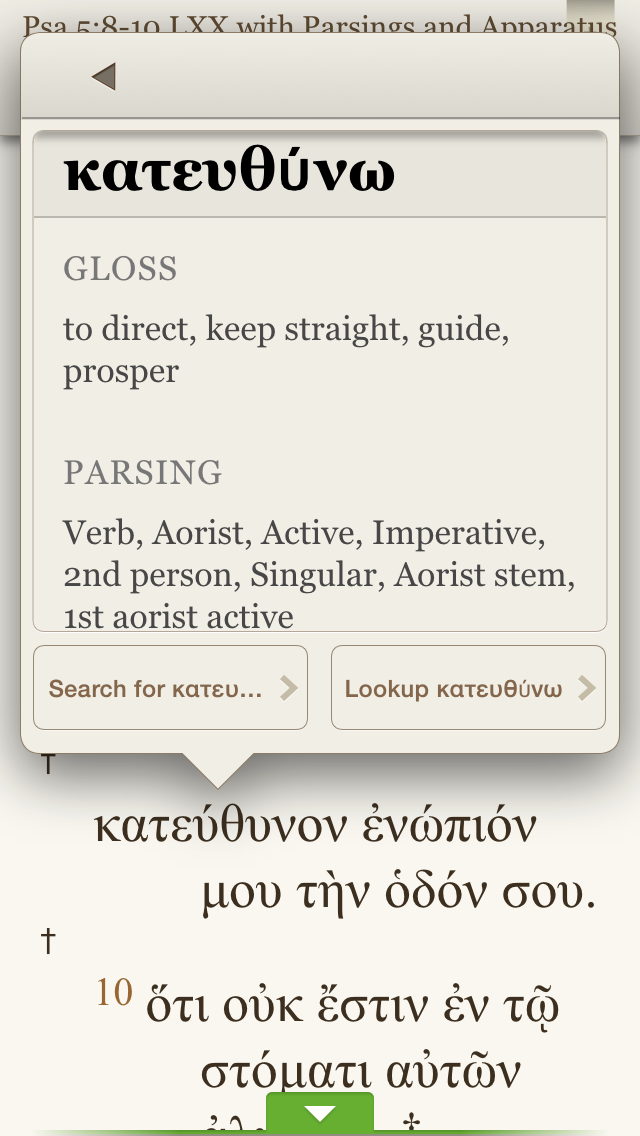
The advantage to having the above combo in Olive Tree is that you can tap any word in the Rahlfs-Hanhart Greek text and get instant parsing information.
You can instantly access that word’s lexical entry in the LEH lexicon. I especially appreciate LEH’s inclusion of word frequency counts, according to sections of the LXX:
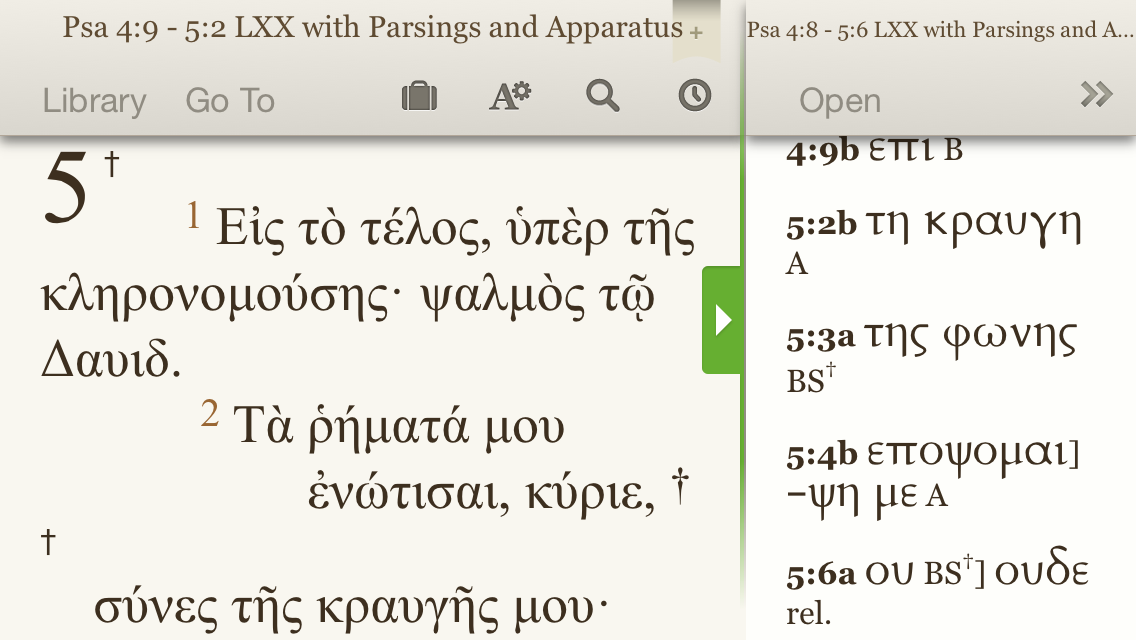
Using the split window setup, here’s what the Rahlfs text with apparatus looks like:
Though Rahlfs never intended his apparatus in this volume to be fully critical, it does help you at least compare LXX readings as found in Vaticanus (B), Alexandrinus (A), and Sinaiticus (S).
And because Olive Tree is fully cross-platform, you can sync any notes you take or highlights you make and they appear on any device on which you have Olive Tree.
Find the whole bundle here, on sale for just a little while longer.
In this post, I offer a sampling of resources–electronic and in print–that could be of help in reading through the Psalms in Greek. Do you know of anything not mentioned here? Please add it in the comments. You can also contact me with any questions or comments about the endeavor.
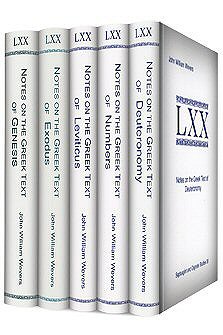
The best (only?) complete set of books on the Greek Pentateuch is now up on Pre-Pub through Logos Bible Software: John William Wevers’s Notes on the Greek Text.
The Society of Biblical Literature’s book page has a helpful write-up of the Deuteronomy volume, which gives a sense of what this series is about:
Wevers [spent] most of his adult life studying the Septuagint, the last thirty years being devoted to the Pentateuch. The author considers the Greek text to be the first commentary on the Pentateuch ever written (in the third century B.C.E.) and not merely a collection for emendations of the Hebrew text. The work focuses on how the translator accomplished his task and on the vocabulary and syntax of the resulting text, rather than on either scholarly opinions on the text or how interpreters subsequently used the text. The Notes are intended for students who would like to use the Greek intelligently but are not specialists in Hellenistic Greek or LXX studies.
You can find the 5-volume set on pre-pub at Logos here. Wevers also wrote valuable LXX-Pentateuch text histories, which are available free online in .pdf form, detailed here.
It’s funny–I was just thinking the other day about how much I missed Greek Isaiah in a Year. More than 200 of us read through the Septuagint text of Isaiah in a year, roughly five verses a day. Both the readings and the discussion were rich.
I didn’t do anything like that this past year, though the Greek Isaiah in a Year Facebook group I’d created stayed active, as folks went after it a second time.
Just this afternoon I learned that Russell Beatty, a member of the Greek Isaiah group, has started a Greek Psalms in a Year group, to launch January 1, 2015.
That group is on Facebook, and you can see the well laid out reading plan here.
You Google yourself about every three months, too, right?
To my surprise, a few months ago I found that Words on the Word had been quoted in a Brill book about digital humanities in biblical studies. (Apparently “digital humanities” is an academic field in which this blog participates.)
Ancient texts, once written by hand on parchment and papyrus, are now increasingly discoverable online in newly digitized editions, and their readers now work online as well as in traditional libraries. So what does this mean for how scholars may now engage with these texts, and for how the disciplines of biblical, Jewish and Christian studies might develop? These are the questions that contributors to this volume address. Subjects discussed include textual criticism, palaeography, philology, the nature of ancient monotheism, and how new tools and resources such as blogs, wikis, databases and digital publications may transform the ways in which contemporary scholars engage with historical sources. Contributors attest to the emergence of a conscious recognition of something new in the way that we may now study ancient writings, and the possibilities that this new awareness raises.
You can find the book at Brill here and here at Amazon. Looks fun! But, of course, now I’m biased.












 Words on the Word
