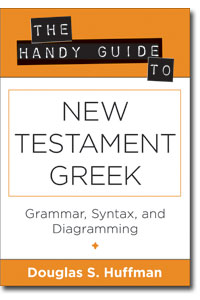
Recently my Greek reading has improved due to spending regular time refreshing my memory on verb paradigms, rules of syntax, and so on. The tool I’ve been using is Douglas S. Huffman’s Handy Guide to New Testament Greek (Kregel, 2012). Huffman’s Handy Guide consists of three parts:
Grammar (“Greek Grammar Reminder: With Enough English to Be Manageable”)
Syntax (“Greek Syntax Summaries: With a Few Helps to Be Memorable”)
Diagramming (“Phrase Diagramming: With Enough Results to Be Motivating”)
“A Select Bibliography” concludes the guide and points beginning, intermediate, and advanced Greek readers to grammar texts, reading resources, diagramming helps, and more.
How does Huffman’s offering differ? Unlike Paradigms and Principal Parts or Greek at a Glance, the Handy Guide consists of more than simply verb paradigms or noun declension charts. It includes those, but with accompanying explanation along the way. In this regard it is similar to Mounce’s Compact Guide.
Different from Mounce, however, is the lack of any vocabulary-related helps in Huffman. It’s hard to imagine someone wanting a “handy guide” to “New Testament Greek” who doesn’t also want some treatment of vocabulary, which Mounce’s guide accomplishes nicely with its included brief lexicon. Huffman does include information about how words are formed, in his chart on comparative and superlative adjectives, for example:
But vocabulary is otherwise absent from the guide.
Part 1, “Greek Grammar Reminder,” covers everything from accents and breathing marks to nouns, adjectives, adverbs, and verb declensions. (Verb paradigm charts take up the majority of part 1.)
Huffman’s “Verb Usage Guide” (from part 2) contains a refreshing amount of detail on Greek verbs for such a short guide. For example, he lists 20 categories of participles followed by a “Participle Usage Identification Guide” to help readers of Greek texts determine what kind of participle is at hand. Part 2 also explains noun case usage. His explanations of nominative, genitive, dative, accusative, and vocative cases are short, clear, and include plenty of examples with Scripture references.
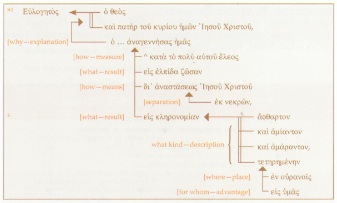
Where Huffman is really unique (and what makes this guide desirable especially for a second-year Greek student or pastor) is in his part 3 on diagramming. He briefly treats “technical diagramming” (the kind some of us had to do for English in 5th grade–showing syntactical relationships at the word level) and arcing, then moves into a rich, 22-page description of “phrase diagramming,” which looks like this:
Huffman, p. 103 (1 Peter 1:3-4)
The goal of this kind of diagramming is “to grasp the writer’s general flow of thought and argument, which he has expressed in particular words and sentences” (85). Huffman’s eight steps to phrase diagramming explain the process so that even a beginner can understand it well. His “Special & Problem Issues” section is the icing on the cake of part 3.
The guide is truly “handy”; it fits nicely together with a Greek New Testament, so one can keep it close at hand. The color-coding in the paradigms is done well, so that verb endings stand out for an easy refresher course.
An unfortunate and fairly noticeable drawback to this guide, in my view, is in the layout and color scheme. The orange theme, as attractive as it looks on the cover (pictured above), gets to be an eyesore after looking at more than a page or two. It’s too bright to read comfortably, and there are charts with at least four different shades of orange.
When there is Greek in black font (in grammatical category explanations), it looks great. But the Greek in the charts in orange has a fuzzy or slightly blurry, pixelated appearance. There are also quite a few charts that are in landscape orientation (rather than the default portrait orientation), so that the reader has to flip the book sideways. That alone would not be a huge deal, but the orange was distracting to me.
Hopefully there will be demand for future printings, and hopefully future printings will make the layout and fonts more useable. And despite the omission of vocabulary, this guide has great content. Resources on sentence and phrase diagramming for Greek are few and far between, but Huffman’s guide covers that territory well, and having that coupled with quick-reference charts will help just about anyone seeking to retain and improve their biblical Greek.
Kregel sent me a copy of the book for review. Its product page is here, and it’s on Amazon here. The Table of Contents are here (pdf); read an excerpt here (pdf).
Here is the schedule and text for Monday through Friday, using again the text from R.R. Ottley’s Book of Isaiah According to the Septuagint. Ottley is also here in Logos (reviewed here) and here as a free, downloadable pdf in the public domain. The full reading plan for our group is here (pdf).
Here is the schedule and text for Monday through Friday, using again the text from R.R. Ottley’s Book of Isaiah According to the Septuagint. Ottley is also here in Logos (reviewed here) and here as a free, downloadable pdf in the public domain. The full reading plan for our group is here (pdf).
This week in Greek Isaiah in a Year covers Isaiah 20 and 21–two full chapters! And this time, I’m including an English translation–one that is in the public domain by R.R. Ottley.
Here is the schedule and text for Monday through Friday, using again the text from Ottley’s Book of Isaiah According to the Septuagint. Ottley is also here in Logos (reviewed here) and here as a free, downloadable pdf in the public domain. The full reading plan for our group is here (pdf).
20 1 In the year when Tartan came to Azotus, when he was sent by Sargon king of the Assyrians, and warred against Azotus and took it,
2 Then spake the Lord to Isaiah, saying, Go, and take off the sackcloth from thy loins, and loose thy shoes from thy feet, and so do, walking naked and barefoot.
3 And the Lord said, Like as my servant Isaiah hath walked naked and barefoot, three years there shall be signs and wonders to the Egyptians and Ethiopians.
4 For thus shall the king of the Assyrians lead away the captivity of Egypt and of the Ethiopians, young men and old men, naked and barefoot, uncovered, the shame of Egypt.
5 And the Egyptians shall be ashamed and discomfited concerning the Ethiopians, upon whom the Egyptians had trusted, for they were their glory.
6 And they that dwell in this isle shall say, Behold, we had trusted to flee unto them for help, who could not be saved from the king of the Assyrians; and how shall we be saved?
21 1 As a tempest passeth through the desert, coming from a desert, from the land. Fearful
2 is the vision, and hard, that was proclaimed to me. He that setteth at nought doth set at nought, and he that transgresseth doth transgress.
The Elamites are upon me, and the envoys of the Persians are coming against me. Now will I mourn, and will comfort myself.
3 Therefore are my loins filled with faintness, and pangs have taken hold of me, as her that travaileth; I did wrong, so as not to hear, I laboured earnestly so as not to see.
4 My heart wandereth, and my transgression overwhelmeth me; my soul turneth to fear.
5 Prepare the table, drink, eat; stand up, ye rulers, and prepare shields.
6 For thus saith the Lord to me, Go, set thee a watchman, and whatsoever thou seest, tell it.
7 And I saw two mounted horsemen, one mounted an an ass, and one mounted on a camel. Hear with diligent hearing,
8 And call Uriah to the watch tower of the Lord. And he said, I have stood continually by day, and over the camp I stood the whole night,
9 And behold, he himself cometh, mounted on a two-horse chariot. And he answered and said, Babylon is fallen: and all her mages and the works of her hands are crushed into the earth.
10 Hear, ye that are left, and are in anguish, hear what I have heard from the Lord of Hosts: the God of Israel hath proclaimed it to us.
The vision of Idumæa.
11 To me ye call from Seir, Watch ye (the) battlements.
12 I watch at morning, and through the night; if thou inquire, inquire, and dwell beside me.
13 In the forest shalt thou lie down at evening, in the way of Dedan.
14 Bring water to the thirsty to meet him, ye that dwell in the and of Teman; meet ye with loaves them that flee,
15 Because of the multitude of them that flee, and because of the multitude of them that wander, and because of the multitude of the sword, and because of the multitude of the bows that are bent, and because of the multitude of them that are fallen in the war.
16 For thus said the Lord to me, Yet a year, as the year of an hireling, the glory of the sons of Kedar shall fail,
17 And the remnant of the bows of the strong sons of Kedar shall be few; for the Lord, the God of Israel, hath spoken.
See here for more resources and links to texts for Greek Isaiah.
And here are the Week 16 readings above, but in pdf form.
Here is the schedule and text for Monday through Friday, using again the text from R.R. Ottley’s Book of Isaiah According to the Septuagint. Ottley is also here in Logos (reviewed here) and here as a free, downloadable pdf in the public domain. The full reading plan for our group is here (pdf).
Bible translators stand at the intersection of the biblical world and their own, with the task of communicating an ancient text in a contemporary language. The Greek translator of Isaiah provides interesting examples of the issues and problems this task presents. For instance, he sometimes substituted the more familiar names of local Greek deities in place of the long-forgotten names of pagan Semitic deities being denounced. Is it “right” to substitute contemporary terms that would clearly communicate the message to the readers in place of ancient terms and idioms that would be accurate but meaningless? Where do accuracy and clarity meet in “getting it right”?
Here is the schedule and text for Monday through Friday, using again the text from R.R. Ottley’s Book of Isaiah According to the Septuagint. Ottley is also here in Logos (reviewed here) and here as a free, downloadable pdf in the public domain. The full reading plan for our group is here (pdf).
This week in Greek Isaiah in a Year covers Isaiah 14:28-16:10. I’ve been behind off and on the last few weeks, but am caught up now. It’s amazing how even five verses a day can be a challenge to keep up with.
Here is the schedule and text for Monday through Friday, using again the text from R.R. Ottley’s Book of Isaiah According to the Septuagint (pictured at left; click on image to go to Amazon product page). Ottley is also here in Logos (I reviewed that edition here) and here as a free, downloadable pdf in the public domain. The full reading plan for our group is here (pdf).
Rod Decker of NT Resources has a very helpful bibliography page of recommended resources for Greek students, broken down by 1st year, 2nd year, and 3rd year. Check it out here.
Here is the schedule and text for Monday through Friday, using again the text from R.R. Ottley’s Book of Isaiah According to the Septuagint. (As always, Ottley is here on Amazon, here in Logos, and here as a free, downloadable pdf in the public domain.) The full reading plan for our group is here (pdf).










 Words on the Word